Last month Bhopal gas victims marched from Bhopal to Delhi on foot.They reached New Delhi by the end of the March and started indefinite hunger strike till their demands are being met.
Victims of the disaster filed suit against Union Carbide and its former CEO, Warren Anderson, in federal court in New York. The leak has killed over 5,000 people immediately, and death toll rose to around 20000 due to various related illness.
After a long legal battle the court has ordered for a compensation of Rs.1500 crores.This is a measly small compensation for an accident in which 5,73,816 people were affected.Many lost their entire livelihood and homes due to ill health.Money from the compensation would be the only source to support these families. bhopal.net reckons this amount will get just Rs.3.40 for a person/day, which will not even be sufficient for a meal.
The site around the former Union Carbide factory in Bhopal remains severely contaminated, even after two decades.More than 20,000 people are being forced to drink water contaminated by chemicals leaking from the abandoned Union Carbide factory. The levels of mercury found in a sample taken inside the factory were between 20,000 and six million times higher than the background levels to be expected in uncontaminated soils according to Greenpeace.It also reports the presence of organochlorines, a class of chemicals which includes DDT(which travels up the food chain causing genetic damage in some organisms) and PCBs (polychlorinated biphenyls).The ground water of the contaminated site also contains trichlorobenzene, chloroform and carbon tetrachloride, a carcinogen.
According to law, polluter must clean-up the contaminated site, but the Dow Chemicals fails to adhere to this.What is shameful is that, Indian government instead of holding Dow Chemicals accountable and pressurizing the company to clean the contaminated site, its is facilitating the Dow Chemicals to invest more in India. Prime Minister, who had no time to meet padayatris who came all the way from Bhopal on foot, had time to meet Andrew N Liveris the present CEO of Dow Chemicals twice earlier.
After lots of protest, and days and days of hunger strike, PM finally agreed to meet the representatives of the victims.Out of six demands four were met.
Among the demands agreed are
*a time-bound plan for the delivery of safe drinking water to communities affected by contamination of water,
*scientific assessment of the depth and spread of toxic contamination in and around the Union Carbide factory in Bhopal, and
*funds to address all health issues related to contamination.
Visit http://bhopal.net/march which has well documented the entire course of events.The page also has truck loads of photographs.
Saturday, April 22, 2006


Friday, April 21, 2006
The power of the blogger
Bloggers and Internet pundits are exerting a "disproportionately large influence" on society, according to a report by a technology research company. Its study suggests that although "active" web users make up only a small proportion of Europe's online population, they are increasingly dominating public conversations and creating business trends.
More than half of the Internet users on the continent are passive and do not contribute to the web at all, while a further 23 per cent only respond when prompted. But the remainder who do engage with the net — through messageboards, websites and blogs — are helping change national conversations.
"We're seeing this growing," said Julian Smith, an online advertising analyst with Jupiter Research and author of the report. "The strongest part of their influence is on the media: if something online suddenly becomes a story in the local press, then it matters."
Although unprompted contributors are generally younger and more vocal than the wider online population, they are increasingly important as opinion formers and trend-setters. Mr. Smith says businesses, media organisations and advertisers reading blogs should be wary of making assumptions about their wider significance, but that their muscle cannot be ignored.
"They're not representative of the larger audience, but what they're saying does matter," he said. "It's a good straw poll — a snapshot of the verbal conversations going on that we can't measure."
"That's exactly right," said Glenn Reynolds, author of An Army of Davids, which explores the explosion in web punditry. "Bloggers and blog-readers are `influentials' — the minority that pays attention to events outside of political and news cycles. They also tend on average to be better off, better educated and, more importantly, employed."
There are now more than 35 million blogs around the world full story>>
More than half of the Internet users on the continent are passive and do not contribute to the web at all, while a further 23 per cent only respond when prompted. But the remainder who do engage with the net — through messageboards, websites and blogs — are helping change national conversations.
"We're seeing this growing," said Julian Smith, an online advertising analyst with Jupiter Research and author of the report. "The strongest part of their influence is on the media: if something online suddenly becomes a story in the local press, then it matters."
Although unprompted contributors are generally younger and more vocal than the wider online population, they are increasingly important as opinion formers and trend-setters. Mr. Smith says businesses, media organisations and advertisers reading blogs should be wary of making assumptions about their wider significance, but that their muscle cannot be ignored.
"They're not representative of the larger audience, but what they're saying does matter," he said. "It's a good straw poll — a snapshot of the verbal conversations going on that we can't measure."
"That's exactly right," said Glenn Reynolds, author of An Army of Davids, which explores the explosion in web punditry. "Bloggers and blog-readers are `influentials' — the minority that pays attention to events outside of political and news cycles. They also tend on average to be better off, better educated and, more importantly, employed."
There are now more than 35 million blogs around the world full story>>
Saturday, April 15, 2006
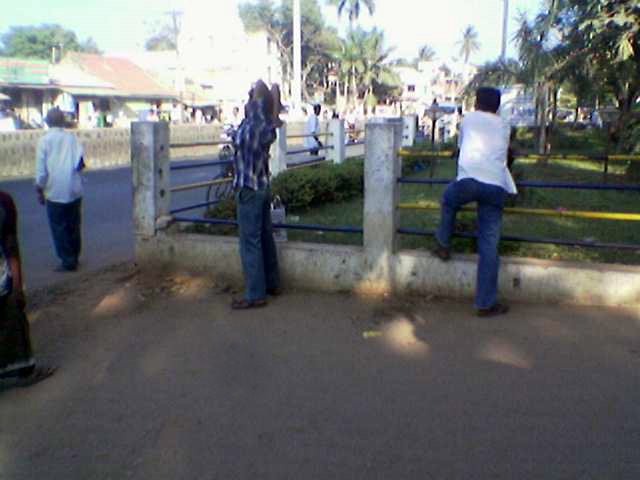
A large number of people from all around the district come to General Hospital, Cuddalore for treatment. Many of these people rely on public transport system to reach and leave from here. But the bus stop near the hospital is too small to accommodate the number of people the hospital handles.Many of those waiting for a bus have stand in hot sun.This makes the people to find an alternate location by themself.
Many have choosen to wait in front of the Gate 2 of the hospital instead of making their way to the bus stop.They use parapet of the nearby roadside park to seat themselves.Result, they break the parapet so often.I have written Park outside Cuddalore General Hospital earlier.After a few days the parapet was repaired and reconstructed (probably by municipality),but now again the wall is broken.
Recently when CM arrived Cuddalore as a part of election campaign municipality was proud to display boards written 'Cuddalore Municipality' on the road side parks.Even the parapet of this park was repainted without rebuilding the broken parts of the wall.The municipality wanted to send a signal to the visitor as if they are being maintained properly.But the truth is that the plants here were not watered for atleast past one year.
Thursday, April 13, 2006
After the tsunami - reconstruction work completed in Pudhupettai
Fifteen months after the tsunami, reconstruction of the South Indian village of Pudhupettai in the district of Cuddalore has been completed. At a festive ceremony, Deutsche Welthungerhilfe (German Agro Action) and its Indian partner organisation Life Help Centre (LHC) officially handed over the village to its inhabitants on 17th March. 45 new houses, a school and a community building have been erected.
A net-mending hall and a fish-drying facility have also been created. 58 fishing families were provided with new or repaired boats and appropriate equipment. After the terrible events of the flood disaster, a degree of normality has been restored to the lives of local inhabitants.
Today, there is little evidence of the extent of devastation caused by the flood in December 2004. Fishermen resumed their work several months ago and are now able to support themselves and their families again. From 17 neighbouring villages, children meet for lessons in the newly erected school. Actively involved in the reconstruction work were the city of Bonn and the daily newspaper Bonner General-Anzeiger, which entered into a partnership with Deutsche Welthungerhilfe under the motto "Bonn helps Cuddalore".
Over 500,000 euro were raised for flood victims in numerous campaigns organised by local citizens and companies "'Bonn helps Cuddalore'" is not just a slogan that appears on banners. It is a genuine declaration of solidarity which has found its way into the hearts of the people here in Pudhupettai," claims Axel Weiser, who supervised the reconstruction project for Welthungerhilfe in Cuddalore.
At the handing-over ceremony, the inhabitants of Pudhupettai celebrated with music and a firework display. Hundreds of people came to express their joy. "It is a miracle that so much has been reconstructed in such a short time," said Gagandeep Singh Bedi, senior government official in the district of Cuddalore.
A net-mending hall and a fish-drying facility have also been created. 58 fishing families were provided with new or repaired boats and appropriate equipment. After the terrible events of the flood disaster, a degree of normality has been restored to the lives of local inhabitants.
Today, there is little evidence of the extent of devastation caused by the flood in December 2004. Fishermen resumed their work several months ago and are now able to support themselves and their families again. From 17 neighbouring villages, children meet for lessons in the newly erected school. Actively involved in the reconstruction work were the city of Bonn and the daily newspaper Bonner General-Anzeiger, which entered into a partnership with Deutsche Welthungerhilfe under the motto "Bonn helps Cuddalore".
Over 500,000 euro were raised for flood victims in numerous campaigns organised by local citizens and companies "'Bonn helps Cuddalore'" is not just a slogan that appears on banners. It is a genuine declaration of solidarity which has found its way into the hearts of the people here in Pudhupettai," claims Axel Weiser, who supervised the reconstruction project for Welthungerhilfe in Cuddalore.
At the handing-over ceremony, the inhabitants of Pudhupettai celebrated with music and a firework display. Hundreds of people came to express their joy. "It is a miracle that so much has been reconstructed in such a short time," said Gagandeep Singh Bedi, senior government official in the district of Cuddalore.
Friday, April 07, 2006
Yet another post on Cuddalore
Recently I have come across this post about Cuddalore and I like to share it with you Cuddalore Periya Kuppam
Is SIPCOT Safe?
Here is an excerpt from NEWS TODAY'S news item 'Report paints a a gloomy picture'.
A report titled 'Is SIPCOT Safe?', a scorecard on the environment that documents at least 45 incidents of environmental pollution and/or workplace incidents involving environmental damage, and/or injury or death of workers and residents in the last 17 months, from October 2004 to February 2006 was released in Cuddalore yesterday.
A report titled 'Is SIPCOT Safe?', a scorecard on the environment that documents at least 45 incidents of environmental pollution and/or workplace incidents involving environmental damage, and/or injury or death of workers and residents in the last 17 months, from October 2004 to February 2006 was released in Cuddalore yesterday.
And the report debunks the government's claim that conditions in SIPCOT Cuddalore have improved. The report has been compiled by SIPCOT Area Community Environmental Monitors (SACEM).
Shweta Narayan of SACEM said there were at least 17 incidents of illegal effluent discharge, eight instances of gas leaks, 10 instances of industrial accidents that killed two and injured nine, and seven instances of illegal dumping of hazardous waste in the area full story>>
Wednesday, April 05, 2006
Coca Cola and groundwater
Water Wars and Bottle Battles
By Nityanand Jayaraman
Recently in the news
Science Forum protest against Coca Cola
By Nityanand Jayaraman
Recently in the news
Science Forum protest against Coca Cola
Saturday, April 01, 2006
CuddaloreOnline-The discussion group
Dear Viewers, I have started a Yahoo group by name CuddaloreOnline (http://groups.yahoo.com/group/cuddaloreonline)
The paramount purpose of this group is to encourage open discussion on topics posted in CuddaloreOnline blog. Though blogspot itself has provision for viewer comments and there by providing chances for an open debate, the problem of tracking back is acute. This group is a supplement but not substitute for blogspot's commenting system.
The activities of the group include / intended for,
*commenting about the articles posted in the CuddaloreOnline blog and expressing alternate views and ideas in the context of the article,
*pointing out misinformation (if any) in the article posted (though utmost care is taken to avoid mistakes, there are huge chances of mistakes in 'Citizen Journalism'. So pointing out mistakes out will greatly help to provide more accurate information),
*suggesting to post article on some specific topic,
*suggesting new weblinks to the blog,
*reporting the negligence of civic authorities (especially municipal authorities), negligence of various departments(especially Revenue Dept. and PWD),PCB and that of policy makers,
*bringing into light of problems faced by people in your immediate surrounding (as you have seen articles posted earlier were repeatedly focused on few important areas in Cuddalore, altogether neglecting the interior parts of Cuddalore. Your effort to report the problem faced by people of your immediate surrounding will help me to bring up articles on a variety of issues covering different parts of Cuddalore),
*contributing your idea to bring up a project that would lead to development and continuous betterment of Cuddalore region,
*sharing the news items you have read about Cuddalore,
*sharing information about important public events/engagement in Cuddalore (you can also share some important events like exhibitions, book fairs,seminars,workshops in Pondicherry region too), and
*sharing photographs (of Cuddalore) with other members of the group.
Group members can also make their contributions to the blog (contribution can be anything like article, photographs, etc., )
This group will also serve as a good source of information for the journalists.
Regards,
Jean Claude Brisseau.
The paramount purpose of this group is to encourage open discussion on topics posted in CuddaloreOnline blog. Though blogspot itself has provision for viewer comments and there by providing chances for an open debate, the problem of tracking back is acute. This group is a supplement but not substitute for blogspot's commenting system.
The activities of the group include / intended for,
*commenting about the articles posted in the CuddaloreOnline blog and expressing alternate views and ideas in the context of the article,
*pointing out misinformation (if any) in the article posted (though utmost care is taken to avoid mistakes, there are huge chances of mistakes in 'Citizen Journalism'. So pointing out mistakes out will greatly help to provide more accurate information),
*suggesting to post article on some specific topic,
*suggesting new weblinks to the blog,
*reporting the negligence of civic authorities (especially municipal authorities), negligence of various departments(especially Revenue Dept. and PWD),PCB and that of policy makers,
*bringing into light of problems faced by people in your immediate surrounding (as you have seen articles posted earlier were repeatedly focused on few important areas in Cuddalore, altogether neglecting the interior parts of Cuddalore. Your effort to report the problem faced by people of your immediate surrounding will help me to bring up articles on a variety of issues covering different parts of Cuddalore),
*contributing your idea to bring up a project that would lead to development and continuous betterment of Cuddalore region,
*sharing the news items you have read about Cuddalore,
*sharing information about important public events/engagement in Cuddalore (you can also share some important events like exhibitions, book fairs,seminars,workshops in Pondicherry region too), and
*sharing photographs (of Cuddalore) with other members of the group.
Group members can also make their contributions to the blog (contribution can be anything like article, photographs, etc., )
This group will also serve as a good source of information for the journalists.
Regards,
Jean Claude Brisseau.
Sunday, March 26, 2006
New bridge to connect Devanampattinam
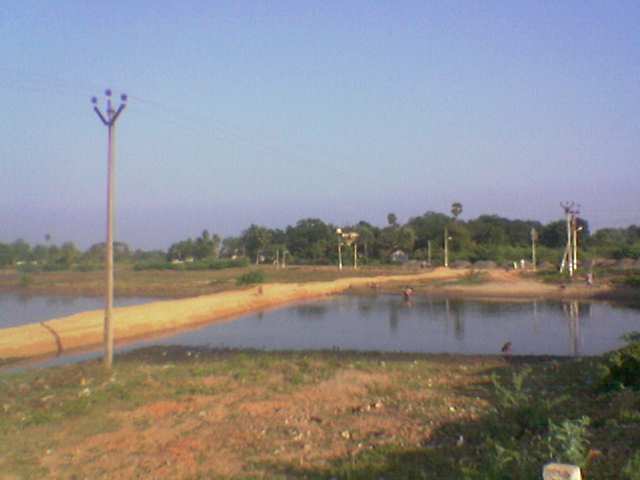 Two bridges over Uppanar connecting Devanam- pattinam with Cuddalore main land are in dilapidated state for decades. Presumably, these bridges were been built during the British rule in India.They are too narrow to cope with present needs. Things remained unchanged for more than half a century.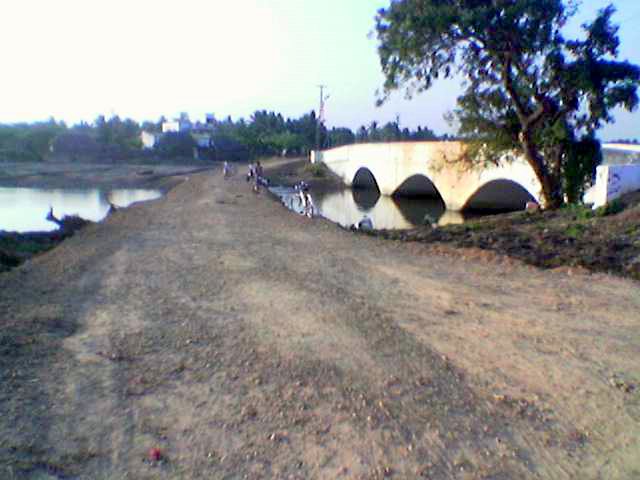
Among the two bridges the one on the north was badly damaged and so people did not use it for more than five years.
The bridge on the south which is en route to Silver Beach, Periyar College of Arts and Science (and other historical monuments like Fort St.David, White House, Marine House,Parry House, Director's Bungalow, New Life Centre) is also ageing week.But the government was unwilling to spend it.
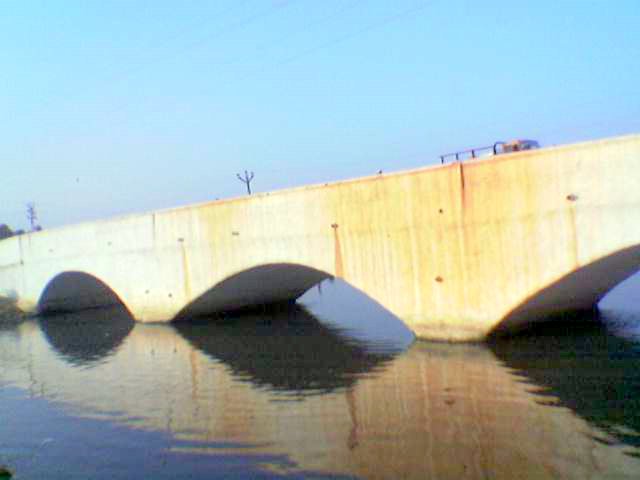 Thanks to tsunami and to the thoughtful district adminis- trator.A portion tsunami relief fund is being utilised to construct a new bridge near the existing one.
Constituency funds of MPs from West Bengal is being utilised for the project .The entire project is estimated at a cost just less than one crore rupees.
Water is being drained to allow construction process and to keep the water off from entering the work zone a large heap of red soil is dumped across the backwater on either side of the worksite.
Above are some of the photographs of bridge and the makeshift barrier,taken when the work started.
Wednesday, March 22, 2006
Roller skating
Roller skating is getting increasingly popular among kids in India both as a recreational sport and as a serious sport.Many from metros like Chennai participated in international competitions and have won prizes.
This sport is no more alien for the rural population.It is intresting to come to know that a division level roller skating competition was held in Kovilpatti (must be somewhere in interior TamilNadu).This shows a brighter future for the sport in this country.
Like most other sport skating needs years of dedicated practice.What really prevents from getting into this sport is the non-availability of smooth rolling floor.There are only handful of rinks in entire the state I suppose.Chennai Corporation has rink at several places like Marina Beach,Veshweshwaraya Park-Anna Nagar.But such facility is not available in others places.
To encourage the sport in Cuddalore region,a rink must be built in Anna Stadium and another in Silver Beach.Also coaches must be appointed to train the children.So that kids from Cuddalore region does not lag behind in this sport.
This sport is no more alien for the rural population.It is intresting to come to know that a division level roller skating competition was held in Kovilpatti (must be somewhere in interior TamilNadu).This shows a brighter future for the sport in this country.
Like most other sport skating needs years of dedicated practice.What really prevents from getting into this sport is the non-availability of smooth rolling floor.There are only handful of rinks in entire the state I suppose.Chennai Corporation has rink at several places like Marina Beach,Veshweshwaraya Park-Anna Nagar.But such facility is not available in others places.
To encourage the sport in Cuddalore region,a rink must be built in Anna Stadium and another in Silver Beach.Also coaches must be appointed to train the children.So that kids from Cuddalore region does not lag behind in this sport.
Tuesday, March 21, 2006
Padayatra taken for Bhopal survivors
Padayatra taken for Bhopal survivors
Human rights, environmental and youth groups in the city Thursday took out a rally in support of the survivors of the December 1984 Union Carbide disaster in Bhopal. The groups are on an 800-km padayatra to New Delhi demanding justice and a life of dignity.
Representatives from pollution-hit communities in Mettur, Cuddalore and Gummidipoondi also participated in the Chennai rally from Monroe Statue to Chepauk Guest House.
A delegation of supporters from Tamilnadu will join them in the last stage of the padayatra.
More than 130 survivors of the Bhopal gas disaster began a march on foot to New Delhi on 20 February, 2006.
The walk was undertaken to demand clean water, clean environment, medical assistance and compensation.
On 10 March, members of Chennai-based youth collective 'We Feel Responsible' met the Tamilnadu Governor and handed over a petition addressed to the Prime Minister with signatures collected in support of the demands of the Bhopalis, Nityanand Jayaraman of Corporate Accountability Desk said.
Representatives from Human Rights - Tamilnadu Initiative, Penn Thozhilalar Sangam, Corporate Accountability Desk, Tamilnadu Dalit Women's Movement, Alliance for People's Movement, Tamilnadu Women's Forum, We Feel Responsible - A Youth Initiative and other organisation took part.
Human rights, environmental and youth groups in the city Thursday took out a rally in support of the survivors of the December 1984 Union Carbide disaster in Bhopal. The groups are on an 800-km padayatra to New Delhi demanding justice and a life of dignity.
Representatives from pollution-hit communities in Mettur, Cuddalore and Gummidipoondi also participated in the Chennai rally from Monroe Statue to Chepauk Guest House.
A delegation of supporters from Tamilnadu will join them in the last stage of the padayatra.
More than 130 survivors of the Bhopal gas disaster began a march on foot to New Delhi on 20 February, 2006.
The walk was undertaken to demand clean water, clean environment, medical assistance and compensation.
On 10 March, members of Chennai-based youth collective 'We Feel Responsible' met the Tamilnadu Governor and handed over a petition addressed to the Prime Minister with signatures collected in support of the demands of the Bhopalis, Nityanand Jayaraman of Corporate Accountability Desk said.
Representatives from Human Rights - Tamilnadu Initiative, Penn Thozhilalar Sangam, Corporate Accountability Desk, Tamilnadu Dalit Women's Movement, Alliance for People's Movement, Tamilnadu Women's Forum, We Feel Responsible - A Youth Initiative and other organisation took part.
New refinery projects to raise capacity to 210 mt -Business Standard
New refinery projects to raise capacity to 210 mt
With a slew of greenfield refinery projects expected to be set up in the country, the crude oil refining capacity will surge to 210 million tonne (mt) per year by 2010. At present, the country’s refining capacity is 127.37 mt from 18 refineries.
Over six greenfield refinery projects are at different stages of development, while two capacity expansion projects are under way. Reliance Industries (RIL) will be a major contributor through its arm Reliance Petroleum, with a refining capacity of 60 mt in four years, industry experts said.
“Apart from RIL, Nagarjuna Oil Corporation, Essar Oil, Bharat Petroleum Corporation (BPCL), Hindustan Petroleum Corporation (HPCL) and Indian Oil Corporation (IOC) are in the fray to build-up refineries. Both IOC and RIL have started expansion in their existing refineries as well,” Deepak Mahurkar, principal consultant - oil and gas, PricewaterhouseCoopers, said.
RIL has the third largest single location refinery in the world at Jamnagar with a capacity of 33 million tonne per annum (mtpa) and accounts for 26 per cent of the country’s refining capacity.
With the new project it plans to increase capacity to 60 mtpa. Reliance Petroleum has announced its pubic issue to fund a new project in Jamnagar. The total project cost will be $6 billion.
Nagarjuna is a new entrant into the petroleum sector with their refinery at Cuddalore in Tamil Nadu. It will have a capacity of 6 mtpa and the commercial production is expected to start in 2008.
The investment for the project is Rs 4,000 crore. The refinery will have the flexibility to process different types of crude oil and produce multiple grade products. full story>>
With a slew of greenfield refinery projects expected to be set up in the country, the crude oil refining capacity will surge to 210 million tonne (mt) per year by 2010. At present, the country’s refining capacity is 127.37 mt from 18 refineries.
Over six greenfield refinery projects are at different stages of development, while two capacity expansion projects are under way. Reliance Industries (RIL) will be a major contributor through its arm Reliance Petroleum, with a refining capacity of 60 mt in four years, industry experts said.
“Apart from RIL, Nagarjuna Oil Corporation, Essar Oil, Bharat Petroleum Corporation (BPCL), Hindustan Petroleum Corporation (HPCL) and Indian Oil Corporation (IOC) are in the fray to build-up refineries. Both IOC and RIL have started expansion in their existing refineries as well,” Deepak Mahurkar, principal consultant - oil and gas, PricewaterhouseCoopers, said.
RIL has the third largest single location refinery in the world at Jamnagar with a capacity of 33 million tonne per annum (mtpa) and accounts for 26 per cent of the country’s refining capacity.
With the new project it plans to increase capacity to 60 mtpa. Reliance Petroleum has announced its pubic issue to fund a new project in Jamnagar. The total project cost will be $6 billion.
Nagarjuna is a new entrant into the petroleum sector with their refinery at Cuddalore in Tamil Nadu. It will have a capacity of 6 mtpa and the commercial production is expected to start in 2008.
The investment for the project is Rs 4,000 crore. The refinery will have the flexibility to process different types of crude oil and produce multiple grade products. full story>>
Wednesday, March 15, 2006
BBC organises tsunami cricket match in India-TelevisionPoint
BBC organises tsunami cricket match in India
Is there a better way to help the tsunami survivors overcome their trauma than by organising a cricket match between a host of celebrities from England and the youth of fishing hamlets for whom cricket is not just a game but religion and cricketers are not players but demigods?
Understanding this rather well, the British Broadcasting Corporation (BBC) hosted a cricket match at Samiyarpettai fishing village, about 20 km from Chennai, on Sunday for the UK-based Charity Comic Relief, between fisher folk drawn from half-a-dozen tsunami-hit coastal hamlets in Cuddalore district and British players comprising celebrities from various fields. Leading the celebrities as their coach is none other than the West Indian legend Alvin Kallicharan.
Even Kalli could not do much against the spirited local boys, who spend most of their spare time when not at sea playing barefooted cricket with tennis balls on the beach. The 'New Indian Tsunami Team' hammered the 'English attack' for 176 runs in just 20 overs losing only five wickets and thereafter bundled out the visitors for 119 in 12 overs.
Who really cared for the result when all that really mattered was the spirit of camaraderie across continents? Reflecting just that mood, the little hamlet of Samiyarpettai was decked up like a high-profile cricket Test center with banners inviting the locals to the great event.
The British team included one of the fine wicketkeepers of our times, Jack Russel and retired left arm spinner and reality television character Phil Tufnell, member of the current England women's cricket team Rosalie Birch, county cricketer Mark Chapman, broadcaster Chris Evans, BBC's anchor Jake Humphrey and popular comedian Patrick Kielty. Also there were Harry Judd, drummer for Mcfly and musician Jay Sean. The contest, watched by over 500 villagers, was done in collaboration with an Indian NGO, 'New Hope'.
"One of the objectives of the contest is to entertain the local crowd and support relief work on the less emotive side," said New Hope director Eliazar T Rose. The English visitors had arrived a couple of days ago and moved around interacting with the enthusiastic local youth in Cuddalore, a town that had witnessed over 600 deaths in the tsunami.
"We never expected that such a big event would be hosted in a small place like ours. Enthusiastic people came from several coastal villages to witness the match," said local youth Prakash. The UK team gifted the winners with a cricket kit before driving to Chennai, where it would play against the tsunami kids at Royapuram on Tuesday and move on to Mumbai to play another match against a celebrity Indian/Bollywood cricket team just before the tmillions of pounds, 66 million pounds last year, to be spent on a wide range of charity projects across the world. Every other year, Comic Relief runs a campaign titled 'Sport Relief' focusing on using sport for raising money for international children's charities.
Is there a better way to help the tsunami survivors overcome their trauma than by organising a cricket match between a host of celebrities from England and the youth of fishing hamlets for whom cricket is not just a game but religion and cricketers are not players but demigods?
Understanding this rather well, the British Broadcasting Corporation (BBC) hosted a cricket match at Samiyarpettai fishing village, about 20 km from Chennai, on Sunday for the UK-based Charity Comic Relief, between fisher folk drawn from half-a-dozen tsunami-hit coastal hamlets in Cuddalore district and British players comprising celebrities from various fields. Leading the celebrities as their coach is none other than the West Indian legend Alvin Kallicharan.
Even Kalli could not do much against the spirited local boys, who spend most of their spare time when not at sea playing barefooted cricket with tennis balls on the beach. The 'New Indian Tsunami Team' hammered the 'English attack' for 176 runs in just 20 overs losing only five wickets and thereafter bundled out the visitors for 119 in 12 overs.
Who really cared for the result when all that really mattered was the spirit of camaraderie across continents? Reflecting just that mood, the little hamlet of Samiyarpettai was decked up like a high-profile cricket Test center with banners inviting the locals to the great event.
The British team included one of the fine wicketkeepers of our times, Jack Russel and retired left arm spinner and reality television character Phil Tufnell, member of the current England women's cricket team Rosalie Birch, county cricketer Mark Chapman, broadcaster Chris Evans, BBC's anchor Jake Humphrey and popular comedian Patrick Kielty. Also there were Harry Judd, drummer for Mcfly and musician Jay Sean. The contest, watched by over 500 villagers, was done in collaboration with an Indian NGO, 'New Hope'.
"One of the objectives of the contest is to entertain the local crowd and support relief work on the less emotive side," said New Hope director Eliazar T Rose. The English visitors had arrived a couple of days ago and moved around interacting with the enthusiastic local youth in Cuddalore, a town that had witnessed over 600 deaths in the tsunami.
"We never expected that such a big event would be hosted in a small place like ours. Enthusiastic people came from several coastal villages to witness the match," said local youth Prakash. The UK team gifted the winners with a cricket kit before driving to Chennai, where it would play against the tsunami kids at Royapuram on Tuesday and move on to Mumbai to play another match against a celebrity Indian/Bollywood cricket team just before the tmillions of pounds, 66 million pounds last year, to be spent on a wide range of charity projects across the world. Every other year, Comic Relief runs a campaign titled 'Sport Relief' focusing on using sport for raising money for international children's charities.
TNPCB Orders Tagros Chemical Shut; Cuts Electricity Connection -SACEM
TNPCB Orders Tagros Chemical Shut; Cuts Electricity Connection
Cuddalore, 6 March, 2006 – The Tamilnadu Pollution Control Board at 4.30 p.m. issued closure orders and disconnected the electricity to Tagros Chemicals, a manufacturer of synthetic pyrethroids, a class of highly toxic pesticides. The company, which is located in Pachaiyankuppam village, had expanded capacity illegally, and was manufacturing and exporting products that it was not authorised to produce. On November 27, 2005, the company was found dumping toxic effluents on a farmer’s land in Poondiyankuppam, a nearby village within the Semmankuppam Panchayat.
The president of the Panchayat had in December 2005 invoked a seldom used clause under the Environmental Protection Act, 1986, and written to the Tamilnadu Pollution Control Board and the Ministry of Environment & Forests -- “Since the Ministry of Environment & Forests and the Tamilnadu Pollution Control Board seem incapable or unwilling to take any action to implement the law, I intend to prosecute Tagros Chemicals and its contractor Mr. Senthil Velan under Section 15 of the Environmental Protection Act, 1986, and under Sections 6 and 16 of the Hazardous Waste (Management & Handling) Rules, 1989. I request the Tamilnadu Pollution Control Board to provide us with all the reports relating to Tagros in its possession to us. Please let us know who the occupier of the facility is, as he/she is liable under Section 16 of the Hazardous Waste (Management & Handling) Rules, 1989.”
Indian law allows citizens to write to the Tamilnadu Pollution Control Board requesting it to prosecute the offender within 60 days, failing which the citizen can step in the shoes of the regulator and conduct the prosecution.
Tagros Chemicals claims to be “India’s leading manufacturer exporters of various Synthetic Pyrethroids like Cypermethrin, Permethrin, Alpha cypermethrin, Deltamethrin and various other products like Imidachloprid, Hexaconazole, Propiconazole.” This was brought to the notice of the TNPCB in August 2004, less than a month before the company was to have a statutory public hearing to seek permission for expanding capacity and introducing new products.
According to SACEM, as early as in 2004, reports from workers and residents of SIPCOT indicated that not only had Tagros completed construction for the expanded capacity, but also engaged in production, including of new products. The matter was brought to the notice of the TNPCB and the Supreme Court Monitoring Committee on Hazardous Wastes in September 2004, and subsequently at the public hearing on September 7, 2004. No action was taken by the TNPCB, and the company continued to manufacture and export the unauthorised products in the illegally expanded factory. In February 2005, the SCMC recommended its closure to TNPCB. The company continued to operate illegally until it was shut-down today, a year later.
In the 17 month period that it operated illegally, and despite the knowledge of the Inspector of Factories, the District Collector of Cuddalore, and the TNPCB, 6 people were injured and one killed in four serious accidents in Tagros, according to SACEM records. During the same period, the company illegally dumped toxic wastes on open land on two separate occasions.
“Gas Trouble” – a September 2004 SACEM study on SIPCOT’s air quality – reports finding 14 chemicals in one air sample taken downwind of Tagros. Cancer-causing chemicals like Carbon Tetrachloride and ethylene dichloride were found at levels 11,538 and 22,973 times higher than levels considered safe by US EPA’s Region 6 screening levels.
Tagros is not the only offender in SIPCOT, Cuddalore. The SCMC had also recommended closure orders for TANFAC, and similar complaints of toxic waste dumping and effluent spills are pending for months against Pondicherry Alum, SPIC, Loyal Super Fabrics and CUSECS.
The TNPCB remains highly inconsistent and arbitrary in the manner in which it applies the law. Tuticorin-based Sterlite Industries is operating an entire illegally constructed factory complex consisting of a 300,000 tonnes/year copper smelter, a 1,25,000 tonnes/year refiner, a power plant, an oxygen plant, and a Continuous Cast Rod unit.
But Sterlite is too well-connected to suffer Tagros’ fate. Despite repeated emphasis by the SCMC that Sterlite has both illegally expanded and endangered the environment, the TNPCB and MoEF have regularised the violation.
Sterlite’s Tuticorin smelter complex has a disturbing track record of safety. Between 1996 and 2004, at least 139 people have reportedly been injured and 13 have lost their lives in 15 incidents.
Related stories
1. Tagros Chemicals caught red handed dumping hazardous waste in SIPCOT area
http://www.sipcotcuddalore.com/updates_061205.html
2. Two more industrial accidents reported from Tagros Chemicals in SIPCOThttp://www.sipcotcuddalore.com/updates_311005.html
Monday, March 13, 2006
Our Opportunity With India
Our Opportunity With India
By Condoleezza Rice
Monday, March 13, 2006;
The week before last President Bush concluded a historic agreement on civilian nuclear cooperation with India, a rising democratic power in a dynamic Asia. This agreement is a strategic achievement: It will strengthen international security. It will enhance energy security and environmental protection. It will foster economic and technological development. And it will help transform the partnership between the world's oldest and the world's largest democracy.
First, our agreement with India will make our future more secure, by expanding the reach of the international nonproliferation regime. The International Atomic Energy Agency would gain access to India's civilian nuclear program that it currently does not have. Recognizing this, the IAEA's director general, Mohamed ElBaradei, has joined leaders in France and the United Kingdom to welcome our agreement. He called it "a milestone, timely for ongoing efforts to consolidate the non-proliferation regime, combat nuclear terrorism and strengthen nuclear safety." full story>>
By Condoleezza Rice
Monday, March 13, 2006;
The week before last President Bush concluded a historic agreement on civilian nuclear cooperation with India, a rising democratic power in a dynamic Asia. This agreement is a strategic achievement: It will strengthen international security. It will enhance energy security and environmental protection. It will foster economic and technological development. And it will help transform the partnership between the world's oldest and the world's largest democracy.
First, our agreement with India will make our future more secure, by expanding the reach of the international nonproliferation regime. The International Atomic Energy Agency would gain access to India's civilian nuclear program that it currently does not have. Recognizing this, the IAEA's director general, Mohamed ElBaradei, has joined leaders in France and the United Kingdom to welcome our agreement. He called it "a milestone, timely for ongoing efforts to consolidate the non-proliferation regime, combat nuclear terrorism and strengthen nuclear safety." full story>>
Sunday, March 12, 2006
Chemical company ordered to be closed
Chemical company ordered to be closedTuesday March 7 2006 00:00 IST
CUDDALORE: The Tamil Nadu Pollution Control Board (TNPCB) has ordered closure of a chemical firm on charges of violating the norms of the TNPCB in the SIPCOT complex here on Monday. The power supply to the firm has also been snapped this evening.
According to sources, the TNPCB had granted permission to Tagros Chemicals India Ltd for the production of pesticide, which included alpha methrin, cyper methrin and per methrin. The firm had obtained licence for a generation capacity of 30 tonnes of the pesticide permonth (1,000 kg per day).
Violating the provisions, the plant had been producing two new products clandestinely. The unit had been developing pesticides - hexaconazole and delta methrin- without the knowledge of TNPCB at the plant. The plant was also generating pesticide more than the prescribed capacity of 1,000 kg of pesticide per day for the past few weeks.
Besides, a contractor of the unit had transported spent hydrochloric acid from the firm and dumped it on an arable land in Poondiyankuppam recently. As a result of this the fertility of the land had been severely affected .
Following intervention of local people and others the plant had extended a relief of Rs 2 lakh to the farmer.
However, the sources said, the unit was held responsible for discarding the acid on the fertile land.
The district unit of TNPCB had conducted an investigation and submitted a detailed report to the TNPCB chairman.
On Monday, the chairman gave necessary directions to the concerned officials to shut the firm immediately.
A team comprising District Environmental Engineer, TNPCB, Ka Karthikeyan, Assistant Engineer, M Malaiyandi, Assistant Executive Engineer, TNEB, Kumarasamy and Assistant Executive Engineer Adhi Moolam visited the firm and served the order.
Source: http://www.newindpress.com/
CUDDALORE: The Tamil Nadu Pollution Control Board (TNPCB) has ordered closure of a chemical firm on charges of violating the norms of the TNPCB in the SIPCOT complex here on Monday. The power supply to the firm has also been snapped this evening.
According to sources, the TNPCB had granted permission to Tagros Chemicals India Ltd for the production of pesticide, which included alpha methrin, cyper methrin and per methrin. The firm had obtained licence for a generation capacity of 30 tonnes of the pesticide permonth (1,000 kg per day).
Violating the provisions, the plant had been producing two new products clandestinely. The unit had been developing pesticides - hexaconazole and delta methrin- without the knowledge of TNPCB at the plant. The plant was also generating pesticide more than the prescribed capacity of 1,000 kg of pesticide per day for the past few weeks.
Besides, a contractor of the unit had transported spent hydrochloric acid from the firm and dumped it on an arable land in Poondiyankuppam recently. As a result of this the fertility of the land had been severely affected .
Following intervention of local people and others the plant had extended a relief of Rs 2 lakh to the farmer.
However, the sources said, the unit was held responsible for discarding the acid on the fertile land.
The district unit of TNPCB had conducted an investigation and submitted a detailed report to the TNPCB chairman.
On Monday, the chairman gave necessary directions to the concerned officials to shut the firm immediately.
A team comprising District Environmental Engineer, TNPCB, Ka Karthikeyan, Assistant Engineer, M Malaiyandi, Assistant Executive Engineer, TNEB, Kumarasamy and Assistant Executive Engineer Adhi Moolam visited the firm and served the order.
Source: http://www.newindpress.com/
All out for charity- BBC Sport 1
All out for charity||
With England are taking on India in the Test series, a celebrity team has set off for the sub-continent to take on the stars of Bollywood.
The Sport Releief Red Socks including former England spin bowler Phil Tufnell, McFly's Harry Judd and radio Dj Chris Evans.
They will also be witnessing at first hand how money raised through Sport Relief is being spent in India.
The trip is being filmed by the BBC and will be shown at the end of May.
Other cricket-mad celebrities in the Red Socks team include hip hop artist Jay Sean and television presenters Dermot O'Leary and Patrick Kielty.
And former England wicket-keeper Jack Russell and Rosalie Birch of the England women's team are also on the week-long trip, which will see them visit Chennai (Madras), Mumbai (Bombay) and Cuddalore.
You can follow their progress by logging on to www.alloutforindia.net
Sport Relief raised £16.5m 2004. This year's event will take place on 15 July.
With England are taking on India in the Test series, a celebrity team has set off for the sub-continent to take on the stars of Bollywood.
The Sport Releief Red Socks including former England spin bowler Phil Tufnell, McFly's Harry Judd and radio Dj Chris Evans.
They will also be witnessing at first hand how money raised through Sport Relief is being spent in India.
The trip is being filmed by the BBC and will be shown at the end of May.
Other cricket-mad celebrities in the Red Socks team include hip hop artist Jay Sean and television presenters Dermot O'Leary and Patrick Kielty.
And former England wicket-keeper Jack Russell and Rosalie Birch of the England women's team are also on the week-long trip, which will see them visit Chennai (Madras), Mumbai (Bombay) and Cuddalore.
You can follow their progress by logging on to www.alloutforindia.net
Sport Relief raised £16.5m 2004. This year's event will take place on 15 July.
Celebrity cricket team sets off for India
Celebrity cricket team sets off for India
A celebrity cricket team - comprising such luminaries as Phil Tufnell, Jack Russell and Harry Judd, the drummer from the pop group, McFly - has set off for India to take on the stars of Bollywood and raise money for Sport Relief.
The Red Socks team will be captained by Tufnell and managed by the former West Indian cricketer, Alvin Kallicharran. In addition to their match at the Brabourne Stadium in Mumbai, they will be visiting Chennai and Cuddalore. The trip is being filmed by the BBC, and will be shown on British television at the end of May.
In 2004, Sport Relief raised £16.5m, and the team members will be able to witness at first hand how the money is being spent. This year's event will take place on July 15.
For further details on the trip, visit alloutforindia.net
© Cricinfo
Link suggested by Mr.Krishnakumar B.She will run on memory rails henceforth -Newindpress
She will run on memory rails henceforth
‘Good bye faithful. Henceforth you will run on our memory rails.’
This was how a large number of commuters and railway employees who thronged the Salem Town Railway Station seemed to bid adieu to the Salem-Virudhachalam meter gauge train as they watched intently the bogies and its diesel engine being wheeled away on a special carrier.
One of the oldest train service in the country, it eventually came to an end four months ago due to gauge conversion between Salem-Cuddalore. Neither the stationmaster nor the Public Relations Officer of the Tiruchy Division (This sector comes under Tiruchy division) were able to tell when the service was introduced in the sector.
V M Ramasamy (75), president of the Salem Theater Owner’s Association and former councillor estimates that the service was introduced in 1921 between Salem and Attur and further extended to Virudhachalam and Cuddalore later.
But the Town Railway Station is much older, started on January 1, 1917. When Rajagopalachari was the Chairman of the Salem Municipality and E W Leigh was the Collector, train service was extended from Salem Junction at Sooramangalam to the Town Railway Station.
Another septuagenarian C Vayapuri, president of the United Farmers Association was active in the Salem-Virudhachalam Meter Gauge Train Commuters Association.
He had participated in several protests to improve the service like adding more boggies, more stops, more trips and extension of the service to port towns as a large numbers of farmers from Attur and Thalaivasal used the service to transport vegetables to port towns.
There are seven station master-managed stations, one run by clerks and five run by halt agents.
But Vayapuri was at pains when he was told that the trains were dismantled and taken away by the railway authorities. He remembered vividly his daily trips to Salem when the sky line was once open and one had the breathtaking views of the Shevroy Hills till Valapadi. But now the concrete jungles have marred those views, he lamented.
The Town Railway Station is still wrapped with vintage though surrounded by modernity. Time machine seem to wind backwards as one enters the shady premises.
The station master still sits in his old cabin in front of the old clock and the ageing block machines used to pull out balls that authorises the driver to go to the next station.
With the mechanical signal arm (called lower quadrant signal lighted with kerosene lamp once) still standing there, the station with old shady trees and concrete benches is irresistible for time killers and oldies.
The groundnut seller continue to do brisk business. But only the train is no more to chug in and out.
‘Good bye faithful. Henceforth you will run on our memory rails.’
This was how a large number of commuters and railway employees who thronged the Salem Town Railway Station seemed to bid adieu to the Salem-Virudhachalam meter gauge train as they watched intently the bogies and its diesel engine being wheeled away on a special carrier.
One of the oldest train service in the country, it eventually came to an end four months ago due to gauge conversion between Salem-Cuddalore. Neither the stationmaster nor the Public Relations Officer of the Tiruchy Division (This sector comes under Tiruchy division) were able to tell when the service was introduced in the sector.
V M Ramasamy (75), president of the Salem Theater Owner’s Association and former councillor estimates that the service was introduced in 1921 between Salem and Attur and further extended to Virudhachalam and Cuddalore later.
But the Town Railway Station is much older, started on January 1, 1917. When Rajagopalachari was the Chairman of the Salem Municipality and E W Leigh was the Collector, train service was extended from Salem Junction at Sooramangalam to the Town Railway Station.
Another septuagenarian C Vayapuri, president of the United Farmers Association was active in the Salem-Virudhachalam Meter Gauge Train Commuters Association.
He had participated in several protests to improve the service like adding more boggies, more stops, more trips and extension of the service to port towns as a large numbers of farmers from Attur and Thalaivasal used the service to transport vegetables to port towns.
There are seven station master-managed stations, one run by clerks and five run by halt agents.
But Vayapuri was at pains when he was told that the trains were dismantled and taken away by the railway authorities. He remembered vividly his daily trips to Salem when the sky line was once open and one had the breathtaking views of the Shevroy Hills till Valapadi. But now the concrete jungles have marred those views, he lamented.
The Town Railway Station is still wrapped with vintage though surrounded by modernity. Time machine seem to wind backwards as one enters the shady premises.
The station master still sits in his old cabin in front of the old clock and the ageing block machines used to pull out balls that authorises the driver to go to the next station.
With the mechanical signal arm (called lower quadrant signal lighted with kerosene lamp once) still standing there, the station with old shady trees and concrete benches is irresistible for time killers and oldies.
The groundnut seller continue to do brisk business. But only the train is no more to chug in and out.
Cuddalore in the news
State railway projects to benefit from budget
.....other major conversion projects to be completed in the next financial year are Cuddalore-Salem and Madurai-Manamdaurai-Rameswaram. In the Cuddalore-Salem project, for which the State Government is sharing 50 per cent of the cost, the section between Cuddalore and Attur has been converted. The remaining stretch will be completed in the current financial year. This project will be executed by RYNL and Rs. 80 crore had been sanctioned...
Call for simpler procedures to import looms -The Hindu
.....To meet the increasing demand, the Government had taken initiatives to set up a processing park at Cuddalore.....
Marriage in sea -The Times of India
...Premanandhan shot to fame with his long-distance swimming efforts to highlight various public issues. On the first anniversary of tsunami on December 26 last year, he swam for 24 kms from here to Devanpattinam in neighbouring Cuddalore district of Tamil Nadu....
Swimmer chooses sea to get married -ChennaiOnline
...on the first anniversary of tsunami on December 26 last year, he swam for a distance of 24 kms from behind the Mahatma Gandhi statue here to Devanpattinam in neighbouring Cuddalore District of Tamil Nadu to bring to focus awareness about the killer waves. ...
High Court's direction to District Collector -New Kerala
The Madras High Court today directed the Cuddalore District Collector to inquire into an allegation by an advocate pertaining to non-distribution of flood relief to farmers in two talukas in the district for not having paid "gratification" to revenue department officials.
"It is clear that there are very serious allegations against revenue officials. The Cuddalore District Collector is directed to go through the representations and conduct an inquiry," a Division Bench comprising Justice M Karpagavinayagam and Justice A R Ramalingam said while disposing of a PIL filed by a city advocate C Palanimurugan.......
.....other major conversion projects to be completed in the next financial year are Cuddalore-Salem and Madurai-Manamdaurai-Rameswaram. In the Cuddalore-Salem project, for which the State Government is sharing 50 per cent of the cost, the section between Cuddalore and Attur has been converted. The remaining stretch will be completed in the current financial year. This project will be executed by RYNL and Rs. 80 crore had been sanctioned...
Call for simpler procedures to import looms -The Hindu
.....To meet the increasing demand, the Government had taken initiatives to set up a processing park at Cuddalore.....
Marriage in sea -The Times of India
...Premanandhan shot to fame with his long-distance swimming efforts to highlight various public issues. On the first anniversary of tsunami on December 26 last year, he swam for 24 kms from here to Devanpattinam in neighbouring Cuddalore district of Tamil Nadu....
Swimmer chooses sea to get married -ChennaiOnline
...on the first anniversary of tsunami on December 26 last year, he swam for a distance of 24 kms from behind the Mahatma Gandhi statue here to Devanpattinam in neighbouring Cuddalore District of Tamil Nadu to bring to focus awareness about the killer waves. ...
High Court's direction to District Collector -New Kerala
The Madras High Court today directed the Cuddalore District Collector to inquire into an allegation by an advocate pertaining to non-distribution of flood relief to farmers in two talukas in the district for not having paid "gratification" to revenue department officials.
"It is clear that there are very serious allegations against revenue officials. The Cuddalore District Collector is directed to go through the representations and conduct an inquiry," a Division Bench comprising Justice M Karpagavinayagam and Justice A R Ramalingam said while disposing of a PIL filed by a city advocate C Palanimurugan.......
Construction of retaining wall in progress
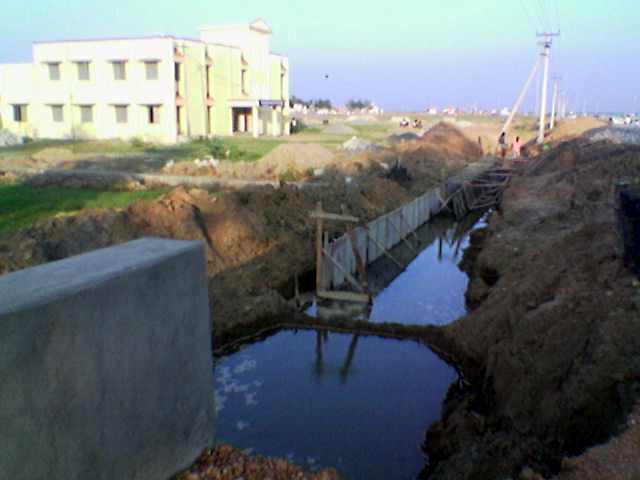
Work on construction of Retaining Wall in Silver Beach is on progress.
Work is in good progress,the photograph show the status of the work,a couple of weeks back.
Drainage outside Municipal Office building
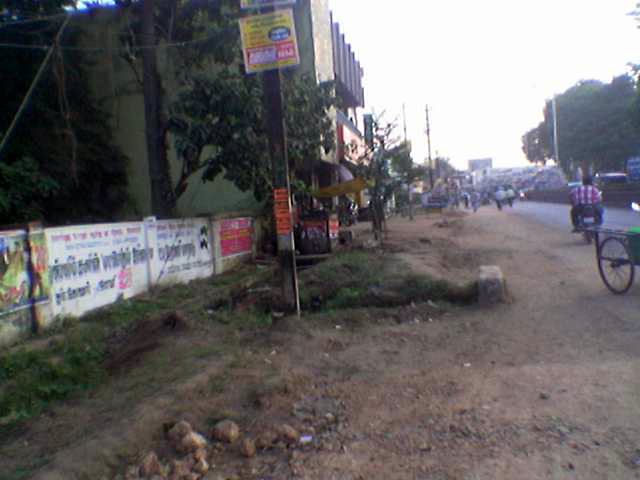
The photograph shows the drainage outside Municipal Office building-left untouched during the road extension process.
Photograph was taken a couple of weeks back.
Piecemeal treatment
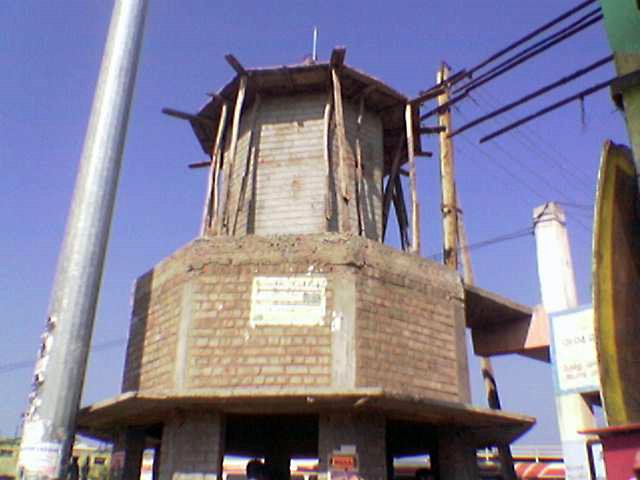
A tall structure(probably an outpost) that is being buit in Cuddalore busstand receives a piecemeal treatment.
Poor quality mortar used

This picture shows the crumbled median in Hospital Road.This betrays the quality of the mortar used in the construction process.
Saturday, March 11, 2006
Dyeing, bleaching units asked to display green measures -Business Standard
Dyeing, bleaching units asked to display green measures
The Tamil Nadu Pollution Control Board (TNPCB) has tightened its noose around the dyeing and bleaching units located at the Sipcot Industrial Estate in Cuddalore and Tirupur. The board has ordered the installation of an electronic display system to ensure transparency in pollution control measures full story>>
The Tamil Nadu Pollution Control Board (TNPCB) has tightened its noose around the dyeing and bleaching units located at the Sipcot Industrial Estate in Cuddalore and Tirupur. The board has ordered the installation of an electronic display system to ensure transparency in pollution control measures full story>>
Thursday, March 09, 2006
Caritas-India Gives Houses to Tsunami Victims
Caritas-India Gives Houses to Tsunami Victims
DEVANAMPATTINAM, India, MARCH 6, 2006 (Zenit.org).- Caritas-India is turning over 648 new houses to families as part of its ongoing relief efforts in the wake of the December 2004 tsunami.
The Catholic aid organization and other ecclesial entities raced to the aid of the tsunami victims and planned their relief efforts by focusing on medium- and long-term reconstruction.
Caritas-India is working with 300 village communities in Tamil Nadu, Andhra Pradesh, Kerala and the Andaman and Nicobar islands to build more than 17,000 homes, in addition to providing livelihood to affected families.
The Catholic bishops' conference of India confirmed that Shri Surjit Singh Barnala, governor of the state of Tamil Nadu, had handed over 648 houses in the tsunami-affected coastal village of Devanampattinam, built by the Pondicherry Multipurpose Social Service Society in partnership with Caritas-India.
"Caritas-India has done this for the affected families of the tsunami, as a mark of selfless and compassionate love," said Father John Noronha, executive director of Caritas-India, during the handover ceremony.
The tsunami claimed 101 lives in Davanampattinam, on the coast of Cuddalore, and destroyed huge amounts of property.
The bishops' conference emphasized the cooperation of the state government with the efforts of Caritas-India and other aid organizations.
© Innovative Media, Inc.
DEVANAMPATTINAM, India, MARCH 6, 2006 (Zenit.org).- Caritas-India is turning over 648 new houses to families as part of its ongoing relief efforts in the wake of the December 2004 tsunami.
The Catholic aid organization and other ecclesial entities raced to the aid of the tsunami victims and planned their relief efforts by focusing on medium- and long-term reconstruction.
Caritas-India is working with 300 village communities in Tamil Nadu, Andhra Pradesh, Kerala and the Andaman and Nicobar islands to build more than 17,000 homes, in addition to providing livelihood to affected families.
The Catholic bishops' conference of India confirmed that Shri Surjit Singh Barnala, governor of the state of Tamil Nadu, had handed over 648 houses in the tsunami-affected coastal village of Devanampattinam, built by the Pondicherry Multipurpose Social Service Society in partnership with Caritas-India.
"Caritas-India has done this for the affected families of the tsunami, as a mark of selfless and compassionate love," said Father John Noronha, executive director of Caritas-India, during the handover ceremony.
The tsunami claimed 101 lives in Davanampattinam, on the coast of Cuddalore, and destroyed huge amounts of property.
The bishops' conference emphasized the cooperation of the state government with the efforts of Caritas-India and other aid organizations.
© Innovative Media, Inc.
Tuesday, March 07, 2006
Online Grievance System - Govt of India
Can you imagine this happening in INDIA ?
I came across this vital information from one of my friends. Just pass on this message if someone wants to clear any grievance.
Government of India has a online Grievance forum at
<http://darpg-grievance.nic.in/
The government wants people to use this tool to highlight the problems they faced while dealing with Government officials or departments like Passport Office, Electricity board, BSNL/MTNL, Railways etc etc. I know many people will say that these things don't work in India, but this actually works as one of our colleague in CSC found. The guy I'm talking about lives in Faridabad. Couple of months back, the Faridabad Municipal corporation laid new ro ads in his area and the residents were very happy about it. But 2 weeks later, BSNL dugged up the newly laid roads to install new cables which annoyed all the residents including this guy. But it was only this guy who used the above listed grievance forum to highlight his concern. And to his surprise, BSNL and Municipal corporation of faridabad was served a show cause notice and the guy received a copy of the notice in one week. Government has asked the MC and BSNL about the goof up as its clear that both the government departments were not in sync at all. So use this grievance forum and educate others who don't know about this facility. This way we can at least raise our concerns instead of just talking about the 'System' in India.
I came across this vital information from one of my friends. Just pass on this message if someone wants to clear any grievance.
Government of India has a online Grievance forum at
<http://darpg-grievance.nic.in/
The government wants people to use this tool to highlight the problems they faced while dealing with Government officials or departments like Passport Office, Electricity board, BSNL/MTNL, Railways etc etc. I know many people will say that these things don't work in India, but this actually works as one of our colleague in CSC found. The guy I'm talking about lives in Faridabad. Couple of months back, the Faridabad Municipal corporation laid new ro ads in his area and the residents were very happy about it. But 2 weeks later, BSNL dugged up the newly laid roads to install new cables which annoyed all the residents including this guy. But it was only this guy who used the above listed grievance forum to highlight his concern. And to his surprise, BSNL and Municipal corporation of faridabad was served a show cause notice and the guy received a copy of the notice in one week. Government has asked the MC and BSNL about the goof up as its clear that both the government departments were not in sync at all. So use this grievance forum and educate others who don't know about this facility. This way we can at least raise our concerns instead of just talking about the 'System' in India.
Rain water stagnates in Nethaji Road
Few months back pedastrian footpath was laid in Nethaji Road.While laying no proper arrangement were made for the rain water to drain.As a result water stagnates after rain.Nethaji Road is one of the busiest road in Cuddalore.Stagnation water during rains heavily interrupt the traffic flow.Especially commuters and school going children are put in great trouble.Till date no steps have been take to set the things right.
In addition road extension process has been started in Nethaji Road and the work is nearing completion.During the process of extension,the edges of the footpath were broken and the tiles were disaplaced at several locations.If these weren't set right at the earliest,the entire footpath will disintegrate into rubbles in a very near future.
Since drilling a hole in platform for the rain water in the road to reach the drainage and the reintegration of tiles in the platform are related process,they must done in immediate sucession.
In addition road extension process has been started in Nethaji Road and the work is nearing completion.During the process of extension,the edges of the footpath were broken and the tiles were disaplaced at several locations.If these weren't set right at the earliest,the entire footpath will disintegrate into rubbles in a very near future.
Since drilling a hole in platform for the rain water in the road to reach the drainage and the reintegration of tiles in the platform are related process,they must done in immediate sucession.
Thursday, March 02, 2006
India Tsunami Project-Plenty
India Tsunami Project, Quarterly Report
Prepared for the Plenty Board by David Purviance
....I met the founder of a UK-based NGO called Wherever the Need (WTN) and accompanied him to Pondicherry and Cuddalore where I introduced him to the executive director of BLESS. As a result of that meeting Gayatri developed a proposal for BLESS which was submitted to WTN and consequently approved. This $15,000 project is providing drinking water and sanitation to a large (2,500) village of tribal people. Next week I will visit that village accompanied by the WTN head......
full story>>
Prepared for the Plenty Board by David Purviance
....I met the founder of a UK-based NGO called Wherever the Need (WTN) and accompanied him to Pondicherry and Cuddalore where I introduced him to the executive director of BLESS. As a result of that meeting Gayatri developed a proposal for BLESS which was submitted to WTN and consequently approved. This $15,000 project is providing drinking water and sanitation to a large (2,500) village of tribal people. Next week I will visit that village accompanied by the WTN head......
full story>>
Asia Tsunami Response
World Vision's Asia Tsunami Response web site has their program overview and various other functions of their mission.Regular 'Tsunami Response Updates' can be viewed at this site.Here is the URL of the site http://www.wvtsunami.org/tsunami.htm
Financial assistance for Cuddalore Govt. Hospital
Central Government has sanctioned Rs.1.50 crores for Cuddalore Government General Hospital.This fund fund would be utilised to improve infrastructure and basic aminities and to buy ambulances.
GPS devices for tsunami-affected fishermen-(Tsunami Response Update) WorldVision
GPS devices for tsunami-affected fishermen
Fishermen in India can now navigate the seas with ease and mark fishing spots thanks to Global Positioning System(GPS) devices provided by World Vision. World Vision distributed 200 instruments to fishermen from 13 Cuddalore villages as part of the tsunami livelihood recovery program's ICT- 4D (Information Communication Technology for Development) initiative. World Vision had already provided these fishermen with boats and nets. “A GPS will facilitate easy navigation for the fishermen,” said World Vision's Samuel Jesudasan. “Once they mark a fishing spot, they can easily return to the same spot the next day and save fuel, time and man power.” The GPS uses coordinates from 12 satellites to create a 3-D map of a location. It can lock on locations and calculate distances and speed of travel. Fisherman Vinayakamoorthi from Cuddalore said, “Earlier, when we had a good catch, we would find it difficult locating the exact spot the next day. This was time consuming, but now, I can locate and record all my favourable spots and get there the next day without any hassle.”
INDIA: Cuddalore agriculturists receive livelihood assistance Agriculturists in Cuddalore, whose farmlands had been inundated by the tsunami are benefiting from new livelihood recovery programs implemented by World Vision . Farming communities in Pichavaram, along the coastline of Cuddalore produce rice, groundnuts, and vegetables; but received little assistance after the tsunami devastated their land. They were also affected by floods late in 2005. World Vision has since identified the community for agricultural interventions and provided tractors, tillers and hydraulic dippers. Close to 900 sets of spades, crowbars and pickaxes, as well as paddy seeds have been provided. Earlier, World Vision helped deepen 20 kilometre-long canals, and desalinate 144 hectares of agricultural land. INDONESIA: ‘Aceh in Colour’: an opportunity for children’s expression Two hundred children’s paintings were recently exhibited in the tsunami-recovering province of Aceh, Indonesia in a collaborative effort between World Vision and an Achenese non-government organisation, ‘La Kaspia Institute’. More than 600 children and government representatives attended the "Aceh in Colour" event after 1,200 children from 21 of World Vision’s Child Friendly Spaces in Aceh participated in drawing training. There was a notable change in the content of children’s drawings exhibited. During the first months after the tsunami, the wave and its devastation featured in most drawings. Now, children preferred to draw their post-tsunami situation. At the exhibition, few drawings featured the tsunami. Sixteen-year-old Vida, noticed this: “Maybe the children don’t want to look back or think of the past. What they want to see is the future,” she said. “Hopefully by conducting the event, more attention will be given to children,” said World Vision's Elfrieda Sinaga. “Let’s create a space for the children to express their opinions and make a better future,” she said. The La Kaspia Institute, based in Banda Aceh was destroyed by the tsunami. The institute is recreating itself after losing everything: its building, staff, equipment and data. World Vision has worked with the institute since March 2005, collaborating on a series of art-focused activities for tsunami-affected children.
© Reuters Foundation.
Fishermen in India can now navigate the seas with ease and mark fishing spots thanks to Global Positioning System(GPS) devices provided by World Vision. World Vision distributed 200 instruments to fishermen from 13 Cuddalore villages as part of the tsunami livelihood recovery program's ICT- 4D (Information Communication Technology for Development) initiative. World Vision had already provided these fishermen with boats and nets. “A GPS will facilitate easy navigation for the fishermen,” said World Vision's Samuel Jesudasan. “Once they mark a fishing spot, they can easily return to the same spot the next day and save fuel, time and man power.” The GPS uses coordinates from 12 satellites to create a 3-D map of a location. It can lock on locations and calculate distances and speed of travel. Fisherman Vinayakamoorthi from Cuddalore said, “Earlier, when we had a good catch, we would find it difficult locating the exact spot the next day. This was time consuming, but now, I can locate and record all my favourable spots and get there the next day without any hassle.”
INDIA: Cuddalore agriculturists receive livelihood assistance Agriculturists in Cuddalore, whose farmlands had been inundated by the tsunami are benefiting from new livelihood recovery programs implemented by World Vision . Farming communities in Pichavaram, along the coastline of Cuddalore produce rice, groundnuts, and vegetables; but received little assistance after the tsunami devastated their land. They were also affected by floods late in 2005. World Vision has since identified the community for agricultural interventions and provided tractors, tillers and hydraulic dippers. Close to 900 sets of spades, crowbars and pickaxes, as well as paddy seeds have been provided. Earlier, World Vision helped deepen 20 kilometre-long canals, and desalinate 144 hectares of agricultural land. INDONESIA: ‘Aceh in Colour’: an opportunity for children’s expression Two hundred children’s paintings were recently exhibited in the tsunami-recovering province of Aceh, Indonesia in a collaborative effort between World Vision and an Achenese non-government organisation, ‘La Kaspia Institute’. More than 600 children and government representatives attended the "Aceh in Colour" event after 1,200 children from 21 of World Vision’s Child Friendly Spaces in Aceh participated in drawing training. There was a notable change in the content of children’s drawings exhibited. During the first months after the tsunami, the wave and its devastation featured in most drawings. Now, children preferred to draw their post-tsunami situation. At the exhibition, few drawings featured the tsunami. Sixteen-year-old Vida, noticed this: “Maybe the children don’t want to look back or think of the past. What they want to see is the future,” she said. “Hopefully by conducting the event, more attention will be given to children,” said World Vision's Elfrieda Sinaga. “Let’s create a space for the children to express their opinions and make a better future,” she said. The La Kaspia Institute, based in Banda Aceh was destroyed by the tsunami. The institute is recreating itself after losing everything: its building, staff, equipment and data. World Vision has worked with the institute since March 2005, collaborating on a series of art-focused activities for tsunami-affected children.
© Reuters Foundation.
'.........Maduvapalam in Cuddalore district has become the first and the only village where people have gone for fishing with own boats after tsunami. This was done through the efforts of the Sumanahalli Society, which was the first external group that reached Cuddalore for the relief work reaching on the 28th morning. They have been able to provide relief to 23 villages ........' full story>>
Uppanar showing signs of pollution
By Nityanand Jayaraman
Inland fisherfolk who fish in the River Uppanar are reporting a marked increase in river pollution over the last 6 months. "We have been noticing an increase in various kinds of diseases afflicting the fish. Things had improved after the 2002 Pioneer incident, and particularly after the first Local Area Committee was formed under Mr. Mohan. Industries were scared then, and incidents were few and far between. Ever since the LAEC was reconstituted, industries have begun to feel that they can get away with anything," says S. Pugazhenthi, an inland fisherman and SIPCOT Area Monitor. In September 2002, a massive discharge of acidic effluents into the River allegedly by Pioneer prevented fishermen from entering the river for over a month. Those who did suffered serious burn injuries that didn't heal quickly.
This morning, Pugazhenthi and his fishing partner returned home by 4 a.m., cutting short their fishing time by several hours, after suffering from intense itching upon entering the water. They entered the River near Sangolikuppam.
According to security personnel in the industries who spoke to the monitors on condition of anonymity, SIPCOT industries routinely discharge effluents directly into the river using pumpsets and hose-pipes that can be removed after the operation. Hotspots include the area behind Pioneer, Arkema Peroxides and TANFAC.
According to fisherfolk, only bottom-dwelling fish are showing signs of disease. "That's because the sludge is seriously contaminated," says Pugazhenthi. The kinds of abnormalities in fish reported by fishermen regularly include:
1. Skin disease: Open sores on the skin, particularly of the Madavai fish. The fish can grow to a maximum of 1.5 feet or 18 inches. Fishermen say that these fish cannot be sold because it is disgusting to look at, and consumers are likely to be turned off by the sores.
2. Stone-like formation in throat: Noticed in fishes such as Seththa Kendai and Madavai, these stone-like formations are naturally found in marine fish such as the Vaalai. When crushed, the stones crumble into a calcareous (limestone-like) substance akin to coral pieces, the fisherfolk say.
3. Eyes: Many fish are being found with tiny lesions (like pin-heads) above the eyes.
4. Tail: Tail deformities have also been reported, although less frequently.
Such observations by fisherfolk are routinely ignored by regulators and special scientific committees, who dismiss them as coming from lay and illiterate people who don't know better. The Supreme Court Monitoring Committee on Hazardous Wastes, for instance, prides in being a scientific body, so much so that it unquestioningly excludes local communities and workers from environmental decision-making because the latter are deemed to be unqualified. The Community Environmental Monitoring program, of which Pugazhenthi is a part, aims to bring common sense back into science by articulating observations by lay people in a language that even scientists can understand.
For more information, visit http://www.sipcotcuddalore.com/
Inland fisherfolk who fish in the River Uppanar are reporting a marked increase in river pollution over the last 6 months. "We have been noticing an increase in various kinds of diseases afflicting the fish. Things had improved after the 2002 Pioneer incident, and particularly after the first Local Area Committee was formed under Mr. Mohan. Industries were scared then, and incidents were few and far between. Ever since the LAEC was reconstituted, industries have begun to feel that they can get away with anything," says S. Pugazhenthi, an inland fisherman and SIPCOT Area Monitor. In September 2002, a massive discharge of acidic effluents into the River allegedly by Pioneer prevented fishermen from entering the river for over a month. Those who did suffered serious burn injuries that didn't heal quickly.
This morning, Pugazhenthi and his fishing partner returned home by 4 a.m., cutting short their fishing time by several hours, after suffering from intense itching upon entering the water. They entered the River near Sangolikuppam.
According to security personnel in the industries who spoke to the monitors on condition of anonymity, SIPCOT industries routinely discharge effluents directly into the river using pumpsets and hose-pipes that can be removed after the operation. Hotspots include the area behind Pioneer, Arkema Peroxides and TANFAC.
According to fisherfolk, only bottom-dwelling fish are showing signs of disease. "That's because the sludge is seriously contaminated," says Pugazhenthi. The kinds of abnormalities in fish reported by fishermen regularly include:
1. Skin disease: Open sores on the skin, particularly of the Madavai fish. The fish can grow to a maximum of 1.5 feet or 18 inches. Fishermen say that these fish cannot be sold because it is disgusting to look at, and consumers are likely to be turned off by the sores.
2. Stone-like formation in throat: Noticed in fishes such as Seththa Kendai and Madavai, these stone-like formations are naturally found in marine fish such as the Vaalai. When crushed, the stones crumble into a calcareous (limestone-like) substance akin to coral pieces, the fisherfolk say.
3. Eyes: Many fish are being found with tiny lesions (like pin-heads) above the eyes.
4. Tail: Tail deformities have also been reported, although less frequently.
Such observations by fisherfolk are routinely ignored by regulators and special scientific committees, who dismiss them as coming from lay and illiterate people who don't know better. The Supreme Court Monitoring Committee on Hazardous Wastes, for instance, prides in being a scientific body, so much so that it unquestioningly excludes local communities and workers from environmental decision-making because the latter are deemed to be unqualified. The Community Environmental Monitoring program, of which Pugazhenthi is a part, aims to bring common sense back into science by articulating observations by lay people in a language that even scientists can understand.
For more information, visit http://www.sipcotcuddalore.com/
Wednesday, March 01, 2006
Re-laying precedes digging
The following article which appeared THE HINDU clearly picturizes the lack of co-ordination between various departments.This is not a problem confined to Coimbatore alone(as the article focuses on Coimbatore) entire country faces this very same problem.
Where re-laying precedes digging
Multiple agency control over services plays havoc on people
he Coimbatore Corporation or the Department of Highways re-lays a road. Soon, it is dug for laying a telephone cable or to erect electric poles and the stretch turns a mess. This is a very common sight across the city where agencies providing various amenities work without coordination and the public suffer.
Many main and sub-roads in the city have borne the brunt of such a lack of co-ordination among the agencies.
Pits of all sizes and shapes devour road users.
While this is treated as just another civic issue, it was pointed out as a major impediment to development full story>>
Where re-laying precedes digging
Multiple agency control over services plays havoc on people
he Coimbatore Corporation or the Department of Highways re-lays a road. Soon, it is dug for laying a telephone cable or to erect electric poles and the stretch turns a mess. This is a very common sight across the city where agencies providing various amenities work without coordination and the public suffer.
Many main and sub-roads in the city have borne the brunt of such a lack of co-ordination among the agencies.
Pits of all sizes and shapes devour road users.
While this is treated as just another civic issue, it was pointed out as a major impediment to development full story>>
George Bush go home - Arundhati Roy
An article worth reading
George Bush go home
||Arundhati Roy
It's not in our power to stop Bush's visit. It is in our power to protest it, and we will.
"When George Bush places flowers on that famous slab of highly polished stone, millions of Indians will wince."
ON HIS triumphalist tour of this part of the world, where he hopes to wave imperiously at people he considers potential subjects, President Bush's itinerary is getting curiouser and curiouser. For his 2nd of March pit stop in New Delhi, the Indian Government tried very hard to have him address our Parliament. A not inconsequential number of MPs threatened to heckle him, so Plan One was hastily shelved. Plan Two was that he address the masses from the ramparts of the magnificent Red Fort where the Indian Prime Minister traditionally delivers his Independence Day address. But the Red Fort, surrounded as it is by the predominantly Muslim population of Old Delhi, was considered a security nightmare. So now we're into Plan Three: President George Bush speaks from Purana Qila, the Old Fort.
Ironic isn't it, that the only safe public space for a man who has recently been so enthusiastic about India's modernity, should be a crumbling medieval fort?
Since the Purana Qila also houses the Delhi zoo, George Bush's audience will be a few hundred caged animals and an approved list of caged human beings who in India go under the category of "eminent persons." They're mostly rich folk who live in our poor country like captive animals, incarcerated by their own wealth, locked and barred in their gilded cages, protecting themselves from the threat of the vulgar and unruly multitudes whom they have systematically dispossessed over the centuries.
So what's going to happen to George W Bush? Will the gorillas cheer him on? Will the gibbons curl their lips? Will the brow-antlered deer sneer? Will the chimps make rude noises? Will the owls hoot? Will the lions yawn and the giraffes bat their beautiful eyelashes? Will the crocs recognise a kindred soul? Will the quails give thanks that Bush isn't travelling with Dick Cheney, his hunting partner with the notoriously bad aim? Will the CEOs agree?
Oh, and on the 2nd of March, Bush will be taken to visit Gandhi's memorial in Rajghat. He's by no means the only war criminal who has been invited by the Indian Government to lay flowers at Rajghat. (Only recently we had the Burmese dictator General Than Shwe — no shrinking violet himself.) But when George Bush places flowers on that famous slab of highly polished stone, millions of Indians will wince. It will be as though he has poured a pint of blood on the memory of Gandhi.
We really would prefer that he didn't.
It's not in our power to stop Bush's visit. It is in our power to protest it, and we will. The Government, the Police and the Corporate Press will do everything they can to minimise the extent of our outrage. Nothing the Happynews Papers say can change the fact that all over India from the biggest cities to the smallest villages, in public places and private homes — George W. Bush, incumbent President of the United States of America, world nightmare incarnate, is just not welcome. — © Arundhati Roy
George Bush go home
||Arundhati Roy
It's not in our power to stop Bush's visit. It is in our power to protest it, and we will.
"When George Bush places flowers on that famous slab of highly polished stone, millions of Indians will wince."
ON HIS triumphalist tour of this part of the world, where he hopes to wave imperiously at people he considers potential subjects, President Bush's itinerary is getting curiouser and curiouser. For his 2nd of March pit stop in New Delhi, the Indian Government tried very hard to have him address our Parliament. A not inconsequential number of MPs threatened to heckle him, so Plan One was hastily shelved. Plan Two was that he address the masses from the ramparts of the magnificent Red Fort where the Indian Prime Minister traditionally delivers his Independence Day address. But the Red Fort, surrounded as it is by the predominantly Muslim population of Old Delhi, was considered a security nightmare. So now we're into Plan Three: President George Bush speaks from Purana Qila, the Old Fort.
Ironic isn't it, that the only safe public space for a man who has recently been so enthusiastic about India's modernity, should be a crumbling medieval fort?
Since the Purana Qila also houses the Delhi zoo, George Bush's audience will be a few hundred caged animals and an approved list of caged human beings who in India go under the category of "eminent persons." They're mostly rich folk who live in our poor country like captive animals, incarcerated by their own wealth, locked and barred in their gilded cages, protecting themselves from the threat of the vulgar and unruly multitudes whom they have systematically dispossessed over the centuries.
So what's going to happen to George W Bush? Will the gorillas cheer him on? Will the gibbons curl their lips? Will the brow-antlered deer sneer? Will the chimps make rude noises? Will the owls hoot? Will the lions yawn and the giraffes bat their beautiful eyelashes? Will the crocs recognise a kindred soul? Will the quails give thanks that Bush isn't travelling with Dick Cheney, his hunting partner with the notoriously bad aim? Will the CEOs agree?
Oh, and on the 2nd of March, Bush will be taken to visit Gandhi's memorial in Rajghat. He's by no means the only war criminal who has been invited by the Indian Government to lay flowers at Rajghat. (Only recently we had the Burmese dictator General Than Shwe — no shrinking violet himself.) But when George Bush places flowers on that famous slab of highly polished stone, millions of Indians will wince. It will be as though he has poured a pint of blood on the memory of Gandhi.
We really would prefer that he didn't.
It's not in our power to stop Bush's visit. It is in our power to protest it, and we will. The Government, the Police and the Corporate Press will do everything they can to minimise the extent of our outrage. Nothing the Happynews Papers say can change the fact that all over India from the biggest cities to the smallest villages, in public places and private homes — George W. Bush, incumbent President of the United States of America, world nightmare incarnate, is just not welcome. — © Arundhati Roy
Friday, February 24, 2006

Thursday, February 23, 2006
The health effects of white asbestos
The health effects of white asbestos
WHEN THE towers of the World Trade Center (WTC) in New York collapsed in September 2001, they released a cloud of hazardous material that included 2000 tonnes of asbestos.
In a ruling on a class action suit filed by people who say they were exposed to this hazard, on February 2, 2006, Judge Deborah Batts chastised the US Environmental Protection Agency for having first assured that the clouds were safe from asbestos and later admitting to this misinformation, calling their assurances as `conscience-shocking'.
The asbestos used at the WTC is what is known as `white asbestos' or chrysotile as it is chemically known. This form of asbestos is being used in the U.S., India and many other countries with the belief that of the various forms of asbestos, chrysotile is the safest.
The basic message
The Asbestos Cement Products Manufacturers Association of India (ASCMA), during the Clemenceau controversy, issued a public interest advertisement stating that (a) chrysotile or white asbestos, when used under controlled conditions, does not pose any risk to health (b) chrysotile fibres are locked as a 8-9 per cent component in a cement matrix which prevents them from escaping into the air, and (c) asbestos occurs in nature and a lot of asbestos fibres are inhaled by us everyday full story>>
| Chrysotile is an established carcinogen and there is no safe threshold |
In a ruling on a class action suit filed by people who say they were exposed to this hazard, on February 2, 2006, Judge Deborah Batts chastised the US Environmental Protection Agency for having first assured that the clouds were safe from asbestos and later admitting to this misinformation, calling their assurances as `conscience-shocking'.
The asbestos used at the WTC is what is known as `white asbestos' or chrysotile as it is chemically known. This form of asbestos is being used in the U.S., India and many other countries with the belief that of the various forms of asbestos, chrysotile is the safest.
The basic message
The Asbestos Cement Products Manufacturers Association of India (ASCMA), during the Clemenceau controversy, issued a public interest advertisement stating that (a) chrysotile or white asbestos, when used under controlled conditions, does not pose any risk to health (b) chrysotile fibres are locked as a 8-9 per cent component in a cement matrix which prevents them from escaping into the air, and (c) asbestos occurs in nature and a lot of asbestos fibres are inhaled by us everyday full story>>
Wednesday, February 22, 2006
Chemplast Sanmar plans new plant - Sify
Chemplast Sanmar plans new plant
Chemplast Sanmar Ltd, a flagship company of the Sanmar Group, on Tuesday said it will invest Rs 300 crore for setting up a power generation plant and for conversion of its mercury based caustic soda manufacturing process at Mettur.
The board of directors has approved the investment of Rs 220 crore for setting up coal based power generation plant and Rs 80 crore for converting mercury based caustic soda manufacturing process to a membrane based process, the company informed the Bombay Stock Exchange.
© Copyright Sify Ltd
Chemplast Sanmar Ltd, a flagship company of the Sanmar Group, on Tuesday said it will invest Rs 300 crore for setting up a power generation plant and for conversion of its mercury based caustic soda manufacturing process at Mettur.
The board of directors has approved the investment of Rs 220 crore for setting up coal based power generation plant and Rs 80 crore for converting mercury based caustic soda manufacturing process to a membrane based process, the company informed the Bombay Stock Exchange.
© Copyright Sify Ltd
In the news
The Great Firewall of China : A Measure of Freedom
Bloggers Who Pursue Change Confront Fear And Mistrust
Rs. 36-cr. UGD project approved
The State Government has released an order recently on the formation of an underground drainage for the municipal area.
2000-year-old site in decay
A historic site in Guduvanchery near Tambaram, dating back to the megalithic period and from where evidences of attempts to make iron from ore have been found, is now in decay. Just 100 metres off the National Highway 45, on the eastern side of the Grand Southern Trunk Road are remnants of what is called `mudhumakkal thaazhi'. It was where the dead were buried in huge earthen pots full story>>
Plea to confer union territory status on Karaikal
The Karaikal Struggle Group, a non-political organisation, has appealed to the Centre to make Karaikal a separate Union Territory full story>>
Bloggers Who Pursue Change Confront Fear And Mistrust
Rs. 36-cr. UGD project approved
The State Government has released an order recently on the formation of an underground drainage for the municipal area.
The same would be established at a cost of Rs 36 crores with funds from the State Government and various agencies.
The works would be commenced after finalising the tender, said the Municipal Commissioner, K.R. Selvaraj full story>>2000-year-old site in decay
A historic site in Guduvanchery near Tambaram, dating back to the megalithic period and from where evidences of attempts to make iron from ore have been found, is now in decay. Just 100 metres off the National Highway 45, on the eastern side of the Grand Southern Trunk Road are remnants of what is called `mudhumakkal thaazhi'. It was where the dead were buried in huge earthen pots full story>>
Plea to confer union territory status on Karaikal
The Karaikal Struggle Group, a non-political organisation, has appealed to the Centre to make Karaikal a separate Union Territory full story>>
India: Flood response in Tamil Nadu-ReliefWeb
India: Flood response in Tamil Nadu
During the last December floods in Tamil Nadu EFICOR provided relief in Cuddalore and Kumbakonam districts to about 9000 families in 46 villages. Some parts of Chidambaram town including EFICOR's office faced water logging and it was reported that water snakes entering houses created panic among the people. Boats distributed to the Tsunami affected fishermen were pressed into service to evacuate and transport the flood affected in some villages.
Most of the affected people were agricultural labourers belonging to the Schedule caste. These scheduled caste labourers work on daily wages in the land which are taken on lease from land owners by people of higher caste. The agricultural labourers in Cuddalore were earlier affected by the Tsunami when sea water had filled the agricultural land in December 2004. After land treatment and desalinataion these labourers who had hardly started farming since last August, were expecting to harvest their crops early January for Pongal. The flood in December destroyed their crops once more, severely affecting their livelihood.
EFICOR provided relief materials to 8000 familes in 38 villages in and around Chidambaram during the second phase of distribution with rice, dal, oil, bedsheet, mat etc. About 1200 families from 8 villages were also provided relief in Kumbakonam district. The distribution just before Pongal helping the flood affected to celebrate one of their important festival was much appreciated.
© 2006 ReliefWeb
During the last December floods in Tamil Nadu EFICOR provided relief in Cuddalore and Kumbakonam districts to about 9000 families in 46 villages. Some parts of Chidambaram town including EFICOR's office faced water logging and it was reported that water snakes entering houses created panic among the people. Boats distributed to the Tsunami affected fishermen were pressed into service to evacuate and transport the flood affected in some villages.
Most of the affected people were agricultural labourers belonging to the Schedule caste. These scheduled caste labourers work on daily wages in the land which are taken on lease from land owners by people of higher caste. The agricultural labourers in Cuddalore were earlier affected by the Tsunami when sea water had filled the agricultural land in December 2004. After land treatment and desalinataion these labourers who had hardly started farming since last August, were expecting to harvest their crops early January for Pongal. The flood in December destroyed their crops once more, severely affecting their livelihood.
EFICOR provided relief materials to 8000 familes in 38 villages in and around Chidambaram during the second phase of distribution with rice, dal, oil, bedsheet, mat etc. About 1200 families from 8 villages were also provided relief in Kumbakonam district. The distribution just before Pongal helping the flood affected to celebrate one of their important festival was much appreciated.
© 2006 ReliefWeb
Tuesday, February 21, 2006
Monday, February 20, 2006
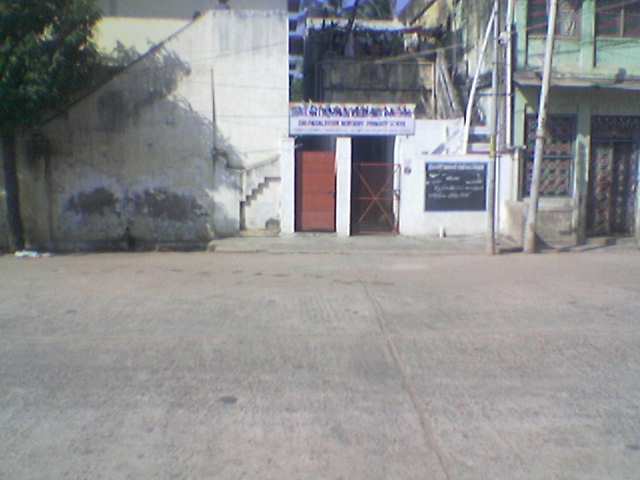
With elections fast approaching politicians concentrate more on pseudo issues.This basically because of the sentiment driven mindset of the people.Tamil Nadu Chief Minister has announced a memorial of Kumbakonam victims at a cost of Rs.60 lakhs.I am not Sagainst the construction of a memorial all together.Politicians fail to take steps that makes a real difference.Till date a large number of schools operate in an insecure condition.
On the left is the picture of a nursery school in Sanathi Street with a too narrow entrance.
If incumbents have concentrated on real issues the state would have been a far better place to live in.
Photo courtesy:Arun Gobu
Clemenceau:another victory for Greenpeace
French ship Clemenceau carrying not less that 700Kg of asbestos,PCBs, lead, mercury, and other toxic chemicals was turned back to France.The decomissioned ship was to be mismantled in a shipbreaking yard in Alang.French government sent it to India despite stiff resistance from Greenpeace and other anti-abestos groups in France.
Greenpeace with its maverick campigning strategy attracted public attention.Trade unions and other environmental action groups like Corporate Accountability Desk,The Other Media and Ban Asbestos India also joined hand.Later the scandal attained media hype and to a greate extend this was a reason behind fair overturn of events.This is just another victory for Greenpeace.With this victory Greenpeace has now started an amibitious campign for regulating the ship breaking industry.The following link takes you to the campign page,
Call upon the international community to accelerate the work of regulating the ship breaking industry
Greenpeace with its maverick campigning strategy attracted public attention.Trade unions and other environmental action groups like Corporate Accountability Desk,The Other Media and Ban Asbestos India also joined hand.Later the scandal attained media hype and to a greate extend this was a reason behind fair overturn of events.This is just another victory for Greenpeace.With this victory Greenpeace has now started an amibitious campign for regulating the ship breaking industry.The following link takes you to the campign page,
Call upon the international community to accelerate the work of regulating the ship breaking industry
Saturday, February 18, 2006
In temple, consumer is god -The Telegraph
In temple, consumer is god
- No bath water, trust fined for deficiency in service
A pilgrim who had to go without a bath after tonsuring his head at an ancient temple in Tamil Nadu has been awarded Rs 500 in damages by a consumer court.
The order is perhaps the first directing a temple devasthanam (trust) to pay compensation for “deficiency in service”.
Selvakumar, an advocate, had visited the famous Shri Devanathaswamy temple at Tiruvendipuram village, 10 km from Cuddalore, with his family on February 7, 2000.
The temple attracts thousands of pilgrims, many of whom come with their children because it also has a shrine to Hayagreeva (Vishnu with the horse’s mouth who saved the Vedas), revered as the Lord of Learning in the Hindu pantheon.
Selvakumar had his head tonsured and paid Rs 5, out of which the barber’s share was Rs 4 while Re 1 went to the devasthanam.
According to a complaint filed at the Cuddalore District Consumer Disputes Redressal Forum, Selvakumar went to take a bath after tonsuring his head but found that the tap in the bathroom near the tonsure centre had run dry.
A nearby hand pump was also not working and Selvakumar could not take a dip in the Gadilam river that courses around the temple because the “water was contaminated with human excreta, drainage water and rubbish”.
Without a bath he could not go for a darshan of the deity, so the pilgrim approached the temple authorities for help.
But the clerk at the “devasthanam office abused me and told me he was not bothered as to whether the complainant was an advocate or a collector” and asked him to do whatever he could, the complaint said full story>>
- No bath water, trust fined for deficiency in service
A pilgrim who had to go without a bath after tonsuring his head at an ancient temple in Tamil Nadu has been awarded Rs 500 in damages by a consumer court.
The order is perhaps the first directing a temple devasthanam (trust) to pay compensation for “deficiency in service”.
Selvakumar, an advocate, had visited the famous Shri Devanathaswamy temple at Tiruvendipuram village, 10 km from Cuddalore, with his family on February 7, 2000.
The temple attracts thousands of pilgrims, many of whom come with their children because it also has a shrine to Hayagreeva (Vishnu with the horse’s mouth who saved the Vedas), revered as the Lord of Learning in the Hindu pantheon.
Selvakumar had his head tonsured and paid Rs 5, out of which the barber’s share was Rs 4 while Re 1 went to the devasthanam.
According to a complaint filed at the Cuddalore District Consumer Disputes Redressal Forum, Selvakumar went to take a bath after tonsuring his head but found that the tap in the bathroom near the tonsure centre had run dry.
A nearby hand pump was also not working and Selvakumar could not take a dip in the Gadilam river that courses around the temple because the “water was contaminated with human excreta, drainage water and rubbish”.
Without a bath he could not go for a darshan of the deity, so the pilgrim approached the temple authorities for help.
But the clerk at the “devasthanam office abused me and told me he was not bothered as to whether the complainant was an advocate or a collector” and asked him to do whatever he could, the complaint said full story>>
Thursday, February 16, 2006
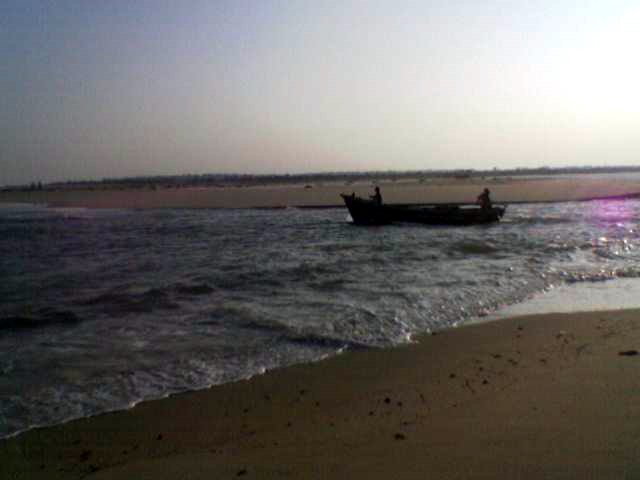
RS.49 crores sanctioned for Cuddalore District
The following link contains a large collection of links which are linked to articles (about Cuddalore) in popular daily's
Rs 49 crore sanctioned for relief to flood-hit farmers
Rs 49 crore sanctioned for relief to flood-hit farmers
Worryingly high school drop out rates in India and Bangladesh-Save the Children
Worryingly high school drop out rates in India and Bangladesh
Children in class at Rasapettai Government primary and middle school, Cuddalore District, Tamil Nadu. The fishing village of Rasapettai did not suffer any fatalities in the Tsunami of 2004 but did lose boats and fishing nets. Save the Children and local partners LEAD (League for Education and Development) have been active in promoting child rights and education in Rasapettai since the Tsunami.
The E-9 meeting of Education Ministers from nine of the world's most populous countries - Bangladesh, Brazil, China, Egypt, India, Indonesia, Mexico, Nigeria and Pakistan - is taking place from 13th-15th February in Monterrey, Mexico.
Save the Children UK is calling on the UK government to commit substantially more resources to improving the quality of primary education in countries where large numbers of children are missing out on education, and to use its international influence to ensure that other donors do the same. This money could go towards improving teacher recruitment and teacher training, and to devoting more resources to reaching those children excluded from education.
More aid to education must go hand in hand with action from country governments to improve the quality of education for children so that they stay in school. Teachers should be trained to move away from rote learning towards interactive teaching methods which give children the skills they need. Furthermore, education must been made more relevant to children's needs, for example by making the curriculum relevant to local work opportunities, and by providing primary education in local languages.
In Bangladesh, statistics (UNDP, 2005) show that:
*80% of primary school age children (6-10 years old) go to school.
*Only 54% are still in school by the time they reach 10 years old.
*Drop out rates from primary school were 33 percent in 2004.
The dropout rate for ethnic minority children in the Chittagong Hill Tracts, an area with a large proportion of ethnic minority people, is much higher than the estimated national rate with more than 60 percent of children dropping out especially in the early years (Asian Development Bank, 2001).
In Bangladesh, among those children who are not enrolled and those who have dropped out, a significant number come from poor households and live in rural areas, urban slums, and areas with high populations of ethnic minorities. The reasons for the lack of quality in education services include lack of well-trained teachers, particularly in remote areas where the poorest and most marginalised children live. On average there are 66 students for every teacher in government primary schools (UNDP, 2005).
Ethnic minority children are often turned away from school by teachers and administrators because they do not speak fluent Bangla (Save the Children's 2005 situation analysis on basic education in Bangladesh).
In India, statistics (UNESCO 2006) show that:
*The net enrolment rate rose to 88% in 2002
*Only 61% are still in school by the time they reach age 10
*Drop out rate is 39%.
*There are vast differences within states and between social groups,
with very low rates of enrolment reported for socially disadvantaged groups such as scheduled castes and scheduled tribes. 50% of scheduled caste and 56% of scheduled tribe children drop out of school.
In India, a recent report showed that 44% of children between the ages of 7 and 10 could not read even a simple paragraph. Teaching is still done by traditional rote learning methods, corporal punishment is rife, and children are often taught in a language they do not understand (Annual Status of Education, 2006).
Copyright:International Save the Children Alliance
Children in class at Rasapettai Government primary and middle school, Cuddalore District, Tamil Nadu. The fishing village of Rasapettai did not suffer any fatalities in the Tsunami of 2004 but did lose boats and fishing nets. Save the Children and local partners LEAD (League for Education and Development) have been active in promoting child rights and education in Rasapettai since the Tsunami.
The E-9 meeting of Education Ministers from nine of the world's most populous countries - Bangladesh, Brazil, China, Egypt, India, Indonesia, Mexico, Nigeria and Pakistan - is taking place from 13th-15th February in Monterrey, Mexico.
Save the Children UK is calling on the UK government to commit substantially more resources to improving the quality of primary education in countries where large numbers of children are missing out on education, and to use its international influence to ensure that other donors do the same. This money could go towards improving teacher recruitment and teacher training, and to devoting more resources to reaching those children excluded from education.
More aid to education must go hand in hand with action from country governments to improve the quality of education for children so that they stay in school. Teachers should be trained to move away from rote learning towards interactive teaching methods which give children the skills they need. Furthermore, education must been made more relevant to children's needs, for example by making the curriculum relevant to local work opportunities, and by providing primary education in local languages.
In Bangladesh, statistics (UNDP, 2005) show that:
*80% of primary school age children (6-10 years old) go to school.
*Only 54% are still in school by the time they reach 10 years old.
*Drop out rates from primary school were 33 percent in 2004.
The dropout rate for ethnic minority children in the Chittagong Hill Tracts, an area with a large proportion of ethnic minority people, is much higher than the estimated national rate with more than 60 percent of children dropping out especially in the early years (Asian Development Bank, 2001).
In Bangladesh, among those children who are not enrolled and those who have dropped out, a significant number come from poor households and live in rural areas, urban slums, and areas with high populations of ethnic minorities. The reasons for the lack of quality in education services include lack of well-trained teachers, particularly in remote areas where the poorest and most marginalised children live. On average there are 66 students for every teacher in government primary schools (UNDP, 2005).
Ethnic minority children are often turned away from school by teachers and administrators because they do not speak fluent Bangla (Save the Children's 2005 situation analysis on basic education in Bangladesh).
In India, statistics (UNESCO 2006) show that:
*The net enrolment rate rose to 88% in 2002
*Only 61% are still in school by the time they reach age 10
*Drop out rate is 39%.
*There are vast differences within states and between social groups,
with very low rates of enrolment reported for socially disadvantaged groups such as scheduled castes and scheduled tribes. 50% of scheduled caste and 56% of scheduled tribe children drop out of school.
In India, a recent report showed that 44% of children between the ages of 7 and 10 could not read even a simple paragraph. Teaching is still done by traditional rote learning methods, corporal punishment is rife, and children are often taught in a language they do not understand (Annual Status of Education, 2006).
Copyright:International Save the Children Alliance
Sunday, February 12, 2006
Bristle worms' life throws light on seawater pollution
Bristle worms' life throws light on seawater pollution
Is there a connection between the quality of seawater and the breeding behaviour of polychaetes or bristle worms that inhabit the ocean?
Very much so, says a researcher, who has looked at these creatures with a different eye to find clues to detect polluted water.
After nearly two decades of research, P. Vivek Raja, head of the department of zoology, Presidency College, has established that the reproductive ability of polychaetes is severely compromised when their habitat is polluted. By correlating the reproductive biology of these creatures with the quality of their habitat, Mr. Raja was able to determine the extent of pollution in the water full story>>
Is there a connection between the quality of seawater and the breeding behaviour of polychaetes or bristle worms that inhabit the ocean?
Very much so, says a researcher, who has looked at these creatures with a different eye to find clues to detect polluted water.
After nearly two decades of research, P. Vivek Raja, head of the department of zoology, Presidency College, has established that the reproductive ability of polychaetes is severely compromised when their habitat is polluted. By correlating the reproductive biology of these creatures with the quality of their habitat, Mr. Raja was able to determine the extent of pollution in the water full story>>
Saturday, February 11, 2006
Chinese Petro offered 26% in Nagarjuna Oil-DNA India
Chinese Petro offered 26% in Nagarjuna Oil
Nagarjuna Oil Corporation, which is implementing the Rs 4,500 crore refinery project at Cuddalore near Chennai, is close to financial closure and will have more than one joint venture equity partner.
Nagarjuna Oil Corporation, which is implementing the Rs 4,500 crore refinery project at Cuddalore near Chennai, is close to financial closure and will have more than one joint venture equity partner.
“While Chinese Petroleum Corporation is one of the options we are also talking to a few other prospective equity partners,” K S Raju, vice chairman and managing director of parent company Nagarjuna Fertiliser Corporation Ltd, (NFCL) told DNA Money.
The Taiwanese company had said in Taipei earlier on Monday it may invest in Nagarjuna Oil Company which had offered it 26% equity in the 6 mtpa capacity project.
“We have not yet finalised the deal with Chinese Petroleum,” Raju said.
Being implemented at a 2:1 debt-equity ratio the project will have a majority holding by the promoter group while the remaining 49% is likely to be split among several joint venture partners. However, Raju did not name the others in the reckoning pending finalisation of the deal. “But we are very close to financial closure and we would be on stream within 3-4 years from now,” he said.
COPYRIGHT © 2006 DILIGENT MEDIA CORPORATION LTDOfficials visit from tsunami-hit regions-OrlandoSentinel
Officials visit from tsunami-hit regions
-Ludmilla Lelis
On Dec. 26, 2004, the day the tsunami struck in the Indian Ocean, he first had to save himself and his family from the massive wave that quickly engulfed his hotel at a seaside resort in India.
As the waters from the Bay of Bengal rose to his shoulders, Gagandeep Singh Bedi ran for higher ground, clutching his young daughter in his arms.
"The force of the tsunami was broken by the hotel. Had it not been for that, I could have been lost to the sea," he said Wednesday.
Then Bedi had to help save his community. As the "collector," the most powerful government official in his coastal district, Bedi rushed back to work to mobilize the police, the medical teams and other government workers for the biggest disaster the Cuddalore district had ever seen.
This week, Bedi visited Port Orange as part of a delegation of Indian government officials hoping to learn from their American counterparts how to prepare for a future calamity and rebuild their homeland.
Two Indian groups are touring Central Florida through the CityLinks program funded by the U.S. Agency for International Development and organized through the International City/County Management Association.
To help Indian cities rebuild from the tsunami's devastation, the program sets up an exchange between government officials at the local levels to share ideas and information.
A Florida delegation in July visited the Cuddalore and Nagapattinam districts, both in the state of Tamil Nadu, and the Indian delegations are visiting Port Orange and Palm Bay this week.
"It's a technical and intellectual exchange of information and ideas," explained Donna Steinebach, assistant to the city manager in Port Orange, who traveled to Cuddalore last year. "It's been very encouraging to see the level of commitment of the officials involved in the exchange. They are so eager to find ways to help their community," she said.
The Cuddalore district, with 2.3 million people, was hit hard by the tsunami: 638 people dead; 29,000 people displaced; dozens of children orphaned; 500 boats damaged in a district where thousands of families depend on fishing.
For officials like Ambuj Sharma, the commissioner of municipal administration in Tamil Nadu, the first week involved 20-hour workdays handling the dead bodies and coordinating relief for the living.
But with the massive outpouring of international aid, the tsunami-ravaged regions are rebuilding. Construction of new, concrete homes is well under way, this time farther inland.
During the Florida trip, the delegation has toured various municipal operations in Port Orange. They visited the emergency-management center, where they learned about advance planning for emergencies and evacuation routes.
They toured stormwater sites, learning how the canals and retention ponds help to mitigate flooding. They toured the city water plant, learning about water-and-sewer operations. And they visited parks and discussed financial management and economic development.
Sharma said he was impressed with a presentation about community emergency-response teams and said he'd like to start a similar program of volunteers ready to respond to disasters.
"We would like to adopt this program to involve the community in taking care of themselves in an emergency because in the initial stages, it will take time for government to respond, especially to some of the remote villages," Sharma said.
They've also had a chance to enjoy the scenery and were impressed by the local parks and the aesthetic beauty of several Florida neighborhoods.
All of it gave them dozens of great ideas that they plan to take home. "We want to not only return to a state of normalcy, but also build our cities better," Bedi said.
Ludmilla Lelis can be reachedat llelis@orlandosentinel.com or 386-253-0964.
Copyright © 2006, Orlando Sentinel
-Ludmilla Lelis
On Dec. 26, 2004, the day the tsunami struck in the Indian Ocean, he first had to save himself and his family from the massive wave that quickly engulfed his hotel at a seaside resort in India.
As the waters from the Bay of Bengal rose to his shoulders, Gagandeep Singh Bedi ran for higher ground, clutching his young daughter in his arms.
"The force of the tsunami was broken by the hotel. Had it not been for that, I could have been lost to the sea," he said Wednesday.
Then Bedi had to help save his community. As the "collector," the most powerful government official in his coastal district, Bedi rushed back to work to mobilize the police, the medical teams and other government workers for the biggest disaster the Cuddalore district had ever seen.
This week, Bedi visited Port Orange as part of a delegation of Indian government officials hoping to learn from their American counterparts how to prepare for a future calamity and rebuild their homeland.
Two Indian groups are touring Central Florida through the CityLinks program funded by the U.S. Agency for International Development and organized through the International City/County Management Association.
To help Indian cities rebuild from the tsunami's devastation, the program sets up an exchange between government officials at the local levels to share ideas and information.
A Florida delegation in July visited the Cuddalore and Nagapattinam districts, both in the state of Tamil Nadu, and the Indian delegations are visiting Port Orange and Palm Bay this week.
"It's a technical and intellectual exchange of information and ideas," explained Donna Steinebach, assistant to the city manager in Port Orange, who traveled to Cuddalore last year. "It's been very encouraging to see the level of commitment of the officials involved in the exchange. They are so eager to find ways to help their community," she said.
The Cuddalore district, with 2.3 million people, was hit hard by the tsunami: 638 people dead; 29,000 people displaced; dozens of children orphaned; 500 boats damaged in a district where thousands of families depend on fishing.
For officials like Ambuj Sharma, the commissioner of municipal administration in Tamil Nadu, the first week involved 20-hour workdays handling the dead bodies and coordinating relief for the living.
But with the massive outpouring of international aid, the tsunami-ravaged regions are rebuilding. Construction of new, concrete homes is well under way, this time farther inland.
During the Florida trip, the delegation has toured various municipal operations in Port Orange. They visited the emergency-management center, where they learned about advance planning for emergencies and evacuation routes.
They toured stormwater sites, learning how the canals and retention ponds help to mitigate flooding. They toured the city water plant, learning about water-and-sewer operations. And they visited parks and discussed financial management and economic development.
Sharma said he was impressed with a presentation about community emergency-response teams and said he'd like to start a similar program of volunteers ready to respond to disasters.
"We would like to adopt this program to involve the community in taking care of themselves in an emergency because in the initial stages, it will take time for government to respond, especially to some of the remote villages," Sharma said.
They've also had a chance to enjoy the scenery and were impressed by the local parks and the aesthetic beauty of several Florida neighborhoods.
All of it gave them dozens of great ideas that they plan to take home. "We want to not only return to a state of normalcy, but also build our cities better," Bedi said.
Ludmilla Lelis can be reachedat llelis@orlandosentinel.com or 386-253-0964.
Copyright © 2006, Orlando Sentinel
Solar power empowers fisher women--CNN-IBN
Solar power empowers fisher women
In Chennai's fishermen's colonies, a solar-powered fish drier has brought in a revolution driving more and more women into scientific food processing and providing many a means for livelihood.
In Chennai's fishermen's colonies, a solar-powered fish drier has brought in a revolution driving more and more women into scientific food processing and providing many a means for livelihood.
It was a project that started in tsunami-hit Cuddalore and now Chennai city has its own Solar fish drier.
Karuvadu or dried fish is a delicacy that 70-year-old Thangapapa has been making all her life.
She buys fish and puts them on the sands to dry them out. It takes a full sunny day, sometimes two, for the fish to dry out.
And it's unhygienic. But now all that's changed with the arrival of a new solar fish drier.
"If we put it for drying outside, then we will have to have five people guarding the fish. Crows and dogs will eat the fish. Now, we just have to put it in the drier and in four hours it's done. It's cleaner and more hygienic," says Thangappa.
She says with the solar drier she can make double the amount of Karuvadu in the same time. She just has to put fish in these trays and put it in the drier powered by solar energy. She's now part of a Self-Help Group and they got the drier, which costs RS 2.5 lakh, with the help of an NGO. And it's attracted more women in this fishing colony to join Thangapapa.
Says Janani, another fisherwoman, "I was unemployed earlier. Now with this machine, I have also started helping out. This means a source of income for me and we now want to put this fish in packets and sell them."
The project was first set up in the tsunami-hit Cuddalore district, where it has been implemented successfully. And now the company which makes the drier and some NGOs are planning to install more such machines in the city's fishing colonies.
Sunday, February 05, 2006
Tackling global warming
According to the World Meteorological Organisation, 2005 missed becoming the warmest year on record by the merest fraction of a degree Celsius. The past decade, 1996-2005, is the warmest on record (if 1996 is taken out of the calculation). The earth's surface has warmed by about 0.6 degrees C since the late 1800s, and the temperature is expected to increase by another 1.4 degrees to 5.8 degrees C by 2100. The culprit is `greenhouse gases,' notably carbon dioxide, methane, and nitrous oxide. These are accumulating to unprecedented levels in the atmosphere as a result of profligate burning of fossil fuels, industrial processes, farming activities, and changing land use. The greenhouse gases act like a blanket around the Earth, trapping too much of the heat that would otherwise have escaped into space. If the Earth warmed further by more than one degree C, it would be warmer than it has been in a million years. James Hansen, a doyen of the science of climate change, recently warned that if carbon dioxide emissions from fossil fuels continue rising at about two per cent a year (as in the past decade), the additional warming would be two to three degrees C this century, implying changes that would mean practically a different planet. Global warming is likely to trigger disastrous changes in rainfall and snowfall patterns. full story>>
Copyright © 2006, The Hindu.
Copyright © 2006, The Hindu.
The Railway Overbridge built at S.N.Chavadi is not utilised by the larger section of population till date.Some prefer to wait for few minutes (when train passes) rather than taking an alternative route which atleast a couple of kilometers to their journey. Many are not aware of train timings, also if one know of the timings ,trains in India seldom keep up the time.
One possible solution I see is to blow siren(or any other suitable type of signal) to indicate that the Raliway Gate is being closed so that people take the alternative route.
These sirens can be placed at
*Lawrence Road-Imperial Road junction
*Subrayachetty street-Lawrence Road junction
*One at Imperial Road and Vandipalayam Road where the connecting bridge road intersects the above roads.
One possible solution I see is to blow siren(or any other suitable type of signal) to indicate that the Raliway Gate is being closed so that people take the alternative route.
These sirens can be placed at
*Lawrence Road-Imperial Road junction
*Subrayachetty street-Lawrence Road junction
*One at Imperial Road and Vandipalayam Road where the connecting bridge road intersects the above roads.
New bridge in record time
Construction of the new bridge connecting Kammianpet and Semandalam was completed in a record time of just nine months.The bridge construction was completed at the cost of two crores and was funded by the Central Government.The bridge was opened to traffic on 14th of January 2006.Though it awaits a formal innaguration a large number of people make use of it especially during the peak hours.School going children and commuters use it to a greater extend.Apart from providing greater connectivity it is believed to bring greater economic prosperity to Semandalam and Kammianpet area.
People were demanding for it for decades.Their dream came true atlast.Once again the person to be thanked is Mr.GanadeepSingh Bedi,without whom the project would not have been completed.He is the administrator who will never be forgotten by the people of Cuddalore.People wish him to stay here for a long long time and severe them and work for the developement of Cuddalore.
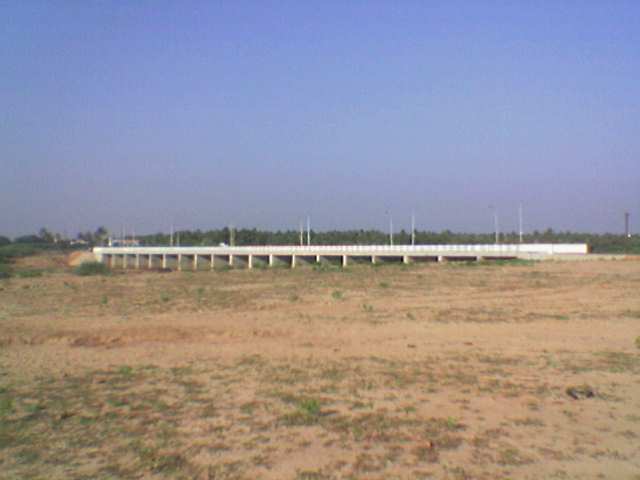
People were demanding for it for decades.Their dream came true atlast.Once again the person to be thanked is Mr.GanadeepSingh Bedi,without whom the project would not have been completed.He is the administrator who will never be forgotten by the people of Cuddalore.People wish him to stay here for a long long time and severe them and work for the developement of Cuddalore.
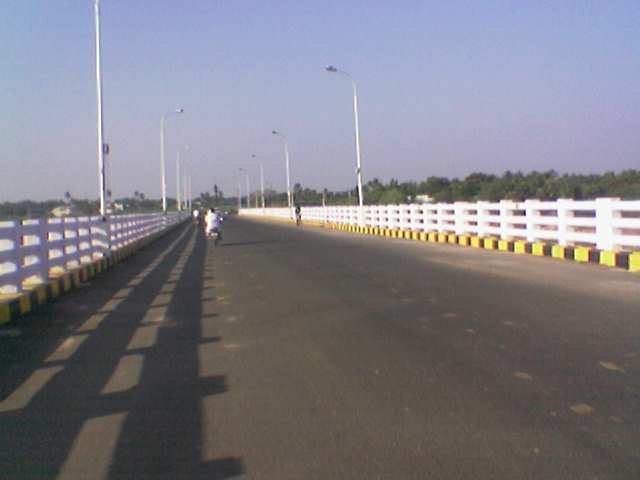
Wednesday, February 01, 2006
Need for a permanent helipad

When political leaders arrive here in helicopters a makeshift helipad is built inside the stadium.This greatly interrupts the routine of the practising players and others who take a talk.
Apart from this the helipad destroys the play field.This time when Ms.Jayalalitha planned to visit Cuddalore during the recent floods a helipad was prepared in footbal l ground,also a new road was laid overnight connecting the foot ball ground to Collector's Office Road thus damaging the joggers footpath.The circumference wall of the stadium near the HomeGuard Office was also broken in the process.None of them where set right till date.
It is necessary to find a solution to this problem by building a permanent helipad.Since Manjakuppam Maidan is an ideal site for public gatherings sure the helipad must be built somewhere near here.There are two potential sites.
- One southwest corner of the maidan sharing border with the Cuddalore Municipal Park and an abandened open theatre.A problem with this site is that when a political arrives for addressing a large crowd he need to traverse the entire section of the crowd to reach the dias which is on the east end.This puts constraints on security.
- Another ideal site which I believe is the southeast corner of the maidan.This section of the ground is not actively used for any reason.So it can be very well utilised.Another advantage of this site is that the leader can directly be moved to the dias for great ease and high security.(A road can be laid connecting the Collector's Office Road with South Esplanade Road(Beach Road) along the (west)circumference wall of the stadium as shown in the fig.This would ease the vehicle movement of political leaders who generally come from Chennai and move down southwards though Chidambaran.(i.e.,)they can first come along the Collectors Office Road,then they can reach the dias along the new road and after addressing they may reach Barathi Road through Beach Road.)If it becomes necessary large a few trees along the Beach Road and which are much closer to this site can be cut down.

If implemented it will be a great relief for the players and police personnel(since its makes the security arragments much easier) alike.
Subscribe to:
Posts (Atom)