Clinton to visit to tsunami-affected countries - The Hindu
...Clinton's office said on Monday, he will first travel to Cuddalore on December one to see a new housing complex constructed for fishermen whose homes were destroyed by the tsunami and a rehabilitated school. He will also visit a cyclone shelter with a newly installed early warning system and witness an early warning test and mock drill more>>
Clinton to visit India in December - NDTV
Clinton to visit tsunami affected areas in December - Zee News
Clinton to make final visit to tsunami-affected countries as U.N. envoy - International Herald Tribune
Clinton to make final visit to tsunami-affected countries as UN envoy - Garavi Gujarat
Wednesday, November 29, 2006


Tuesday, November 28, 2006
Cycle Rally
For the past several days I have been updating the blog on issues related to industrial pollution in SIPCOT Cuddalore. A cycle rally is to start from Cuddalore today to commemorate the Bhopal tragedy. The rally will be ending in Chennai on December 2nd. There are various events planned on the way, including the film screening. Extend your support by ensuring your presence. The details of route and schedule can be found in Remember Bhopal;Fight for Cuddalore article.
Cycling for Green
Leading up to the 22nd Bhopal anniversary, touth from fishing communities and colleges of Chennai, along with environmental activists and residents from pollution-impacted communities in Mettur and Cuddalore, will cycle 280km from Cuddalore to Chennai starting 28 November, 2006. Jessie Bhangoo presents an audio introduction to the roadshow. Click here to listen.
Toxic Truck Spotted in Cuddalore-SACEM
27 November, 2006. Cuddalore -- A truck carrying a hazardous chemical powder was found parked for more than 30 minutes without driver or cleaner near Sellankuppam at 11 a.m. today. SACEM member G.K. Amrithalingam who reported the incident said shopkeepers and commuters experienced severe irritation of the throat due to the fine white powder that was being released as dust from the truck. Upon their return, the driver and cleaner were asked to take the vehicle out. The vehicle (License No. TN31H 1687) was carrying cargo loaded at TANFAC Ltd in SIPCOT, and was destined to Andhra Pradesh.
The vehicle made another tense 15 minute stop near the railway overbridge at Chavadi, before proceeding towards SIPCOT. Monitors in SIPCOT area have been alerted and asked to keep an eye out for the vehicle.
The driver was unaware about the nature of the cargo. That in itself and the insecure manner in which the cargo was being carried is a violation of the Hazardous Chemicals Rules, and the guidelines for transporting hazardous chemicals. SACEM has alerted the Assistant Environmental Engineer about the incident.
Monday, November 27, 2006
Local Government Resolves Against Chemplast PVC factory
By Nityanand Jayaraman
Cuddalore, 26 November, 2006 -- Thyagavelli Panchayat, in which the marine terminal facility for Chemplast Sanmar's PVC factory is to be set up, resolved on 14.11.2006 against the Chemplast PVC factory. In doing so, they have dealt a major blow to the company's plans. Before undertaking any construction, project promoters are required to secure the consent of Grama Panchayats, according to the Tamilnadu Panchayat Rules. Fishing villages, particularly Chitrapettai through which a pipeline carrying hazardous raw material will pass, are upset that the Tamilnadu Government permitted the company to set up a plant and jetty that would affect fisheries without consulting the fisherfolk. The company separated the PVC plant and the marine terminal facility proposals. While a public hearing was held for the PVC facility, the company bypassed local communities and secured an environmental clearance for the marine terminal facility directly from the Union Ministry of Environment & Forests.
Fishing communities in Cuddalore have resolved to defeat the company's plans for a PVC plant in Cuddalore. Fishing villages in Pondicherry, Kanchipuram and Chennai have also extended their support to the fisherfolk from Cuddalore.
http://www.sipcotcuddalore.com/
Cuddalore, 26 November, 2006 -- Thyagavelli Panchayat, in which the marine terminal facility for Chemplast Sanmar's PVC factory is to be set up, resolved on 14.11.2006 against the Chemplast PVC factory. In doing so, they have dealt a major blow to the company's plans. Before undertaking any construction, project promoters are required to secure the consent of Grama Panchayats, according to the Tamilnadu Panchayat Rules. Fishing villages, particularly Chitrapettai through which a pipeline carrying hazardous raw material will pass, are upset that the Tamilnadu Government permitted the company to set up a plant and jetty that would affect fisheries without consulting the fisherfolk. The company separated the PVC plant and the marine terminal facility proposals. While a public hearing was held for the PVC facility, the company bypassed local communities and secured an environmental clearance for the marine terminal facility directly from the Union Ministry of Environment & Forests.
Fishing communities in Cuddalore have resolved to defeat the company's plans for a PVC plant in Cuddalore. Fishing villages in Pondicherry, Kanchipuram and Chennai have also extended their support to the fisherfolk from Cuddalore.
http://www.sipcotcuddalore.com/
Sunday, November 26, 2006
Folk Song on Cuddalore Pollution (Tamil)
 by Nityanand Jayaraman
"Gana Vijay's Villu Paattu -- a folk music form from Tamilnadu literally translated as "bow song" -- evokes the beauty and bounty of Cuddalore, and quickly switches to explain the current where the once-productive River Uppanar has no fish, the goats are dying and the chicken are sick -- all because of pollution. This is a sample from Gana Vijay's diverse portfolio."
Gana Vijay heating his "Parai" over a gas
stove. Parai is a percussion instrument made
using raw buffalo hide drawn taut over a ring.
stove. Parai is a percussion instrument made
using raw buffalo hide drawn taut over a ring.
If you're interested in learning more about Villu Paattu, visit: http://www.webindia123.com/tamilnadu/art/folkmusic%201.htm
Thursday, November 23, 2006
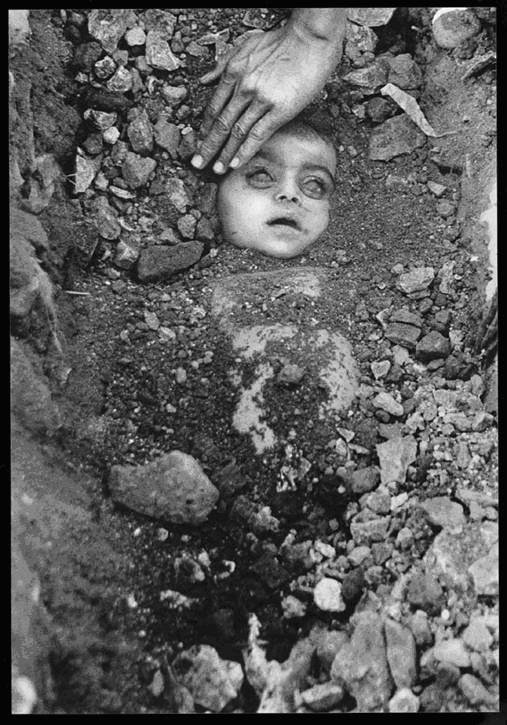
Remember Bhopal;
Fight for Cuddalore
Youth on Cycles for Cuddalore – 28 November to 2 December
Route and Schedule
28 November: Flag Off from Cuddalore Town. (Route: Old Town, Pachaiyankuppam, Thaikal, CUSECS 6, Rajapettai, Chitrapettai, Naduthittu, Thyagavelli, Thiruchopuram, Periyakuppam, Tamanampettai, Ayyampettai, Poochimedu, Periyapattu, Cuddalore Town). Film screening: Chitrapettai, Thyagavelli, Periyapattu. Night Halt: Periyapattu
29 November: Periyapattu to Sonnanchavadi, Semmankuppam, Sangolikuppam, Eachangadu, Kudikadu, Devanampattinam, Thazhanguda, Pondicherry. Film screening/Night Halt: Pondicherry
30 November: Pondy to Marakkanam, Tindivanam. Film screening/Night halt: Tindivanam
1 December: Tindivanam to Madurantakam, Chengalpattu. Film screening/Night halt: Chengalpattu
2 December: Chengalpattu to Kovalam, Besant Nagar. Film screening: Besant Nagar
Background: December 3 is the 22nd anniversary of the 1984 Union Carbide disaster in Bhopal. In the lead-up to the anniversary of the world’s worst industrial disaster, the International Campaign for Justice in Bhopal (Chennai) and its supporters wish to highlight Cuddalore as a Bhopal in our own backyard.
- Chemplast PVC factory and marine terminal, and desalination plant, Semmankuppam and Chitrapettai
- 4000MW coal-fired thermal power plant, Naduthittu
- A mega textile park, Periyapattu
- A 6 million tones per annum petrochemical refinery by Nagarjuna, Thyagavelli
- Effluents pumped into sea from Tiruppur textile dyeing units
- Effluents pumped into sea from Ambur-Vaniyambadi leather tanneries
- A shipbuilding yard
For more information on Bhopal and Cuddalore
Email - nopvcever@gmail.com
www.sipcotcuddalore.com
http://cuddaloreonline.blogspot.com
Issued by:
SIPCOT Area Community Environmental Monitoring, Cuddalore District Consumer Protection Organisation, DEPORT, Youth for Social Change, The Other Media
c/o 42A, 1st Floor, 5th Avenue, Besant Nagar, Chennai 600 090
Massive explosion in Loyal Super Fabrics; - SACEM
Locals block road; demand closure of the company
Cuddalore, 22 November 2006: A massive explosion at Loyal Super Fabrics rocked the SIPCOT Industrial estate at around 12 noon today. The explosion took place at a newly set-up oil boiler of the unit and was followed by a fire that ravaged sections of the unit. According to SACEM, whose monitors arrived on the scene immediately, the fire was difficult to control. It took 8 fire fighting vehicles more than 2 hours to bring the fire under control. Officials of the TNPCB were present at the spot, but no representative from the Factories Inspectorate visited the site.
Residents of Kudikadu village, the community worst affected by Loyal, and representatives of Pattali Makkal Katchi, a political party, blocked the road outside the unit in the afternoon demanding immediate closure of the unit.
A September 2006 public hearing report observed that local youth and residents were very agitated about the pollution caused by the factory, and the inability of the TNPCB to rein in the pollution. Like many other factories in Tamilnadu, Loyal too has no valid Consent to operate. Loyal’s consent expired in 1998, and has not been renewed since.
Pursuant to community pressure, Loyal came under the TNPCB’s scanner and was shut down in the month of July for not following the Consent conditions. The unit was eventually reopened conditionally for two months in August 2006 and the later its operations were extended till 10 December 2006.
Numerous reports of pollution from this unit and other factories in SIPCOT have been systematically ignored by the government. Rather than curb pollution, the Government is approving more and more polluting factories to come up in residential and agricultural areas in Cuddalore.
The Loyal explosion comes at an ominous time, less than 10 days before the 22nd anniversary of the Union Carbide gas disaster in Bhopal.

Read earlier reports here:
Loyal Super Fabrics operations extended for two months
http://www.sipcotcuddalore.com/updates_111006.html
www.sipcotcuddalore.com/updates_240706.html
Locals block road; demand closure of the company
Cuddalore, 22 November 2006: A massive explosion at Loyal Super Fabrics rocked the SIPCOT Industrial estate at around 12 noon today. The explosion took place at a newly set-up oil boiler of the unit and was followed by a fire that ravaged sections of the unit. According to SACEM, whose monitors arrived on the scene immediately, the fire was difficult to control. It took 8 fire fighting vehicles more than 2 hours to bring the fire under control. Officials of the TNPCB were present at the spot, but no representative from the Factories Inspectorate visited the site.
Residents of Kudikadu village, the community worst affected by Loyal, and representatives of Pattali Makkal Katchi, a political party, blocked the road outside the unit in the afternoon demanding immediate closure of the unit.
A September 2006 public hearing report observed that local youth and residents were very agitated about the pollution caused by the factory, and the inability of the TNPCB to rein in the pollution. Like many other factories in Tamilnadu, Loyal too has no valid Consent to operate. Loyal’s consent expired in 1998, and has not been renewed since.
Pursuant to community pressure, Loyal came under the TNPCB’s scanner and was shut down in the month of July for not following the Consent conditions. The unit was eventually reopened conditionally for two months in August 2006 and the later its operations were extended till 10 December 2006.
Numerous reports of pollution from this unit and other factories in SIPCOT have been systematically ignored by the government. Rather than curb pollution, the Government is approving more and more polluting factories to come up in residential and agricultural areas in Cuddalore.
The Loyal explosion comes at an ominous time, less than 10 days before the 22nd anniversary of the Union Carbide gas disaster in Bhopal.

Read earlier reports here:
Loyal Super Fabrics operations extended for two months
http://www.sipcotcuddalore.com/updates_111006.html
www.sipcotcuddalore.com/updates_240706.html
Wednesday, November 22, 2006
Death of a Community Foretold
"Death of a Community Foretold" is a story about a pocket of Cuddalore's coastal countryside, where the residents live in the shadows of chemical industries. The SIPCOT chemical industrial estate is the smelly armpit of industrial civilization. This is a story of a frustrated community struggling to get the Government to save them from the industrial pollution. The Government has other plans. Cuddalore has been earmarked to accommodate the most polluting industries, including a PVC plastic factory. All that the community wants is a clean environment and healthy children. But that, we're told, is economically unviable.
Duration:20:23
Language:Tamil
Subtitle:English
The video content is divided into 3 parts.
For smooth viewing, start the video and pause it immediately to let it render, and playback after sometime.
Part 1
Part 2
Part 3
Following are the direct links to the videos
Part 1:
http://www.youtube.com/watch?v=sQC2Q6W9vjQ
Part 2:
http://www.youtube.com/watch?v=-2TjFKub1ME
Part 3:
http://www.youtube.com/watch?v=yB3ArqudFxM
The script for embedding these videos into blog/website can the found to the right of the corresponding videos.
If you're concerned and want to help:
Contact: nopvcever@gmail.com
Visit: www.sipcotcuddalore.com
Tel: +91 9444082401
Duration:20:23
Language:Tamil
Subtitle:English
The video content is divided into 3 parts.
For smooth viewing, start the video and pause it immediately to let it render, and playback after sometime.
Part 1
Part 2
Part 3
Following are the direct links to the videos
Part 1:
http://www.youtube.com/watch?v=sQC2Q6W9vjQ
Part 2:
http://www.youtube.com/watch?v=-2TjFKub1ME
Part 3:
http://www.youtube.com/watch?v=yB3ArqudFxM
The script for embedding these videos into blog/website can the found to the right of the corresponding videos.
If you're concerned and want to help:
Contact: nopvcever@gmail.com
Visit: www.sipcotcuddalore.com
Tel: +91 9444082401
Friday, November 10, 2006
Cuddalore – Toxic Present; Troubled Future
By Nityanand Jayaraman
Cuddalore, the place by the sea, is soon set to be assaulted. Some of the dirtiest industries – chemical factories, petrochemical refineries, shipbuilding yard, textile dyeing units, and coal-fired power plants – are making a beeline for Cuddalore. The Tamilnadu Government has earmarked Cuddalore district for locating polluting industries. Their argument: Cuddalore is already polluted. So let's concentrate all polluting industries in this district, thereby saving the rest of Tamilnadu from pollution.
Fact aside, that only one part of Cuddalore – the SIPCOT Industrial Estate in Pachaiyankuppam, Kudikadu and Semmankuppam panchayats – is polluted. The rest of Cuddalore is home to white-sand beaches, dense mangroves, lazy rivers, cashew groves and casuarinas.
I have heard about this decision to sacrifice Cuddalore repeated often. At least two chairpersons of the Tamilnadu Pollution Control Board have admitted over the last 8 years that Cuddalore's fate is sealed. . .that a decision to sacrifice Cuddalore has been taken at the highest levels.
 Indiscriminate dumping of toxic wastes has spoilt agricultural fields and groundwater.
The kind of industrialization that is planned for Cuddalore will mean the death of Cuddalore as we know it. Pollution-intensive industrialization has its beneficiaries in far-away places. The local people and the local economy will take a punishing beating.
On the one hand, people dependent on water and land for a livelihood – fishers and farmers – will lose their source of income. On the other, the ill-health caused by a poisoned environment will mean fewer work days, and higher medical expense
There are industries, and there are industries. Industries that destroy local resources, poison the air, water and land will eventually impoverish the local people rather than lend to their prosperity.
How do I know? Because we have experience of this kind of chemical-intensive industrialization in Cuddalore, and we know that it has made local people poorer.
All you have to do is check out the 8 km stretch south of Pachaiyankuppam on the Cuddalore-Chidambaram Highway. The SIPCOT industrial estate located here has been judged by many as ranking among the smelliest places in India. About 19 chemical industries, manufacturing pesticides, pharmaceuticals, dye chemicals, explosives, gelatin and sundry chemicals, spew out noxious air emissions and liquid effluents.
 Contaminated groundwater does not spare even the utensils it is stored in.
Just as Eskimos have a thousand words to describe the snow, SIPCOT residents have numerous descriptions for the various smells that assault their senses day-long. SPIC smells of shit; Tagros smells like a hospital; Shasun smells like rotten cabbage, rotten eggs; Pioneer Miyagi smells like a decomposing corpse; Asian Paints smells like sapota fruit. Then there are other smells – nail polish, rotten egg, fruity odours. In all, the SIPCOT Area Community Environmental Monitors (SACEM) – a team of five villagers trained in environmental monitoring – have identified at least 36 odours emanating from the SIPCOT industries.
Surely, progress can't be this smelly. These smells are not merely a nuisance; anybody that tells you that is lying. Odours are indicators of pollution, of chemicals in the air. Hydrogen sulphide, a deadly gas, has a characteristic rotten egg odour. The nail polish odour indicates the presence of acetone. Rotten cabbage is the smell of your cooking gas resulting from the chemical methyl mercaptan. The shit smell means the presence of a category of chemicals called Indoles.
Indeed, when samples of the ambient air in SIPCOT was sent to the United States for analysis by SACEM, at least 25 chemicals were discovered. Eight of them are known to cause cancer. These include – chloroform, methylene chloride, trichloroethylene, 1,2-dichloroethane, carbon tetrachloride, vinyl chloride, bromomethane and benzene.
1,2-dichloroethane was more than safe levels by a factor of 22,973; chloroform was above safe levels by a factor of 5119.
 At least 13 of the chemicals found are used as raw material in one or more industries. In other words, toxic chemicals are constantly spilling out of the factories through chimneys and various other leaks and contaminating the air breathed by more than 20,000 people.
The effects are there for all to see. Children in the SIPCOT villages can be seen with rheumy eyes, running noses and rashes on the skin. The eye and nose disorders are indicative of upper respiratory tract problems – a likely sign of air pollution. Anecdotal evidence gathered during the visit of Justice J. Kanakaraj and team as part of the Indian People's Tribunal revealed shocking information. Women in SIPCOT were reporting menstrual irregularities, delayed onset of puberty among girls, compromised physical development among boys, widespread dental and skin problems.
These long-term effects pale in front of the acute effects people experience when the air pollution gets intense. "We can't breathe; it feels like somebody is sitting on your chest. Whatever is in the air burns your eyes, tears through your nose and sets your lungs on fire. At least we can hold a cloth to our nose; imagine the fate of infants," said one irate mother from Eachangadu, a village surrounded on three sides by smelly factories.
Several 100 acres of fertile farm land have been abandoned because ground water in the entire SIPCOT area is contaminated, and the lands are awash with effluents and toxic waste. The River Uppanar, once the lifeline for more than 8 villages of inland fisherfolk, is now a faint shadow of its original productive self. Ask any fisherman and he will rattle off the names of at least 30 kinds of fishes that used to be found in the River. Now, less than 8 commercial species are found.
In all this, the TNPCB and the State Government have played villains, colluding with the polluters and punishing residents when they complain about pollution. Many of the industries function outside the law. CUSECS -- a company that was set up with Government participation to collect treated effluents and discharge it into the Bay of Bengal -- is completely illegal. It has no permits whatsoever. Information about quality of effluents discharged from CUSECS was recently obtained by SACEM using Right to Information. That information revealed that CUSECS was not merely illegal, but was discharging highly toxic and untreated effluents into the sea. The long-term effect on fisheries and consumers of Cuddalore fish can be devastating.
 A fisherman displays a fish damaged by pollutants in the River Uppanar
The verdict on Cuddalore is straightforward. The State Human Rights Commission, the Indian People's Tribunal headed by Justice J. Kanakaraj, and various other agencies both Governmental and non-Governmental have said that Cuddalore is overpolluted, and the people are ill. They have recommended that no further polluting industries be allowed in Cuddalore. But nobody is listening.
Despite intense opposition, the Government is pushing ahead with a proposal by Chemplast Sanmar to set up a factory to manufacture PVC plastic. PVC is one of the most toxic plastics. Its production, usage and disposal are all associated with the release of highly toxic chemicals, including dioxins and furans which are the most toxic chemicals known to science.
The scenic sand dunes of Naduthittu are earmarked for a ultra-mega coal-fired thermal plant which will throw out tones of sulphur dioxide into the air, and release a flyash slurry that will convert the bountiful ocean floor into a concrete cemetery.
Effluents from Tirupur textile units, and from the Ambur-Vaniyambadi leather tanneries are also rumoured to be making their way to the Cuddalore seas via long-distance pipelines. All in all, Cuddalore is set to become the smelly, sweaty armpit of industrial civilization.
Some may call this progress or development. But for the people who live in Cuddalore, this is hell. The ones that can afford to have already left Cuddalore. The unfortunate ones and the elderly have no option but to stay in what has now become a gas chamber.
 Young fishermen in the River Uppanar. Will the river still be alive when these boys grow up?
If you're concerned and want to help:
Contact: mailto:nopvcever@gmail.com?subject=Response%20for%20Cuddalore%20%E2%80%93%20Toxic%20Present;%20Troubled%20Future
Visit: http://www.sipcotcuddalore.com/
Tel: +91 9444082401
By Nityanand Jayaraman
Cuddalore, the place by the sea, is soon set to be assaulted. Some of the dirtiest industries – chemical factories, petrochemical refineries, shipbuilding yard, textile dyeing units, and coal-fired power plants – are making a beeline for Cuddalore. The Tamilnadu Government has earmarked Cuddalore district for locating polluting industries. Their argument: Cuddalore is already polluted. So let's concentrate all polluting industries in this district, thereby saving the rest of Tamilnadu from pollution.
Fact aside, that only one part of Cuddalore – the SIPCOT Industrial Estate in Pachaiyankuppam, Kudikadu and Semmankuppam panchayats – is polluted. The rest of Cuddalore is home to white-sand beaches, dense mangroves, lazy rivers, cashew groves and casuarinas.
I have heard about this decision to sacrifice Cuddalore repeated often. At least two chairpersons of the Tamilnadu Pollution Control Board have admitted over the last 8 years that Cuddalore's fate is sealed. . .that a decision to sacrifice Cuddalore has been taken at the highest levels.
 Indiscriminate dumping of toxic wastes has spoilt agricultural fields and groundwater.
 The kind of industrialization that is planned for Cuddalore will mean the death of Cuddalore as we know it. Pollution-intensive industrialization has its beneficiaries in far-away places. The local people and the local economy will take a punishing beating.
On the one hand, people dependent on water and land for a livelihood – fishers and farmers – will lose their source of income. On the other, the ill-health caused by a poisoned environment will mean fewer work days, and higher medical expense
There are industries, and there are industries. Industries that destroy local resources, poison the air, water and land will eventually impoverish the local people rather than lend to their prosperity.
How do I know? Because we have experience of this kind of chemical-intensive industrialization in Cuddalore, and we know that it has made local people poorer.
All you have to do is check out the 8 km stretch south of Pachaiyankuppam on the Cuddalore-Chidambaram Highway. The SIPCOT industrial estate located here has been judged by many as ranking among the smelliest places in India. About 19 chemical industries, manufacturing pesticides, pharmaceuticals, dye chemicals, explosives, gelatin and sundry chemicals, spew out noxious air emissions and liquid effluents.
 Contaminated groundwater does not spare even the utensils it is stored in.
Just as Eskimos have a thousand words to describe the snow, SIPCOT residents have numerous descriptions for the various smells that assault their senses day-long. SPIC smells of shit; Tagros smells like a hospital; Shasun smells like rotten cabbage, rotten eggs; Pioneer Miyagi smells like a decomposing corpse; Asian Paints smells like sapota fruit. Then there are other smells – nail polish, rotten egg, fruity odours. In all, the SIPCOT Area Community Environmental Monitors (SACEM) – a team of five villagers trained in environmental monitoring – have identified at least 36 odours emanating from the SIPCOT industries.
Surely, progress can't be this smelly. These smells are not merely a nuisance; anybody that tells you that is lying. Odours are indicators of pollution, of chemicals in the air. Hydrogen sulphide, a deadly gas, has a characteristic rotten egg odour. The nail polish odour indicates the presence of acetone. Rotten cabbage is the smell of your cooking gas resulting from the chemical methyl mercaptan. The shit smell means the presence of a category of chemicals called Indoles.
Indeed, when samples of the ambient air in SIPCOT was sent to the United States for analysis by SACEM, at least 25 chemicals were discovered. Eight of them are known to cause cancer. These include – chloroform, methylene chloride, trichloroethylene, 1,2-dichloroethane, carbon tetrachloride, vinyl chloride, bromomethane and benzene.
1,2-dichloroethane was more than safe levels by a factor of 22,973; chloroform was above safe levels by a factor of 5119.
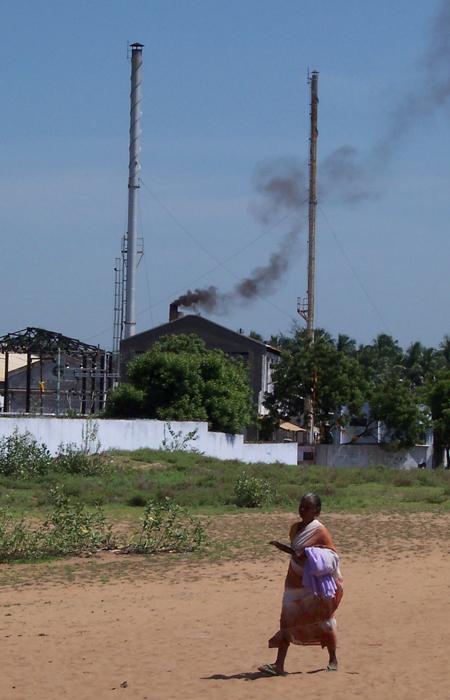 At least 13 of the chemicals found are used as raw material in one or more industries. In other words, toxic chemicals are constantly spilling out of the factories through chimneys and various other leaks and contaminating the air breathed by more than 20,000 people.
The effects are there for all to see. Children in the SIPCOT villages can be seen with rheumy eyes, running noses and rashes on the skin. The eye and nose disorders are indicative of upper respiratory tract problems – a likely sign of air pollution. Anecdotal evidence gathered during the visit of Justice J. Kanakaraj and team as part of the Indian People's Tribunal revealed shocking information. Women in SIPCOT were reporting menstrual irregularities, delayed onset of puberty among girls, compromised physical development among boys, widespread dental and skin problems.
These long-term effects pale in front of the acute effects people experience when the air pollution gets intense. "We can't breathe; it feels like somebody is sitting on your chest. Whatever is in the air burns your eyes, tears through your nose and sets your lungs on fire. At least we can hold a cloth to our nose; imagine the fate of infants," said one irate mother from Eachangadu, a village surrounded on three sides by smelly factories.
Several 100 acres of fertile farm land have been abandoned because ground water in the entire SIPCOT area is contaminated, and the lands are awash with effluents and toxic waste. The River Uppanar, once the lifeline for more than 8 villages of inland fisherfolk, is now a faint shadow of its original productive self. Ask any fisherman and he will rattle off the names of at least 30 kinds of fishes that used to be found in the River. Now, less than 8 commercial species are found.
In all this, the TNPCB and the State Government have played villains, colluding with the polluters and punishing residents when they complain about pollution. Many of the industries function outside the law. CUSECS -- a company that was set up with Government participation to collect treated effluents and discharge it into the Bay of Bengal -- is completely illegal. It has no permits whatsoever. Information about quality of effluents discharged from CUSECS was recently obtained by SACEM using Right to Information. That information revealed that CUSECS was not merely illegal, but was discharging highly toxic and untreated effluents into the sea. The long-term effect on fisheries and consumers of Cuddalore fish can be devastating.
 A fisherman displays a fish damaged by pollutants in the River Uppanar
Despite intense opposition, the Government is pushing ahead with a proposal by Chemplast Sanmar to set up a factory to manufacture PVC plastic. PVC is one of the most toxic plastics. Its production, usage and disposal are all associated with the release of highly toxic chemicals, including dioxins and furans which are the most toxic chemicals known to science.
The scenic sand dunes of Naduthittu are earmarked for a ultra-mega coal-fired thermal plant which will throw out tones of sulphur dioxide into the air, and release a flyash slurry that will convert the bountiful ocean floor into a concrete cemetery.
Effluents from Tirupur textile units, and from the Ambur-Vaniyambadi leather tanneries are also rumoured to be making their way to the Cuddalore seas via long-distance pipelines. All in all, Cuddalore is set to become the smelly, sweaty armpit of industrial civilization.
Some may call this progress or development. But for the people who live in Cuddalore, this is hell. The ones that can afford to have already left Cuddalore. The unfortunate ones and the elderly have no option but to stay in what has now become a gas chamber.
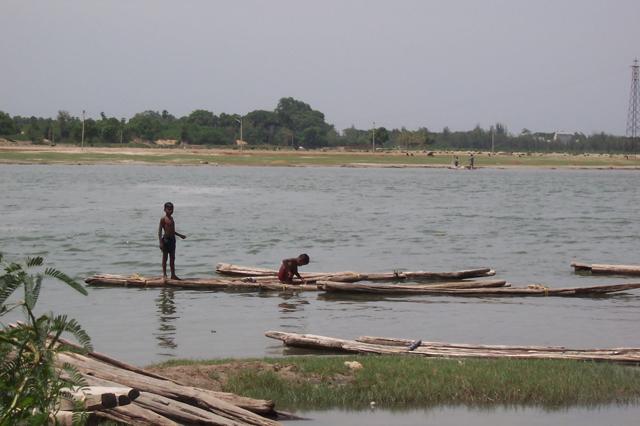 Young fishermen in the River Uppanar. Will the river still be alive when these boys grow up?
If you're concerned and want to help:
Contact: mailto:nopvcever@gmail.com?subject=Response%20for%20Cuddalore%20%E2%80%93%20Toxic%20Present;%20Troubled%20Future
Visit: http://www.sipcotcuddalore.com/
Tel: +91 9444082401
Up and running
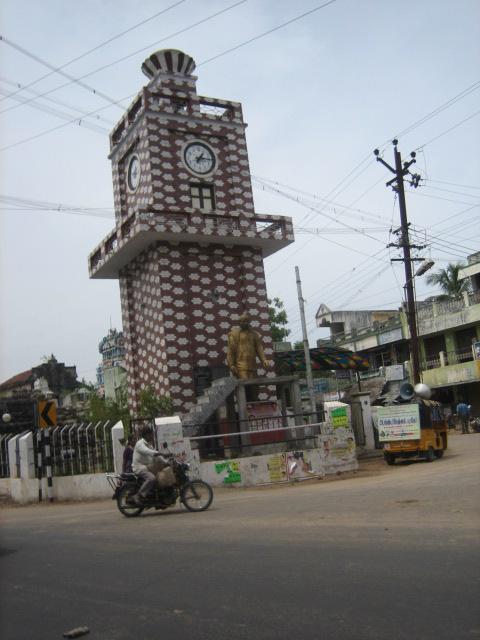 A couple of weeks back NinA wrote about 'Manjakuppam mani koondu' not working and that the clock was removed from the tower. Now the clock has been fixed and is back to life again. Thanks to the steps taken by the district administration.
File photo
Photo:Mathimaran
Thursday, November 09, 2006
Cuddalore to have ship building yard - News Today
The Chennai-based Good Earth Maritime Ltd has proposed to invest Rs 1,000 crore in Cuddalore for setting up a world class ship building yard and had applied to Tamilnadu Maritime Board for project clearance.
In connection with the project, Anandan, chairman and managing director of the company and Dr Shin, its technical advisor and also chairman of Korea Maritime Consultants, met the Chief Minister M Karunanidhi at the Secretariat today.
According to an official release, out of the proposed investment, Rs 500 crore would be invested in the first phase and the yard would employ nearly 5,000 people directly and give indirect employment to 20,000 full story>>
In connection with the project, Anandan, chairman and managing director of the company and Dr Shin, its technical advisor and also chairman of Korea Maritime Consultants, met the Chief Minister M Karunanidhi at the Secretariat today.
According to an official release, out of the proposed investment, Rs 500 crore would be invested in the first phase and the yard would employ nearly 5,000 people directly and give indirect employment to 20,000 full story>>
High corruption level largely affecting poor
High corruption level largely affecting poor - Times of India
CUDDALORE: The high level of corruption found in government offices in India, including the police and judicial services largely affects the poor, director of the Tamil Nadu state judicial academy S Vimala said on Tuesday.
Inaugurating a week-long vigilance awareness week, organised by the Neyveli Lignite Corporation, she quoted a recent survey which stated that an amount of 21,068 crore was received by government officials each year. A proper mindset is needed to eradicate corruption which ideally should not exist in a democratic country, she said.
Vimala said that people have to wait for too long to get justice in India. This was due to the fact that there was only one judge for one lakh people.
NLC chairman-cum Managing Director S Jayaraman said NLC follows clear cut procedures for every purchase and awarding of contracts. "To avoid corruption, NLC has been implementing e-procure methods for purchase of materials," he said.
Copyright ©2006Times Internet Limited.
CUDDALORE: The high level of corruption found in government offices in India, including the police and judicial services largely affects the poor, director of the Tamil Nadu state judicial academy S Vimala said on Tuesday.
Inaugurating a week-long vigilance awareness week, organised by the Neyveli Lignite Corporation, she quoted a recent survey which stated that an amount of 21,068 crore was received by government officials each year. A proper mindset is needed to eradicate corruption which ideally should not exist in a democratic country, she said.
Vimala said that people have to wait for too long to get justice in India. This was due to the fact that there was only one judge for one lakh people.
NLC chairman-cum Managing Director S Jayaraman said NLC follows clear cut procedures for every purchase and awarding of contracts. "To avoid corruption, NLC has been implementing e-procure methods for purchase of materials," he said.
Copyright ©2006Times Internet Limited.
Textile mills seek announced power cuts to maintain production - The Hindu
.......... Speaking at an interactive session on technical textiles and manpower training held here recently, he said the textile-processing park proposed by the association at Cuddalore aimed at about Rs. 750 crore investment.
The project also looked at marine discharge of treated effluents from the units.
Mr. Arumugam appealed to the State Government for speedy environmental clearances so that the project could take off at the earliest full story>>
The project also looked at marine discharge of treated effluents from the units.
Mr. Arumugam appealed to the State Government for speedy environmental clearances so that the project could take off at the earliest full story>>
Monday, November 06, 2006
Grim reality
 Sewage workers clearing the clogged drainage line without any protective clothing.
Photo courtesy of Vinoth Thiyagarajan.
Sunday, November 05, 2006
T.R. Baalu sanctions repair works on NH-45 A
THIRU T.R. BAALU SANCTIONS SPECIAL REPAIR WORKS ON NH-45 A IN TAMIL NADU -Press Information Bureau
The Union Minister of Shipping, Road Transport and Highways, Thiru T.R. Baalu has approved Special Repair Works from km 87/00 to km 93/00 and from km 104/00 to km 109/00 of NH 45 A at Parangipettai and Bhuvanagiri-Chidambaram Section respectively in Cuddalore District in Tamil Nadu at a cost of Rs. 598.63 lakh. This would also include the reconstruction of 14 cross drainage falling in this stretch full story>>
The Union Minister of Shipping, Road Transport and Highways, Thiru T.R. Baalu has approved Special Repair Works from km 87/00 to km 93/00 and from km 104/00 to km 109/00 of NH 45 A at Parangipettai and Bhuvanagiri-Chidambaram Section respectively in Cuddalore District in Tamil Nadu at a cost of Rs. 598.63 lakh. This would also include the reconstruction of 14 cross drainage falling in this stretch full story>>
Friday, November 03, 2006
Water stagnates in Cuddalore museum
Rain water stagnates inside the Government Museum campus in Cuddalore. The level of the floor is below the road level. The museum is supposedly in a rented land.
 Photo courtesy of Vinoth Thiyagaragan.
 Photo courtesy of Vinoth Thiyagaragan.
Thursday, November 02, 2006
Cuddalore in the news
New life from the depths of despair-This is Lancashire
by Maxine Wolstenholme
.....In Pattaraiyadi, near Chidambaram in the district of Cuddalore, houses built 20 years ago by the Indian Government had collapsed. There, smiling women announced: "You have made us very happy. Now we have strong houses. In our life it would be impossible to build a house like this one. Please say thank you to the people who made it possible."
..........
Mr Surimuthi, village leader in Pattarayaidi, Cuddalore, told us: "On full moon days the water comes up to our house and we sometimes wonder if it will be a tsunami again, but we have had training and now we have confidence. Thirty-five people have been trained in this village so that we have confidence to rescue people if it happens again." full story>>
Architecture For Humanity, Tsunami Reconstruction and LEAD - The Green Appeal (A blog)
Six held for hurling petrol bombs at chemical unit-New Indian Express
Six held for attack on factory-Gulf Times
Steps to tackle floods in Cuddalore district-The Hindu
CII, Deutsche Bank reach out to tsunami-hit farmers-The Hindu
by Maxine Wolstenholme
.....In Pattaraiyadi, near Chidambaram in the district of Cuddalore, houses built 20 years ago by the Indian Government had collapsed. There, smiling women announced: "You have made us very happy. Now we have strong houses. In our life it would be impossible to build a house like this one. Please say thank you to the people who made it possible."
..........
Mr Surimuthi, village leader in Pattarayaidi, Cuddalore, told us: "On full moon days the water comes up to our house and we sometimes wonder if it will be a tsunami again, but we have had training and now we have confidence. Thirty-five people have been trained in this village so that we have confidence to rescue people if it happens again." full story>>
Architecture For Humanity, Tsunami Reconstruction and LEAD - The Green Appeal (A blog)
Six held for hurling petrol bombs at chemical unit-New Indian Express
Six held for attack on factory-Gulf Times
Steps to tackle floods in Cuddalore district-The Hindu
CII, Deutsche Bank reach out to tsunami-hit farmers-The Hindu
Wednesday, November 01, 2006
Hospital Road broadening work
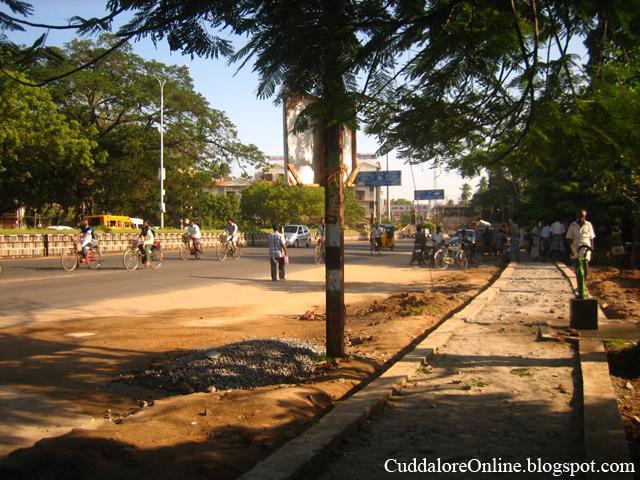
After the completion of pedestrian footpath along both the sides in Hospital Road, the broadening work has just begun. Speed breakers are also built on both the sides of the road.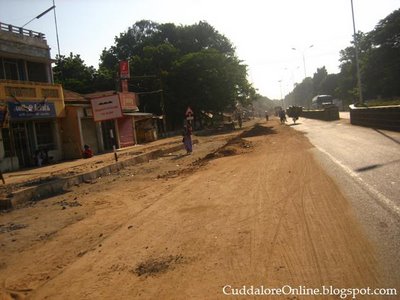 More importantly, the broadening work is underway in the place where Hospital Road leads into the Nellikuppam High Road.
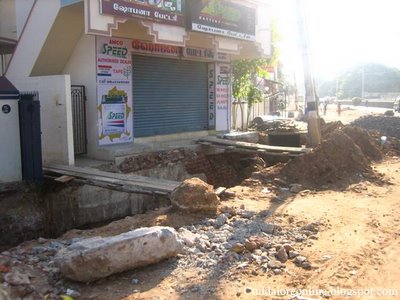
 More importantly, the broadening work is underway in the place where Hospital Road leads into the Nellikuppam High Road.

Saturday, October 28, 2006

Thursday, October 26, 2006
From clean beach to dirty beach
Two years back there was a discussion in the NDTV Message Central on "Which is the cleanest beach in India ?", one message board user from Edinburgh had replied in the forum that Silver Beach in Cuddalore as a clean beach in India. 
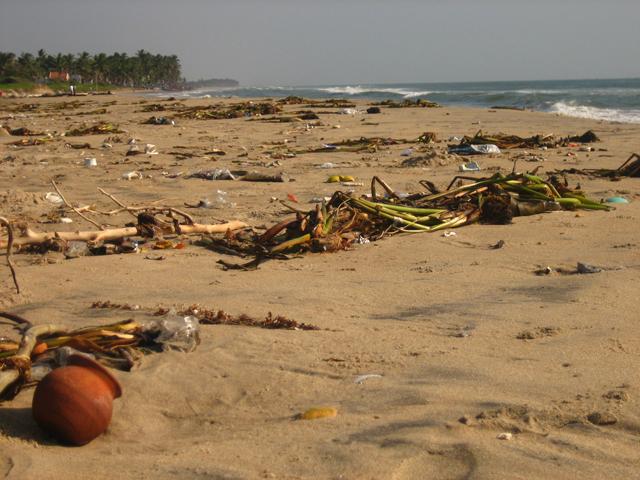
Silver Beach used to be a clean beach, but in the recent months it is getting more and more dirtier. Papers and plastic materials thrown out by people visiting beach forms the major portion of the garabage. Now this type of waste is reduced to a greater extend after effective steps taken by the district administration. But they form only a portion of the total lump. Materials used for rituals are left out in beach, after the ritual is over. Nowadays these waste materials are spread across the breadth of the beach.

The scene in the above photograph are more common if one happens to go to the beach in the morning hours. People come, perform the rituals, throw-away/leave behind whatever and wherever they feel like. As District Collector Mr.Gagandeep Singh Bedi pointed out , whatever steps the administration takes to improve the aesthetics and cleanliness of the town, if people do not cooperate, none of the programme can be successful.


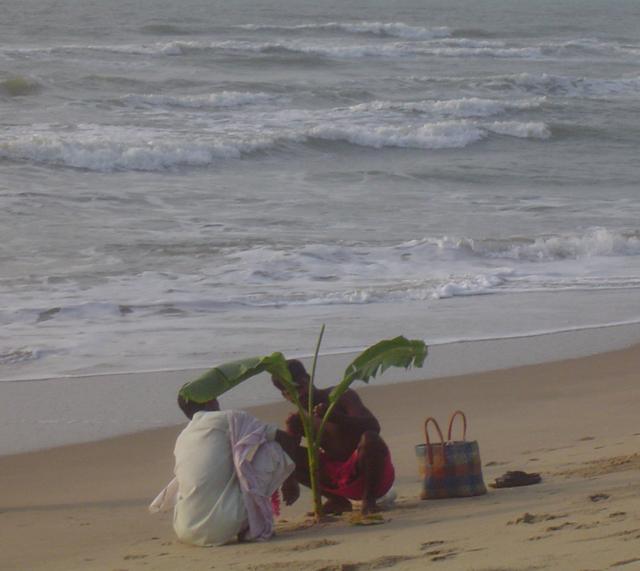
The scene in the above photograph are more common if one happens to go to the beach in the morning hours. People come, perform the rituals, throw-away/leave behind whatever and wherever they feel like. As District Collector Mr.Gagandeep Singh Bedi pointed out , whatever steps the administration takes to improve the aesthetics and cleanliness of the town, if people do not cooperate, none of the programme can be successful.
Wednesday, October 25, 2006
Manjakuppam mani koondu
“Manjakuppam mani koondu ! ”
This is the welcome call we hear from the bus conductors once we touch the boundary of Cuddalore from Pondy.
But the clock tower itself is not working for the past two months and one of the clocks is removed a month back.
Lets wait and see when the clock tower will comeback alive.
This is the welcome call we hear from the bus conductors once we touch the boundary of Cuddalore from Pondy.
But the clock tower itself is not working for the past two months and one of the clocks is removed a month back.
Lets wait and see when the clock tower will comeback alive.
Tuesday, October 24, 2006

Gedilam bank to be raised-The Hindu
Cuddalore: The right bank of the Gedilam will be raised to serve a double purpose: as a protective wall from the recurrent floods as well as an alternative route to decongest the town.
A statement from District Collector Gagandeep Singh Bedi said that at many places the right bank was far below the maximum flood level, thus quite often causing flood havoc. The Gedilam originating from the Kaattu Idayar hillock in Ulundurpet block is draining in the Bay of Bengal after traversing 121 km.
Since Cuddalore happened to be at the confluence point, it was subjected to floods, whenever the river was in a spate. Therefore, as a remedial measure, it had been decided to raise the level of the right bank from the Khammiampettai bridge to the Jawans' Bhavan.
The soil for the scheme would be brought from the Karaikadu Agraharam, 12 km from the town. After its completion, the bus services from Panruti, Pondicherry and Salem would be diverted on this bank to reach the Thirupadiripuliyur bus stand.
This measure would ease the traffic congestion in the heart of the town, the statement added.
Monday, October 23, 2006
Rs. 3000 crore plan to develop textile infrastructure-The Hindu
Rs. 3000 crore plan to develop textile infrastructure
.....The processing parks are proposed to be set up in Cuddalore and Perunthurai at an investment of Rs. 300 crore each. The Perunthurai park will also come up at the SIPCOT industrial complex.....
.....The processing parks are proposed to be set up in Cuddalore and Perunthurai at an investment of Rs. 300 crore each. The Perunthurai park will also come up at the SIPCOT industrial complex.....
New strategy to replenish groundwater-The Hindu
New strategy to replenish groundwater
Cuddalore: For replenishing the ground water, a new strategy has been adopted in Cuddalore district. Owing to increasing demand, there is over-exploitation of ground water. Therefore, to arrest the trend and to improve the condition, the Agricultural Engineering Department has started adopting the "recharge shaft" technique.
Under the system, 6 to 8 inch diametre and 15 to 30 metre deep bore wells are being dug to recharge the underground soil and the rocky terrain. According to Gagandeep Singh Bedi, District Collector, 30 recharge shafts had been put up in the district by utilising the funds sanctioned under the Rashtriya Sam Vikas Yojana.
Cuddalore: For replenishing the ground water, a new strategy has been adopted in Cuddalore district. Owing to increasing demand, there is over-exploitation of ground water. Therefore, to arrest the trend and to improve the condition, the Agricultural Engineering Department has started adopting the "recharge shaft" technique.
Under the system, 6 to 8 inch diametre and 15 to 30 metre deep bore wells are being dug to recharge the underground soil and the rocky terrain. According to Gagandeep Singh Bedi, District Collector, 30 recharge shafts had been put up in the district by utilising the funds sanctioned under the Rashtriya Sam Vikas Yojana.
Thursday, October 19, 2006
Revisiting tsunami
This video footage seems to have been shot in a fishing hamlet in Cuddalore District, just hours after tsunami waves struck the coast.
Viewer discretion strongly advised.
Wednesday, October 18, 2006
Afforestation drive
Restoring the fading forest-News Today
"Isha Foundation, in the past two years, planted 2.5 lakh trees as a pilot project at Six Tsunami affected villages in Cuddalore district. Around 25,000 trees of 65 species were planted along the five-filometre stretch on the seashore, to create a green wall."
700,000 saplings to be planted in TN in a single day-India Post
"Project Green Hands stands apart from other plantation initiatives due to the expansiveness of the project that will cover 28 districts including Chennai, Coimbatore, Cuddalore and Salem. Isha Foundation aims to encourage school children and people in rural areas to be a part of the project."
"Isha Foundation, in the past two years, planted 2.5 lakh trees as a pilot project at Six Tsunami affected villages in Cuddalore district. Around 25,000 trees of 65 species were planted along the five-filometre stretch on the seashore, to create a green wall."
700,000 saplings to be planted in TN in a single day-India Post
"Project Green Hands stands apart from other plantation initiatives due to the expansiveness of the project that will cover 28 districts including Chennai, Coimbatore, Cuddalore and Salem. Isha Foundation aims to encourage school children and people in rural areas to be a part of the project."
Sunday, October 15, 2006
India: Temporary shelter, permanent pain - Relief Web
India: Temporary shelter, permanent pain
By Max Martin
CHENNAI, (indiadisasters.org): During the last rainy season when her temporary shelter was flooded Elanji had to spend the night standing up, holding her baby, in ankle-deep water.
This year again Elanji and her neighbours in this tsunami shelter cluster in Puthukuppam, Nagapattinam - seven hours drive from Chennai - are awaiting the rains with fear.
Most of the people living in 178 temporary shelter sites still left in Tamil Nadu live in such fear of rain, notes a study by the prestigious Loyola College in Chennai.
People line their leaky roofs with tarpaulin sheets and lay corrugated metal sheets to cover the floor, knowing well that water will still flood in. "Last time we often had to spend the night sitting on a single cot so as not to get wet," said another resident.
The first rains of the north-eastern monsoon have already hit parts of India’s eastern coast in Tamil Nadu. Hectic repairs are on at Nagapattinam, where bulk of the remaining shelters are located. It is a daunting task.
The Loyola study notes that in Tamil Nadu 76 per cent of shelters need repair or replacement of roofs; and 78 per cent need wall repair.
Officials said that the shelters - each costing Rs 8000 - were meant initially to be used for only three to five months of residence. But they are still around 21 months after the tsunami, as the government so far could finish only one-fifth of the 54,620 tsunami rehabilitation houses proposed to be built for those displaced by the Asian tsunami.
A tour along the study areas in Kanyakumari, Nagapattinam, Kancheepuram,Cuddalore and Villupuram revealed a striking picture - blown-off roofs, damaged walls, low-lying floors and the sheer helplessness of people.
"The findings were striking indeed," said Gladston Xavier, a social work lecturer at the Loyola who led the study team with the support of Oxfam America. "There was no adherence to Sphere standards (of humanitarian relief).
Officials acknowledge that there is a big problem. "In Nagapattinam it is a matter of concern, as many shelter sites are located in lowlands," said C V Sankar, an Indian Administrative Service (IAS) officer on special duty, who supervises the tsunami rehabilitation in Tamil Nadu.
"These sites face the risk of flood, and it can be very bad when it rains," Sankar said. "The district collectors have been instructed to make the repairs before the rainy season," he said in an interview.
Garbriel Britto, former policy and advocacy advisor of Oxfam International who was part of the study, said that Tamil Nadu still fared better compared with the response to earlier disasters elsewhere. "Systems were functional here unlike in, say, Kutch, a forlorn place (where an earthquake struck in 2001). The people here got basic services fast."
"There was an initial rush of goodies, often at unmanageable levels - I found someone who got nine stoves for instance; then everybody seems to have gone into a slumber."
The Loyola study is a response to this slumber. Its context: "…in 2005, practically all the sites were flooded four times; the roofs leaked; food grains got soaked; fires gutted the shelters in over eight places; chicken pox spread in several settlements, and over time the temporary shelter materials had degraded. It was urgent that an appraisal be done…"
Most of the houses were damaged in earlier floods and needed repairs, he study noted. One-third of the houses needed overall repairs and nother one-third needed outright replacement. Worse, in about 80 per cent of the shelters, there is no provision for storm drains.
People living in more than half the shelter sites suffered mosquito bites. In the case of Salavankuppam of Kancheepuram District almost all families reported cases of Chickungunya a disease, spread by mosquitoes and marked by high fever and body-ache.
At Selavankuppam, the people are stuck in cluster of shabby shelters close to the East Coast Highway, as the government could not find a good place for their rehabilitation. "Here it (chikungunya) attacked everyone. I could not even walk, said Susheela, a resident.
Under the original tsunami rehabilitation package, 54,620 houses need to be built - 22,060 by the government in Chennai and Thriuvallur districts and the rest by NGOs. The Government has handed over 8,077 houses and 3,179 more houses were ready by 30th August.
Another 17,542 houses are under construction, still leaving 25,822 houses yet to be built. Finding adequate, acceptable land is a problem, officials said.
In the meanwhile, the rains are gathering strength and the situation ahead looks rather grim.
By Max Martin
CHENNAI, (indiadisasters.org): During the last rainy season when her temporary shelter was flooded Elanji had to spend the night standing up, holding her baby, in ankle-deep water.
This year again Elanji and her neighbours in this tsunami shelter cluster in Puthukuppam, Nagapattinam - seven hours drive from Chennai - are awaiting the rains with fear.
Most of the people living in 178 temporary shelter sites still left in Tamil Nadu live in such fear of rain, notes a study by the prestigious Loyola College in Chennai.
People line their leaky roofs with tarpaulin sheets and lay corrugated metal sheets to cover the floor, knowing well that water will still flood in. "Last time we often had to spend the night sitting on a single cot so as not to get wet," said another resident.
The first rains of the north-eastern monsoon have already hit parts of India’s eastern coast in Tamil Nadu. Hectic repairs are on at Nagapattinam, where bulk of the remaining shelters are located. It is a daunting task.
The Loyola study notes that in Tamil Nadu 76 per cent of shelters need repair or replacement of roofs; and 78 per cent need wall repair.
Officials said that the shelters - each costing Rs 8000 - were meant initially to be used for only three to five months of residence. But they are still around 21 months after the tsunami, as the government so far could finish only one-fifth of the 54,620 tsunami rehabilitation houses proposed to be built for those displaced by the Asian tsunami.
A tour along the study areas in Kanyakumari, Nagapattinam, Kancheepuram,Cuddalore and Villupuram revealed a striking picture - blown-off roofs, damaged walls, low-lying floors and the sheer helplessness of people.
"The findings were striking indeed," said Gladston Xavier, a social work lecturer at the Loyola who led the study team with the support of Oxfam America. "There was no adherence to Sphere standards (of humanitarian relief).
Officials acknowledge that there is a big problem. "In Nagapattinam it is a matter of concern, as many shelter sites are located in lowlands," said C V Sankar, an Indian Administrative Service (IAS) officer on special duty, who supervises the tsunami rehabilitation in Tamil Nadu.
"These sites face the risk of flood, and it can be very bad when it rains," Sankar said. "The district collectors have been instructed to make the repairs before the rainy season," he said in an interview.
Garbriel Britto, former policy and advocacy advisor of Oxfam International who was part of the study, said that Tamil Nadu still fared better compared with the response to earlier disasters elsewhere. "Systems were functional here unlike in, say, Kutch, a forlorn place (where an earthquake struck in 2001). The people here got basic services fast."
"There was an initial rush of goodies, often at unmanageable levels - I found someone who got nine stoves for instance; then everybody seems to have gone into a slumber."
The Loyola study is a response to this slumber. Its context: "…in 2005, practically all the sites were flooded four times; the roofs leaked; food grains got soaked; fires gutted the shelters in over eight places; chicken pox spread in several settlements, and over time the temporary shelter materials had degraded. It was urgent that an appraisal be done…"
Most of the houses were damaged in earlier floods and needed repairs, he study noted. One-third of the houses needed overall repairs and nother one-third needed outright replacement. Worse, in about 80 per cent of the shelters, there is no provision for storm drains.
People living in more than half the shelter sites suffered mosquito bites. In the case of Salavankuppam of Kancheepuram District almost all families reported cases of Chickungunya a disease, spread by mosquitoes and marked by high fever and body-ache.
At Selavankuppam, the people are stuck in cluster of shabby shelters close to the East Coast Highway, as the government could not find a good place for their rehabilitation. "Here it (chikungunya) attacked everyone. I could not even walk, said Susheela, a resident.
Under the original tsunami rehabilitation package, 54,620 houses need to be built - 22,060 by the government in Chennai and Thriuvallur districts and the rest by NGOs. The Government has handed over 8,077 houses and 3,179 more houses were ready by 30th August.
Another 17,542 houses are under construction, still leaving 25,822 houses yet to be built. Finding adequate, acceptable land is a problem, officials said.
In the meanwhile, the rains are gathering strength and the situation ahead looks rather grim.
Thursday, October 12, 2006
News article from SipcotCuddalore.com
15 Hospitalised after Consuming Poisoned Water
03 October, 2006. CUDDALORE -- At least fourteen people from Sonanchavadi village, and one from Vairankuppam colony, in SIPCOT, Cuddalore, had to be hospitalised this morning after consuming poisoned water. It is suspected that someone intentionally added a toxic pesticide to the overhead tank storing water to the village. People started reporting symptoms after 6.30 a.m. Most of the victims were women. Victims described their symptoms as giddiness, nausea and a burning sensation in the stomach. Doctors at the Government Hospital suggested that the pesticide Novacrone may have been added to the water.
According to local reports, relief was quick and efficient. The victims were removed to the Government Hospital in private vehicles loaned by neighboring villagers. The Fire Department flushed out the overhead tank. The Police has begun investigations. The local legislator, Mr. Ayyappan visited the victims in the hospital, and urged the hospital authorities to extend quality care to the victims. The motive behind the crime is not yet known.
Local body elections are around the corner, and the election campaign has begun all over Tamilnadu in full earnest.
03 October, 2006. CUDDALORE -- At least fourteen people from Sonanchavadi village, and one from Vairankuppam colony, in SIPCOT, Cuddalore, had to be hospitalised this morning after consuming poisoned water. It is suspected that someone intentionally added a toxic pesticide to the overhead tank storing water to the village. People started reporting symptoms after 6.30 a.m. Most of the victims were women. Victims described their symptoms as giddiness, nausea and a burning sensation in the stomach. Doctors at the Government Hospital suggested that the pesticide Novacrone may have been added to the water.
According to local reports, relief was quick and efficient. The victims were removed to the Government Hospital in private vehicles loaned by neighboring villagers. The Fire Department flushed out the overhead tank. The Police has begun investigations. The local legislator, Mr. Ayyappan visited the victims in the hospital, and urged the hospital authorities to extend quality care to the victims. The motive behind the crime is not yet known.
Local body elections are around the corner, and the election campaign has begun all over Tamilnadu in full earnest.
Bio-shield likely in coastal region
Bio-shield likely in coastal region-The New Indian Express
Wednesday October 11 2006 00:00 IST
CUDDALORE: The State Government has proposed to develop a bio-shield on 400 hectares of land in the coastal region to protect people from natural calamities, informed District Collector Gagandeep Singh Bedi.
Addressing a function here on Monday, Bedi said the bio-shield would be developed to protect the habitants in the coastal hamlets from disasters, including cyclone, flood and tsunami. Causerina trees would be planted on 250 hectares of land at Pitchavaram and Parangipettai.
The government had plans to develop a mangrove forest on the 100 hectares of land near the backwaters in Pitchavaram, Bedi said.
The government has also plans to plant Causerina trees on the 100 hectares of land in the coastal region and develop a green belt on the 57.5 km stretch of land along the coast line this year.
Trees were planted on 22,800 sq km of land in the reserve forest in Tamil Nadu and 3,67,00 hectares of land in Cuddalore district. And mangrove trees were cultivated on 1,357 hectares of land in the Pitchavaram region in the coastal district, the Collector said.
He said Malattar river, located near Panruti, had become extinct due to repeated deluge in 1970. Residents in 40 villages had faced hardships over the years and the government allotted Rs 40 lakh for taking up steps to give a new lease of life to the river, as a result of which, the ground water table would be recharged effectively, Bedi added.
Forest Department officials, including Villupuram Division Forest Officer V Valaguruvan and Ajay Singh Panwar, spoke on the occasion.
Wednesday October 11 2006 00:00 IST
CUDDALORE: The State Government has proposed to develop a bio-shield on 400 hectares of land in the coastal region to protect people from natural calamities, informed District Collector Gagandeep Singh Bedi.
Addressing a function here on Monday, Bedi said the bio-shield would be developed to protect the habitants in the coastal hamlets from disasters, including cyclone, flood and tsunami. Causerina trees would be planted on 250 hectares of land at Pitchavaram and Parangipettai.
The government had plans to develop a mangrove forest on the 100 hectares of land near the backwaters in Pitchavaram, Bedi said.
The government has also plans to plant Causerina trees on the 100 hectares of land in the coastal region and develop a green belt on the 57.5 km stretch of land along the coast line this year.
Trees were planted on 22,800 sq km of land in the reserve forest in Tamil Nadu and 3,67,00 hectares of land in Cuddalore district. And mangrove trees were cultivated on 1,357 hectares of land in the Pitchavaram region in the coastal district, the Collector said.
He said Malattar river, located near Panruti, had become extinct due to repeated deluge in 1970. Residents in 40 villages had faced hardships over the years and the government allotted Rs 40 lakh for taking up steps to give a new lease of life to the river, as a result of which, the ground water table would be recharged effectively, Bedi added.
Forest Department officials, including Villupuram Division Forest Officer V Valaguruvan and Ajay Singh Panwar, spoke on the occasion.
Cuddalore in the news
Abandon proposals to set up new units: panel-The Hindu
Computers in disrepair-The Hindu
Coastal people oppose Centre's move-The Hindu
Shifting alliance-Frontline
Computers in disrepair-The Hindu
Coastal people oppose Centre's move-The Hindu
Shifting alliance-Frontline
Tuesday, October 10, 2006
Substandard roads

Over the past two years tens of crores was allocated and spent for laying roads in Cuddalore. Execellent quality roads were laid in some parts of the town while others are of poor quality. Especially in broad roads like Barathi Road the quailty of road decreases as a gradient outwards.
Also the roads laid in patches are given an poor finishing. For example if a road is 30 feet wide, it is laid in two stages, 15 feet in each. The level of road laid in each stage are different, so is the quality(See Pic. 1 - around middle of the road). As a result roads are worn away easily by fast moving vehicles.

A good quailty road was laid along Beach Road by the end of June. But its quality is poor towards the beach end. Both picture 1 and 2 shows this.
Sunday, October 08, 2006
Open Air Auditorium in neglected state

Open Air Theaters/ Audi- tourism, much alien to India and its people. But I was surprised to see one such Open Air Auditorium in Cuddalore, unfortunately in a neglected state.
This theater is at the south-west end of the Manjakuppam Maidan. Locals say that the theater was operational until a few decades back. They say even the most celebrated artists of Tamil film industry and popular dramatists had performed in the very stage.
The theater is spread over a vast area and can accommodate huge crowd. It is located in one of the most easily accessible part of Cuddalore. But what lead it to this state of ruin perplexes me.
Since the theater is so large,the audience at the back rows would not have had a better look at the stage. This might have been a reason for decline of popularity among people. This problem can be addressed by providing a downward slope towards the stage. Lack of proper toilet facilities for the audiences might be another possible reason.
In addition arrangement for a food kiosk can be made to attract more audience.This will also serve as a means of refreshment during the breaks of large performances.
This theater can be used for performing various traditional arts. Particularly foreign tourists would love to see such shows. Now states such as Assam and Arunachala Pradesh are taking some serious steps to promote tourism following Kerala, Rajasthan, but Government of TamilNadu remains unmindful. For both Kerala and Rajasthan folks arts are important source of attraction. Pondicherry is also doing a great job to attract both foreign and domestic tourists. If the Open Air Theatre is developed as center flaunting rich heritage of region through dance and musical performances.
Also since it is located in Beach Road, weekend shows would attract a huge crowd. Arrangements for regular weekend shows can also be made.This may also serve a means of income for the near extinct traditional performers.
Photo Courtesy: Narendar Kumar
Friday, October 06, 2006
Tsunami Survivors Move into New Homes Built by the Sikh Community - Sikh Sangat News
Tsunami Survivors Move into New Homes Built by the Sikh Community
By SSNews, UNITED SIKHS
Oct 4, 2006, 15:18
CUDDALORE, Tamil Nadu, India: Guru Nanak Sarbat Sikh Sangat (GNSSS), a coalition comprising of UNITED SIKHS and eleven other Sikh organizations delivered the keys of newly built permanent houses to the survivors of the 2004 Tsunami in the village of Muzhukuthurai in the Cuddalore district of Tamil Nadu on September 28th 2006.
Speaking at the inaugural function, the Tamil Nadu Governor Surjit Barnala praised the efforts and dedication of the NGOs in helping rehabilitate the victims of the Tsunami. Gagandeep Singh Bedi, the District Collector of Cuddalore and the person in charge of handling natural disasters also addressed those at the inaugural function recollecting the destruction caused by the Tsunami and applauding the building efforts of the NGOs. A total of 161 new homes were built by GNSSS and other non-Sikh NGOs.
The twelve NGOS took up the project to construct houses for the villagers rendered roofless by tsunami and aside from the permanent houses, have provided a primary school, a community hall, a primary health centre, a fish market area, roads, electrification, rainwater harvesting structures and drainage systems.
Rajinder Singh of Guru Nanak Sarbat Sikh Sangat said “I believe anything that starts under Guru Nanak’s name completes successfully. I am motivated by the initiative of all member organizations.”
Dimple Kaur, UNITED SIKHS Project Coordinator, said Tsunami-ravaged South Asia had required prompt response from all involved. The efforts of UNITED SIKHS were led by sewadars such as Bhai Esher Singh, Lakhvinder Kaur and Navneet Singh who along with the rest of the GHANAIA (Giving Humanitarian Aid Necessities and Assistance Impartially to All) team provided relief to affected people in areas including Campbell Bay and Cuddalore. The team had to use innovative ways to reach the Tsunami victims to provide emergency supply including food and clothes.
Dimple Kaur continued, “UNITED SIKHS joined GNSSS on the Tsunami permanent housing and infrastructure project making it a high priority task, gathering funds and disbursing them to its team on the ground. We have other permanent rehabilitation projects running in Campbell Bay, Poonch in Kashmir and other parts of the world where natural calamities have struck. We are grateful to all our other partners in this venture are special thanks to district collector Gagandeep Singh for his support”.
Other members of the coalition present at the inauguration event included Harbhajan Singh of Nishkam Sikh Welfare Society, Kulwant Singh of Guru Gobind Singh Study Circle, President Sri Guru Singh Sabha Mumbai, Jaspal Singh of Gurmat Charitable Trust, Harbans Singh Anand of Guru Nanak Satsang Sabha, Surjit Singh, Mata Harnam Kaur of Guru Granth Sahib Study Centre.
For more details visit http://www.unitedsikhs.org/ghanaia/gallery/
To read a previous community voice on UNITED SIKHS projects for Tsunami survivors please click http://www.unitedsikhs.org/PressReleases/COMVCE-17-02-2006-00.htm
By SSNews, UNITED SIKHS
Oct 4, 2006, 15:18
CUDDALORE, Tamil Nadu, India: Guru Nanak Sarbat Sikh Sangat (GNSSS), a coalition comprising of UNITED SIKHS and eleven other Sikh organizations delivered the keys of newly built permanent houses to the survivors of the 2004 Tsunami in the village of Muzhukuthurai in the Cuddalore district of Tamil Nadu on September 28th 2006.
Speaking at the inaugural function, the Tamil Nadu Governor Surjit Barnala praised the efforts and dedication of the NGOs in helping rehabilitate the victims of the Tsunami. Gagandeep Singh Bedi, the District Collector of Cuddalore and the person in charge of handling natural disasters also addressed those at the inaugural function recollecting the destruction caused by the Tsunami and applauding the building efforts of the NGOs. A total of 161 new homes were built by GNSSS and other non-Sikh NGOs.
The twelve NGOS took up the project to construct houses for the villagers rendered roofless by tsunami and aside from the permanent houses, have provided a primary school, a community hall, a primary health centre, a fish market area, roads, electrification, rainwater harvesting structures and drainage systems.
Rajinder Singh of Guru Nanak Sarbat Sikh Sangat said “I believe anything that starts under Guru Nanak’s name completes successfully. I am motivated by the initiative of all member organizations.”
Dimple Kaur, UNITED SIKHS Project Coordinator, said Tsunami-ravaged South Asia had required prompt response from all involved. The efforts of UNITED SIKHS were led by sewadars such as Bhai Esher Singh, Lakhvinder Kaur and Navneet Singh who along with the rest of the GHANAIA (Giving Humanitarian Aid Necessities and Assistance Impartially to All) team provided relief to affected people in areas including Campbell Bay and Cuddalore. The team had to use innovative ways to reach the Tsunami victims to provide emergency supply including food and clothes.
Dimple Kaur continued, “UNITED SIKHS joined GNSSS on the Tsunami permanent housing and infrastructure project making it a high priority task, gathering funds and disbursing them to its team on the ground. We have other permanent rehabilitation projects running in Campbell Bay, Poonch in Kashmir and other parts of the world where natural calamities have struck. We are grateful to all our other partners in this venture are special thanks to district collector Gagandeep Singh for his support”.
Other members of the coalition present at the inauguration event included Harbhajan Singh of Nishkam Sikh Welfare Society, Kulwant Singh of Guru Gobind Singh Study Circle, President Sri Guru Singh Sabha Mumbai, Jaspal Singh of Gurmat Charitable Trust, Harbans Singh Anand of Guru Nanak Satsang Sabha, Surjit Singh, Mata Harnam Kaur of Guru Granth Sahib Study Centre.
For more details visit http://www.unitedsikhs.org/ghanaia/gallery/
To read a previous community voice on UNITED SIKHS projects for Tsunami survivors please click http://www.unitedsikhs.org/PressReleases/COMVCE-17-02-2006-00.htm
Thursday, October 05, 2006
Cuddalore protests industrial pollution-India eNews.com
Cuddalore protests industrial pollution
Industries are welcome but pollutants in the sea are not, say Cuddalore residents who are protesting the water pollution caused by factories along the seashore of the Tamil Nadu district.
Notwithstanding the protests, the state government is planning a major expansion of the Cuddalore industrial area.
The government has given 1,000 acres of land on the seashore, where tributaries of the Cauvery enter the Bay of Bengal, to the State Industries Promotion Corp of Tamil Nadu (SIPCOT) to be given to medium and major industries. Investors have responded positively.
E.V.K.S. Elangovan, the central minister of state for textiles, has been promoting the relocation of polluting dye industries from the textile hub of Tirupur to Cuddalore, 200 km south of Chennai.
‘This is because Cuddalore has abundant water and a coast, so all the rejects can be easily discarded,’ says Shewta Narayan, an activist from a citizen’s NGO.
To discuss the problem, the SIPCOT Area Community Environmental Monitoring Group, Cuddalore District Consumer Protection Organisation and the community environmental monitoring programme of The Other Media had organised a public hearing.
Based on the hearing, a report titled ‘Environmental and Human Rights Violations in the SIPCOT Complex, Cuddalore’ has been released by the hearing panel comprising R. Saraswati, retired head of the department of sociology in Queen Mary’s College, S. Janakarajan of the Madras Institute of Development Studies, and Rakhal Gaithonde, a community health physician.
The report recommended against the expansion of polluting industries in Cuddalore and has called upon the government ‘to respect local sentiments’.
‘The current proposals to set up groundwater intensive polluting industries in Cuddalore will only threaten the long-term economic sustainability of the region,’ the report says.
‘It is clear that companies with political clout can and do get away with anything in SIPCOT. Such unregulated and corrupt functioning in dealing with highly hazardous industries located in close proximity to residential populations is a recipe for disaster.
‘The pervasive bad odour, the devastated environment and the lengthy list of health complaints of residents make us wonder how they manage to live there.’
This is not the first time the government has been warned about the environmental crisis.
In 1994, the Asian Development Bank (AND) had warned of salinity ingress in the region.
The State Human Rights Commission had in 1998 investigated reported environment-related human rights violations in SIPCOT and found this industrial area over-polluted.
It remains to be seen if one more call will wake up the government and improve the lot of the Cuddalore residents.
- Indo Asian News Service
The same news item was published in DailyIndia for which I have provided the link below
Cuddalore protests industrial pollution-DailyIndia.com
Industries are welcome but pollutants in the sea are not, say Cuddalore residents who are protesting the water pollution caused by factories along the seashore of the Tamil Nadu district.
Notwithstanding the protests, the state government is planning a major expansion of the Cuddalore industrial area.
The government has given 1,000 acres of land on the seashore, where tributaries of the Cauvery enter the Bay of Bengal, to the State Industries Promotion Corp of Tamil Nadu (SIPCOT) to be given to medium and major industries. Investors have responded positively.
E.V.K.S. Elangovan, the central minister of state for textiles, has been promoting the relocation of polluting dye industries from the textile hub of Tirupur to Cuddalore, 200 km south of Chennai.
‘This is because Cuddalore has abundant water and a coast, so all the rejects can be easily discarded,’ says Shewta Narayan, an activist from a citizen’s NGO.
To discuss the problem, the SIPCOT Area Community Environmental Monitoring Group, Cuddalore District Consumer Protection Organisation and the community environmental monitoring programme of The Other Media had organised a public hearing.
Based on the hearing, a report titled ‘Environmental and Human Rights Violations in the SIPCOT Complex, Cuddalore’ has been released by the hearing panel comprising R. Saraswati, retired head of the department of sociology in Queen Mary’s College, S. Janakarajan of the Madras Institute of Development Studies, and Rakhal Gaithonde, a community health physician.
The report recommended against the expansion of polluting industries in Cuddalore and has called upon the government ‘to respect local sentiments’.
‘The current proposals to set up groundwater intensive polluting industries in Cuddalore will only threaten the long-term economic sustainability of the region,’ the report says.
‘It is clear that companies with political clout can and do get away with anything in SIPCOT. Such unregulated and corrupt functioning in dealing with highly hazardous industries located in close proximity to residential populations is a recipe for disaster.
‘The pervasive bad odour, the devastated environment and the lengthy list of health complaints of residents make us wonder how they manage to live there.’
This is not the first time the government has been warned about the environmental crisis.
In 1994, the Asian Development Bank (AND) had warned of salinity ingress in the region.
The State Human Rights Commission had in 1998 investigated reported environment-related human rights violations in SIPCOT and found this industrial area over-polluted.
It remains to be seen if one more call will wake up the government and improve the lot of the Cuddalore residents.
- Indo Asian News Service
The same news item was published in DailyIndia for which I have provided the link below
Cuddalore protests industrial pollution-DailyIndia.com
Abandon proposals to set up new units: panel
Abandon proposals to set up new units: panel-The Hindu
"Move will aggravate pollution in SIPCOT Industrial Estate"
# Long-term economic sustainability of the region threatened
# Creation of value-added opportunities to traditional economies suggested
CUDDALORE: After a public hearing on the proposals to set up new units in the SIPCOT Industrial Estate here, an expert committee has concluded that the move will aggravate pollution problem and threaten a long-term economic sustainability of the region. The committee urged the Tamil Nadu Government to abandon any proposals to set up new units, particularly the groundwater-intensive ones.
Instead, the committee suggested creation of value-added opportunities to traditional economies such as fisheries, agriculture and weaving. The proposed Southern India Mills Association Textile Park, the Chemplast Sanmar poly-vinyl chloride and Nagarjuna petroleum refinery were certainly not in the interest of the local people, and hence, must be given up, it noted.
In its report "Environmental and Human Rights Violations in SIPCOT Complex, Cuddalore", the committee pointed out that the public hearing had brought to limelight the fact that the companies having a political clout could get away with their intransigence on the pollution front.
Local response
It said the pervasive bad odour, the devastated environment and a host of health complaints of residents made the living in the area miserable.
The frustration among the local youth was palpable and the continued collusion between the officials and the polluters could result in a serious law and order situation, it cautioned. The committee squarely blamed the Tamil Nadu Pollution Control Board and the Inspector of Factories for the negligence in dealing with polluting and hazardous industries in the estate.
It said that rather than improving the local economy, the industries had eroded the self-sufficiency of the region, by throwing weavers, fishermen and farmers out of their traditional livelihood.
Increased health expenditure, combined with lower incomes, had impoverished the communities, and compromised their ability to exercise healthy choices.
The public hearing panel was constituted by the SIPCOT Area Community Environmental Monitoring, the Cuddalore District Consumer Protection Organisation, and the Community Environmental Monitoring programme of The Other Media.
The committee comprised Prof. S. Janakarajan of Madras Institute of Development Studies, Prof. R. Saraswathi, former Head of Department, Department of Sociology in Queen Mary's College, and Rakhal Gaithonde, a community health physician from the Community Health Cell.
"Move will aggravate pollution in SIPCOT Industrial Estate"
# Long-term economic sustainability of the region threatened
# Creation of value-added opportunities to traditional economies suggested
CUDDALORE: After a public hearing on the proposals to set up new units in the SIPCOT Industrial Estate here, an expert committee has concluded that the move will aggravate pollution problem and threaten a long-term economic sustainability of the region. The committee urged the Tamil Nadu Government to abandon any proposals to set up new units, particularly the groundwater-intensive ones.
Instead, the committee suggested creation of value-added opportunities to traditional economies such as fisheries, agriculture and weaving. The proposed Southern India Mills Association Textile Park, the Chemplast Sanmar poly-vinyl chloride and Nagarjuna petroleum refinery were certainly not in the interest of the local people, and hence, must be given up, it noted.
In its report "Environmental and Human Rights Violations in SIPCOT Complex, Cuddalore", the committee pointed out that the public hearing had brought to limelight the fact that the companies having a political clout could get away with their intransigence on the pollution front.
Local response
It said the pervasive bad odour, the devastated environment and a host of health complaints of residents made the living in the area miserable.
The frustration among the local youth was palpable and the continued collusion between the officials and the polluters could result in a serious law and order situation, it cautioned. The committee squarely blamed the Tamil Nadu Pollution Control Board and the Inspector of Factories for the negligence in dealing with polluting and hazardous industries in the estate.
It said that rather than improving the local economy, the industries had eroded the self-sufficiency of the region, by throwing weavers, fishermen and farmers out of their traditional livelihood.
Increased health expenditure, combined with lower incomes, had impoverished the communities, and compromised their ability to exercise healthy choices.
The public hearing panel was constituted by the SIPCOT Area Community Environmental Monitoring, the Cuddalore District Consumer Protection Organisation, and the Community Environmental Monitoring programme of The Other Media.
The committee comprised Prof. S. Janakarajan of Madras Institute of Development Studies, Prof. R. Saraswathi, former Head of Department, Department of Sociology in Queen Mary's College, and Rakhal Gaithonde, a community health physician from the Community Health Cell.
Friday, September 29, 2006
Old clothes are dumped in Gadilum river
When I happened to walk along the bridge over Gadilum (connecting Thirupadhiripuliyur and Manjakuppam) I saw a huge heap of worn out clothes strewn from the top of the old bridge.These dumps are adding much strain to the already polluted local ecosystem.
Location is North side of East end of the new bridge.
I invite anyone of you to take photo and send it to cuddaloreonline for posting it in our blog.
Location is North side of East end of the new bridge.
I invite anyone of you to take photo and send it to cuddaloreonline for posting it in our blog.
Thursday, September 28, 2006
Nagarjuna refinery project to attain financial closure
Nagarjuna refinery to tie up funds soon-Business Standard
Gayatri Ramanathan / Mumbai September 28, 2006
The six-million tonne refinery at Cuddalore in Tamil Nadu, promoted by the Nagarjuna group and the Tamil Nadu government is expected to complete financial closure by the end of the year.
Company sources said that most of the debt for the Rs 4,750-crore project was already tied up and that the group was in talks with several small foreign oil companies, including Russia’s Itera group, for equity placements.
“We are not sure if Itera will take up equity at this point, as we are still talking with them. We are also in talks with several other foreign companies for equity but cannot reveal any names,” said a source close to the development.
Tata Sons has already picked up a 26-per cent stake at Rs 400 crore in the project and is expected to hike it to 40 per cent at a later stage, sources said. This will be Tata group’s first foray into the down-stream refining sector.
Indian refining major, Indian Oil Corporation (IOC), has also picked up a 10-per cent stake in the project through its subsidiary, Indian Oil Corporation Tankers.
IOC has also signed a memorandum of understanding with Nagarjuna Oil Corporation for marketing its products such as LPG, Euro-IV motor spirit, high-speed diesel, fuel oil petrochemical, naphtha and sulphur.
The Nagarjuna group will have a 51-per cent equity stake in the project, while co-promoter Tamil Nadu Industrial Development Corporation holds 5 per cent. Krupp Uhde, the EPC contractor has a 7 per cent stake in the firm.
Gayatri Ramanathan / Mumbai September 28, 2006
The six-million tonne refinery at Cuddalore in Tamil Nadu, promoted by the Nagarjuna group and the Tamil Nadu government is expected to complete financial closure by the end of the year.
Company sources said that most of the debt for the Rs 4,750-crore project was already tied up and that the group was in talks with several small foreign oil companies, including Russia’s Itera group, for equity placements.
“We are not sure if Itera will take up equity at this point, as we are still talking with them. We are also in talks with several other foreign companies for equity but cannot reveal any names,” said a source close to the development.
Tata Sons has already picked up a 26-per cent stake at Rs 400 crore in the project and is expected to hike it to 40 per cent at a later stage, sources said. This will be Tata group’s first foray into the down-stream refining sector.
Indian refining major, Indian Oil Corporation (IOC), has also picked up a 10-per cent stake in the project through its subsidiary, Indian Oil Corporation Tankers.
IOC has also signed a memorandum of understanding with Nagarjuna Oil Corporation for marketing its products such as LPG, Euro-IV motor spirit, high-speed diesel, fuel oil petrochemical, naphtha and sulphur.
The Nagarjuna group will have a 51-per cent equity stake in the project, while co-promoter Tamil Nadu Industrial Development Corporation holds 5 per cent. Krupp Uhde, the EPC contractor has a 7 per cent stake in the firm.
Tuesday, September 26, 2006
News items from sipcotcuddalore.com
Effluent leak from Arkema pipeline to CUSECS 2
Cuddalore, 21 September 2006: A leak in the effluent pipeline of Arkema Peroxide to CUSECS pump no 2 was reported at about 7:45 am today. According to the SACEM monitors, the leak was detected on the pipeline near a mini sump before CUSECS 2.
Though a substantial quantity of water had leaked the monitors reported that there was no unpleasant odour or discolouration of the water. The matter was immediately reported to the Joint Chief Environment Engineer of TNPCB. More information on the action is awaited.
SIPCOT Residents Block Highway to Protest PVC Plant
Cuddalore, 17 September 2006: About 800 villagers, mostly women from SIPCOT villages, organised a salai marial (road blockade) of the National Highway passing through the industrial estate, less than a day after learning that the Tamilnadu Pollution Control Board had issued "Consent for Establish" to Chemplast Sanmar to set up a 140,000 tons per annum PVC factory in SIPCOT. Residents of Sangolikuppam, Semmankuppam, Vairamkuppam, Sonanchavadi, Chitrapettai and Nochikadu blocked the national highway demanding that the proposal to set up the PVC plant be abandoned immediately. They alleged that the TNPCB had caved in to political pressure and granted consent without giving villagers an opportunity to present their concerns. They said the TNPCB had granted the consent even before its own conditions had been fulfilled.
"The turnout of villagers was substantial despite intense mobilisation the previous night by Chemplast's agents who went around to each household asking, threatening and discouraging people from joining the action," said Vijay Kumar, a retired military man from Sangolikuppam who was one of the organisers of the blockade.
Around 30 police personnel including women cops and the village Tahsildar arrived on the scene to get the situation under control. Villagers who addressed the crowd during the action said they would not allow Chemplast to come up, and warned co-villagers against believing company's promises for jobs. "Jobs are only for engineers. How many engineers do you have in your village? In return for your health and environment, you'll be lucky if you get a coolie's job," said one speaker.
The villagers dispersed peacefully only after the Inspector of Police for Cuddalore OT police station assured them that no construction would be permitted until villagers met the District Collector on 19th September.
Since 2001, when the project was first mooted, SIPCOT residents have opposed the setting up of a PVC factory in Semmankuppam. In July 2003, the Indian People's Tribunal headed by Justice (Retd) J. Kanakaraj of the Madras High Court recommended against the setting up of any new polluting industries in SIPCOT. The panel specifically warned against setting up the PVC factory considering that PVC is a poison plastic whose production, usage and disposal are associated with the release of deadly environmental poisons.
Rejected by Cuddalore residents, Chemplast shifted its proposal to Krishnapatnam in coastal Andhra Pradesh. However, villagers and fisherfolk in Krishnapatnam gathered in massive numbers and opposed the proposal at a public hearing organised by the district authorities. Owing to public pressure, the Andhra Pradesh Pollution Control Board did not grant consent. In 2005, the company modified the proposal and added new components including a desalination plant and re-submitted the proposal to the Tamilnadu Pollution Control Board.
Villagers complain that the company manages to secure appointments with TNPCB and even Ministers with ease to get its job done. They say that numerous petitions by villagers to the District Collector and the TNPCB regarding the existing pollution and requesting that no further pollution be added have been ignored by the officials.
Villagers have said that they will continue their peaceful agitation against the company until the proposal is dropped, and will also take up this issue in the upcoming local body elections.
Cuddalore, 21 September 2006: A leak in the effluent pipeline of Arkema Peroxide to CUSECS pump no 2 was reported at about 7:45 am today. According to the SACEM monitors, the leak was detected on the pipeline near a mini sump before CUSECS 2.
Though a substantial quantity of water had leaked the monitors reported that there was no unpleasant odour or discolouration of the water. The matter was immediately reported to the Joint Chief Environment Engineer of TNPCB. More information on the action is awaited.
SIPCOT Residents Block Highway to Protest PVC Plant
Cuddalore, 17 September 2006: About 800 villagers, mostly women from SIPCOT villages, organised a salai marial (road blockade) of the National Highway passing through the industrial estate, less than a day after learning that the Tamilnadu Pollution Control Board had issued "Consent for Establish" to Chemplast Sanmar to set up a 140,000 tons per annum PVC factory in SIPCOT. Residents of Sangolikuppam, Semmankuppam, Vairamkuppam, Sonanchavadi, Chitrapettai and Nochikadu blocked the national highway demanding that the proposal to set up the PVC plant be abandoned immediately. They alleged that the TNPCB had caved in to political pressure and granted consent without giving villagers an opportunity to present their concerns. They said the TNPCB had granted the consent even before its own conditions had been fulfilled.
"The turnout of villagers was substantial despite intense mobilisation the previous night by Chemplast's agents who went around to each household asking, threatening and discouraging people from joining the action," said Vijay Kumar, a retired military man from Sangolikuppam who was one of the organisers of the blockade.
Around 30 police personnel including women cops and the village Tahsildar arrived on the scene to get the situation under control. Villagers who addressed the crowd during the action said they would not allow Chemplast to come up, and warned co-villagers against believing company's promises for jobs. "Jobs are only for engineers. How many engineers do you have in your village? In return for your health and environment, you'll be lucky if you get a coolie's job," said one speaker.
The villagers dispersed peacefully only after the Inspector of Police for Cuddalore OT police station assured them that no construction would be permitted until villagers met the District Collector on 19th September.
Since 2001, when the project was first mooted, SIPCOT residents have opposed the setting up of a PVC factory in Semmankuppam. In July 2003, the Indian People's Tribunal headed by Justice (Retd) J. Kanakaraj of the Madras High Court recommended against the setting up of any new polluting industries in SIPCOT. The panel specifically warned against setting up the PVC factory considering that PVC is a poison plastic whose production, usage and disposal are associated with the release of deadly environmental poisons.
Rejected by Cuddalore residents, Chemplast shifted its proposal to Krishnapatnam in coastal Andhra Pradesh. However, villagers and fisherfolk in Krishnapatnam gathered in massive numbers and opposed the proposal at a public hearing organised by the district authorities. Owing to public pressure, the Andhra Pradesh Pollution Control Board did not grant consent. In 2005, the company modified the proposal and added new components including a desalination plant and re-submitted the proposal to the Tamilnadu Pollution Control Board.
Villagers complain that the company manages to secure appointments with TNPCB and even Ministers with ease to get its job done. They say that numerous petitions by villagers to the District Collector and the TNPCB regarding the existing pollution and requesting that no further pollution be added have been ignored by the officials.
Villagers have said that they will continue their peaceful agitation against the company until the proposal is dropped, and will also take up this issue in the upcoming local body elections.
Monday, September 25, 2006
Negligence of a nursing home in Cuddalore
This article appeared several days back in The Hindu
Nursing home told to cough up Rs. 2 lakh for negligence
Nursing home told to cough up Rs. 2 lakh for negligence
Saturday, September 23, 2006
New Police Outpost in Silver Beach
A new police outpost is being built in Silver Beach by the Government of Rajasthan. Old police outpost was brought down by tsunami. Police personnel incharge of maintaining order in the beach had to spend their evenings in open air for more than an year. Boomi pooja was conducted about a couple of months back and the construction work has started in full swing.
Friday, September 22, 2006
'Intelligent Design'
Thursday, September 21, 2006
Global energy investment advisor sets foot in India-Hindustan Times
Hydrocarbon sector investment advisory firm Global Union Energy Ventures on Tuesday announced its entry into India and said it aimed to finance at least three major projects every year in the range of $500 million to $5 billion.
"We are talking to all the major players in the downstream and midstream sectors in India and hope to do at least three major projects on an annual basis," Global Union Energy Ventures Chairman Jeffrey Waterous said.
..........
The company is part financing the Nagarjuna Oil Corp's refinery project in Cuddalore, being built at a cost of $1.1 billion on the east coast.
The mothballed refinery project will have a capacity of 1,25,000 barrels a day. "We are acting as a financial advisor to this project," Waterous said full story>>
"We are talking to all the major players in the downstream and midstream sectors in India and hope to do at least three major projects on an annual basis," Global Union Energy Ventures Chairman Jeffrey Waterous said.
..........
The company is part financing the Nagarjuna Oil Corp's refinery project in Cuddalore, being built at a cost of $1.1 billion on the east coast.
The mothballed refinery project will have a capacity of 1,25,000 barrels a day. "We are acting as a financial advisor to this project," Waterous said full story>>
Tuesday, September 19, 2006
Free land distribution in the district
Gifted lands cannot be sold for 30 years: Minister-The Hindu
................The benefit of free land was made available to all sections of the society, he said. For instance, in Cuddalore, 990.63 acres were given away on Monday to 1,380 beneficiaries. They included Adi Dravidars–407, Backward Classes–275, Most Backward Classes–694 and others–four.
The lands were located at Cuddalore–90 acres, Panruti–168 acres, Chidambaram–80 acres, Vriddhachalam–705 acres, Thittakudi–286 acres and Kattumannarkoil–51 acres.
The Minister said 5,599 acres of land had been identified for free distribution in the entire district with the number of beneficiaries put at 7,482. Wherever necessary, officials of the Agriuclture Department would test the quality of the soil, he said full story>>
................The benefit of free land was made available to all sections of the society, he said. For instance, in Cuddalore, 990.63 acres were given away on Monday to 1,380 beneficiaries. They included Adi Dravidars–407, Backward Classes–275, Most Backward Classes–694 and others–four.
The lands were located at Cuddalore–90 acres, Panruti–168 acres, Chidambaram–80 acres, Vriddhachalam–705 acres, Thittakudi–286 acres and Kattumannarkoil–51 acres.
The Minister said 5,599 acres of land had been identified for free distribution in the entire district with the number of beneficiaries put at 7,482. Wherever necessary, officials of the Agriuclture Department would test the quality of the soil, he said full story>>
Monday, September 18, 2006
Cuddalore in the news
“NLC’s green cover efforts remarkable”- The Hindu
“Dense foliage in the township has cut mean temperature by 2 degree Celsius”.
14 life convicts on indefinite fast demanding release -Ind Law News
TN CM to launch waste land development scheme-The Hindu
“Dense foliage in the township has cut mean temperature by 2 degree Celsius”.
14 life convicts on indefinite fast demanding release -Ind Law News
TN CM to launch waste land development scheme-The Hindu
Saturday, September 16, 2006
Establishment of ITPP in progress
Minister for extension of textile schemes - The Hindu
The State Government has written to the Centre to extend the Technology Upgradation Scheme (TUF) and Integrated Textile Park Scheme for the next Five Year Plan to enhance investments in the textile industry, according to Handloom and Textiles Industry Minister N.K.K.P. Raja.
.............
In addition to the above parks, the Central Government had given approval for establishment of integrated textile parks at Erode, Kumarapalayam and Chengampalli. Proposals had been sent to the Centre for setting up Madurai Integrated Textile Park. Establishment of advanced technology oriented processing park at Cuddalore was in progress. There was a proposal to establish another processing park at Erode full story>>
The State Government has written to the Centre to extend the Technology Upgradation Scheme (TUF) and Integrated Textile Park Scheme for the next Five Year Plan to enhance investments in the textile industry, according to Handloom and Textiles Industry Minister N.K.K.P. Raja.
.............
In addition to the above parks, the Central Government had given approval for establishment of integrated textile parks at Erode, Kumarapalayam and Chengampalli. Proposals had been sent to the Centre for setting up Madurai Integrated Textile Park. Establishment of advanced technology oriented processing park at Cuddalore was in progress. There was a proposal to establish another processing park at Erode full story>>
Friday, September 15, 2006
Thursday, September 14, 2006
Solar-powered fish drying unit to be set up by World Vision in Kancheepuram district. Traditionally fish drying is carried out in an unhygienic manner. May these aid agencies help and change our unhealthy practice.
Tuesday, September 12, 2006
JIPMER and autonomy
When institutions all around India die for autonomy, its ridiclous that JIPMER employees strike againt the plan of autonomizing the institution. Also there is a widespread discontent among all section of the public. Their fear is that, they would lose the 'excessive' fund from the Centre.
Monday, September 11, 2006
We, The Staple-Outlook
S. Anand
After the J. Jayalalitha-led AIADMK crashlanded in the May '06 assembly elections, Jaya TV reporters conducted an informal survey among the fisherfolk of the tsunami-battered Nagapattinam and Cuddalore districts. "Amma gave you everything after the tsunami: house, boats, nets, provisions, stoves. Why didn't you vote for her?" The reply was piercingly frank: "True, she rebuilt our lives. We'll always be indebted to her. But she did not give us a TV. Karunanidhi was offering us that and more. So we voted for him." Many had lost their TV sets too in the tsunami full story>>
S. Anand
After the J. Jayalalitha-led AIADMK crashlanded in the May '06 assembly elections, Jaya TV reporters conducted an informal survey among the fisherfolk of the tsunami-battered Nagapattinam and Cuddalore districts. "Amma gave you everything after the tsunami: house, boats, nets, provisions, stoves. Why didn't you vote for her?" The reply was piercingly frank: "True, she rebuilt our lives. We'll always be indebted to her. But she did not give us a TV. Karunanidhi was offering us that and more. So we voted for him." Many had lost their TV sets too in the tsunami full story>>
Sunday, September 10, 2006
Roads lead nowhere
Improper planning on a larger scale and violations of norms has resulted in too many dead ends in newly emerging residential areas. There is a definite pattern in which these new residential areas come up. First the fields along the prominent roads are cleared for plots. Houses and shops come up along these roads. Only after few years houses come up on the inner lands. Due to lack of long sighted planning the streets of the earlier developed areas dont lead into the the later, resulting in dead ends. Real estate owners while designing a 'nagar' tries to utilise as much area as possible and makes plot at the end of road which actually must have lead into the next nagar which come up later. Also these nagars dont have as much public spaces or broader streets as it is supposed to have. Nagars and their streets in Semandalam and Koothapakkam are good examples.
Thursday, September 07, 2006
USAID focus on disaster preparedness in six districts
USAID focus on disaster preparedness in six districts - The Hindu
The US Agency for International Development's (USAID) support is targeted at improving disaster preparedness in six coastal districts of Tamil Nadu, David T. Hopper, U.S. Consul General in Chennai, said on Tuesday, while inaugurating sanitation systems in the coastal hamlets of Chinnakuppam, Injambakkam and Periyakuppam.
A programme linking the cities of Cuddalore and Nagapattinam with the U.S. cities in the State of Florida, which are highly prone to disasters, is also ongoing, he said full story>>
The US Agency for International Development's (USAID) support is targeted at improving disaster preparedness in six coastal districts of Tamil Nadu, David T. Hopper, U.S. Consul General in Chennai, said on Tuesday, while inaugurating sanitation systems in the coastal hamlets of Chinnakuppam, Injambakkam and Periyakuppam.
A programme linking the cities of Cuddalore and Nagapattinam with the U.S. cities in the State of Florida, which are highly prone to disasters, is also ongoing, he said full story>>
Tuesday, September 05, 2006
Possibility of Chennai to Cuddalore ship service
Maritime varsity to get Cabinet nod - The New Indian Express
The Indian Maritime University proposal at Semanchery will get cabinet approval in the next Parliamentary session said Union Minister for Shipping, Road Transport and Highways T R Baalu.
Inaugurating the five-day Bharat Nirman Campaign at Okkiyam Thuraipakkam on Sunday, the Minister said the proposal would be tabled for approval next week.
In the next parliament session, approval will be given and become a law. Besides the university, a massive maritime complex in an area of 400 acres, is also on the anvil, the Minister said.
To boost internal shipping transport, the Buckingham Canal will be dredged to a length of 1,750 kms at an outlay of Rs 600 crore. Small ship service would be made feasible from Chennai to Cuddalore once the project became a reality.
The scheme has also been submitted to the Central Government for approval, Baalu said.
Speaking about the performance of the shipping industry, the Minister said in the last 18 months, the tonnage had increased from 7.05 million tonnes to 8.65 million tonnes.
The Central Government has allowed Rs 1,00,000 crore for port development works which has to be completed by 2009. Out of this, a container terminal at Tuticorin would be developed at an outlay of Rs 150 crore, a second container terminal at Chennai Port at Rs 490 crore, a coal terminal at Enore at Rs 380 crore and an iron terminal near Enore at an outlay of Rs 500 crore.
Speaking about the Central Government road projects in the state, T R Baalu said in Tamil Nadu Rs 16,000 crore has been taken up under various central funded schemes.
Roads for a length of 3,200 kms have been taken up by the National Highway Authority. 265 kms on the Golden Quadrilateral, 34 kms on the North-South corridor and Chennai two-way bypass road measuring 19.20 kms and Tambaram-Tindivanam for 93 kms both on NH 45 have been completed in the first phase.
A total of 444.60 kms at an outlay of Rs 2,453 crore is in progress in the state. This includes the Golden Quadrilateral, North-South Corridor, port connectivity scheme and others in Phase 1 and 2 of the National Highway development scheme.
State highway roads development from Central funds has been taken up from May 2004 in Tamil Nadu for a length of 1,140 kms at an outlay of Rs 177 crore, Baalu said.
The Indian Maritime University proposal at Semanchery will get cabinet approval in the next Parliamentary session said Union Minister for Shipping, Road Transport and Highways T R Baalu.
Inaugurating the five-day Bharat Nirman Campaign at Okkiyam Thuraipakkam on Sunday, the Minister said the proposal would be tabled for approval next week.
In the next parliament session, approval will be given and become a law. Besides the university, a massive maritime complex in an area of 400 acres, is also on the anvil, the Minister said.
To boost internal shipping transport, the Buckingham Canal will be dredged to a length of 1,750 kms at an outlay of Rs 600 crore. Small ship service would be made feasible from Chennai to Cuddalore once the project became a reality.
The scheme has also been submitted to the Central Government for approval, Baalu said.
Speaking about the performance of the shipping industry, the Minister said in the last 18 months, the tonnage had increased from 7.05 million tonnes to 8.65 million tonnes.
The Central Government has allowed Rs 1,00,000 crore for port development works which has to be completed by 2009. Out of this, a container terminal at Tuticorin would be developed at an outlay of Rs 150 crore, a second container terminal at Chennai Port at Rs 490 crore, a coal terminal at Enore at Rs 380 crore and an iron terminal near Enore at an outlay of Rs 500 crore.
Speaking about the Central Government road projects in the state, T R Baalu said in Tamil Nadu Rs 16,000 crore has been taken up under various central funded schemes.
Roads for a length of 3,200 kms have been taken up by the National Highway Authority. 265 kms on the Golden Quadrilateral, 34 kms on the North-South corridor and Chennai two-way bypass road measuring 19.20 kms and Tambaram-Tindivanam for 93 kms both on NH 45 have been completed in the first phase.
A total of 444.60 kms at an outlay of Rs 2,453 crore is in progress in the state. This includes the Golden Quadrilateral, North-South Corridor, port connectivity scheme and others in Phase 1 and 2 of the National Highway development scheme.
State highway roads development from Central funds has been taken up from May 2004 in Tamil Nadu for a length of 1,140 kms at an outlay of Rs 177 crore, Baalu said.
Sunday, September 03, 2006
Broadening of Hospital Road and the shortfalls
Several months back Hospital Road was broadened. There were electric posts at the edge of the old road. The extension work was carried without shifting the posts away. As a results vehicles cannot go beyond the old road. The broadening work did not serve its purpose. Concrete floors laid as a part of the extension work were of extreme poor quality.
Now a few weeks back a black topped road was laid over that again without shifting the electric posts outwards. May it be luggishness of Electricity Board or the Department of Highways, ultimate sufferers are the people.
The footpath construction work is in progress on the other side of the road. Though in a very slow pace,seems the work would get complete in a couple of months.
The most dangerous part of the road is turning where Hospital Road leads into Nellikuppam High Road. Building of median helped to bring down the number of accidents here. But still it is not a safer place. Trees are cut down and culverts are extended to broaden the road here. Seems some work on the drainge need to done (to the north of the road) before the actual broadening process can take place. But the temple to the south of the road here remains untouched. It is sensitive issue to remove an encroachment when it is temple. People easily get infuriated and fall to pseudo sentiments when a temple is to be removed and try all they can do to stop the removal work. Without realising that it is being down for their comfort and saftey, and finally one day they themselves or their children become the prey.
Now a few weeks back a black topped road was laid over that again without shifting the electric posts outwards. May it be luggishness of Electricity Board or the Department of Highways, ultimate sufferers are the people.
The footpath construction work is in progress on the other side of the road. Though in a very slow pace,seems the work would get complete in a couple of months.
The most dangerous part of the road is turning where Hospital Road leads into Nellikuppam High Road. Building of median helped to bring down the number of accidents here. But still it is not a safer place. Trees are cut down and culverts are extended to broaden the road here. Seems some work on the drainge need to done (to the north of the road) before the actual broadening process can take place. But the temple to the south of the road here remains untouched. It is sensitive issue to remove an encroachment when it is temple. People easily get infuriated and fall to pseudo sentiments when a temple is to be removed and try all they can do to stop the removal work. Without realising that it is being down for their comfort and saftey, and finally one day they themselves or their children become the prey.
Saturday, September 02, 2006
Trucks find difficult to enter Panpari Market
Panpari market in Thirupadhiripuliyur is an important centre of commercial activity in the town. Since it is located in most accessible part of the town people conveniently use it to get the essential daily commodities. Vegetables from the all around the state and from the neighbouring states reach the market through trucks. There are three notable entry points for the market, two in Lawrence Road and one in Vandipalayam Road. Of these the one in Vandipalayam Road and one among the two in Lawrence Road is too narrow for the trucks to enter.
So all the trucks entering the market to unload must rely on the thrid entry point near the railway gate in Lawrence Road. But this entry point is also narrow. It can merely let a truck to crawl in. As the day gets busy this place gets congested making it more difficult for the trucks. Also a large number of hawkers,foot path vendors and push cart vendors throng along this entry. Since there no enough space in Lawrence Road at this place for the trucks to take a turn, trucks takes a lot of time to get in and get out this entrance which leads to traffic blocks in the Lawrence Road. To add to the agony, there is step slope from the Lawrence Road. A slightest mistake by truck driver would prove disastrous (Its is worthwhile to recall an accident near Aanjinair temple several years back. Brake failure on a truck riding up the slope costed the life two pilgrims). Further whenever traffic gets blocked here some haste their way into the right side of the road which increases the possibilities of head-on collision with the vehicles coming from the railway station end.
Though broadening of this entry point would be helpful, an alternative entrace would be a lasting solution. Possibilities of an altrenative entrance from Vandipalyam Road and from the new Railway Overbridge end must be explored.
So all the trucks entering the market to unload must rely on the thrid entry point near the railway gate in Lawrence Road. But this entry point is also narrow. It can merely let a truck to crawl in. As the day gets busy this place gets congested making it more difficult for the trucks. Also a large number of hawkers,foot path vendors and push cart vendors throng along this entry. Since there no enough space in Lawrence Road at this place for the trucks to take a turn, trucks takes a lot of time to get in and get out this entrance which leads to traffic blocks in the Lawrence Road. To add to the agony, there is step slope from the Lawrence Road. A slightest mistake by truck driver would prove disastrous (Its is worthwhile to recall an accident near Aanjinair temple several years back. Brake failure on a truck riding up the slope costed the life two pilgrims). Further whenever traffic gets blocked here some haste their way into the right side of the road which increases the possibilities of head-on collision with the vehicles coming from the railway station end.
Though broadening of this entry point would be helpful, an alternative entrace would be a lasting solution. Possibilities of an altrenative entrance from Vandipalyam Road and from the new Railway Overbridge end must be explored.
Friday, September 01, 2006
Tsunami-hit elderly learn to help themselves
Tsunami-hit elderly learn to help themselves - Indian eNews.com, Thursday, August 31st, 2006
Cuddalore (Tamil Nadu) - For days together, in the aftermath of the tsunami that ravaged Tamil Nadu in south India, Perumal would only watch from a distance when aid workers distributed relief.
The 75-year-old man from the coastal district of Cuddalore explained why.
‘I have been pushed around, I even fell once. I know I will get nothing. The fastest get the food, the old and injured don’t get anything.’
Perumal was not the only old man complaining along the coast. It needed HelpAge India to make a difference to the situation. But HelpAge is not the only NGO at work among the aged and infirm, battered both by age and a disaster that killed almost 10,000 people in Tamil Nadu and wiped out entire communities.
The National Bank for Agriculture and Rural Development (NABARD) has also chipped in by promising micro-finance to the elderly.
Two weeks after tsunami, a survey of 1,507 elderly people in Cuddalore district showed they had received almost no assistance.
‘There were no special packages for the elderly as they were seen as an integral part of the family. In the coastal areas only those people are considered family who can fish,’ Rajeshwar Devarakonda, head, HelpAge India Tsunami Project, told IANS.
‘When our own children wanted us to die, HelpAge helped us,’ said a despondent Radha of Cuddalore’s Granny Care Board.
HelpAge formed Elders Self Help Groups (ESHG) to empower Radha and 5,634 other members like her. In the last one-and-a-half years, HelpAge has established 350 self-help grouns for sustaining livelihoods and for advocacy.
In this year, HelpAge India has earmarked Rs.700,000 to provide for Income Generation Seed Capital through the groups.
‘The self-help grouns have been graded on their performance by NABARD. The challenge has been to unite them at the village, block and district levels,’ Devarakonda said.
‘If the self-help groups have regular savings, proper lending policy and systems including problem-solving ability we will help them,’ NABARD DGM J.K. Chetalan said at the workshop.
The elderly have requested NABARD to assist them in opening bank accounts for self-help groups, which is a big hurdle for the movement.
Copyright © IndiaeNews.com
Cuddalore (Tamil Nadu) - For days together, in the aftermath of the tsunami that ravaged Tamil Nadu in south India, Perumal would only watch from a distance when aid workers distributed relief.
The 75-year-old man from the coastal district of Cuddalore explained why.
‘I have been pushed around, I even fell once. I know I will get nothing. The fastest get the food, the old and injured don’t get anything.’
Perumal was not the only old man complaining along the coast. It needed HelpAge India to make a difference to the situation. But HelpAge is not the only NGO at work among the aged and infirm, battered both by age and a disaster that killed almost 10,000 people in Tamil Nadu and wiped out entire communities.
The National Bank for Agriculture and Rural Development (NABARD) has also chipped in by promising micro-finance to the elderly.
Two weeks after tsunami, a survey of 1,507 elderly people in Cuddalore district showed they had received almost no assistance.
‘There were no special packages for the elderly as they were seen as an integral part of the family. In the coastal areas only those people are considered family who can fish,’ Rajeshwar Devarakonda, head, HelpAge India Tsunami Project, told IANS.
‘When our own children wanted us to die, HelpAge helped us,’ said a despondent Radha of Cuddalore’s Granny Care Board.
HelpAge formed Elders Self Help Groups (ESHG) to empower Radha and 5,634 other members like her. In the last one-and-a-half years, HelpAge has established 350 self-help grouns for sustaining livelihoods and for advocacy.
In this year, HelpAge India has earmarked Rs.700,000 to provide for Income Generation Seed Capital through the groups.
‘The self-help grouns have been graded on their performance by NABARD. The challenge has been to unite them at the village, block and district levels,’ Devarakonda said.
‘If the self-help groups have regular savings, proper lending policy and systems including problem-solving ability we will help them,’ NABARD DGM J.K. Chetalan said at the workshop.
The elderly have requested NABARD to assist them in opening bank accounts for self-help groups, which is a big hurdle for the movement.
Copyright © IndiaeNews.com
Government sanctions Rs.35 crores for SHGs in tsunami hit areas of Cuddalore district
Funds for SHGs in tsunami-hit areas sanctioned - The New Indian Express
CUDDALORE: The State Government has sanctioned Rs 35 crore for the development of women self-help group members in tsunami-affected hamlets in the coastal district, said Minister for Backward Classes M R K Panneerselvam.
Inaugurating a five-day ‘Bharat Nirman - Public Information Campaign’ in Bhuvanagiri, near here recently, he said Chief Minister M Karunanidhi had sanctioned the fund for various livelihood support programmes for women and physically-challenged persons in tsunami devastated region.
The government has organised special camps for issuing certificates and other documents to physically challenged persons in the state.
The Congress-led United Progressive Alliance Government has been taking effective steps to provide a telephone link to all the villages soon. As many as 62,000 villages, which do not have telephone connectivity, will be provided with the service by 2007.
The state has achieved a phenomenal growth in the field of Information and Technology in the past two years. The Cuddalore district administration has set up 41 stalls in the school and women Self-Help Groups have displayed the wares, which were produced by them. Central and State Government officials participated in the programme.
CUDDALORE: The State Government has sanctioned Rs 35 crore for the development of women self-help group members in tsunami-affected hamlets in the coastal district, said Minister for Backward Classes M R K Panneerselvam.
Inaugurating a five-day ‘Bharat Nirman - Public Information Campaign’ in Bhuvanagiri, near here recently, he said Chief Minister M Karunanidhi had sanctioned the fund for various livelihood support programmes for women and physically-challenged persons in tsunami devastated region.
The government has organised special camps for issuing certificates and other documents to physically challenged persons in the state.
The Congress-led United Progressive Alliance Government has been taking effective steps to provide a telephone link to all the villages soon. As many as 62,000 villages, which do not have telephone connectivity, will be provided with the service by 2007.
The state has achieved a phenomenal growth in the field of Information and Technology in the past two years. The Cuddalore district administration has set up 41 stalls in the school and women Self-Help Groups have displayed the wares, which were produced by them. Central and State Government officials participated in the programme.
Early warning system for disaster management
Early warning system for disaster management - The New Indian Express
CUDDALORE: For the first time in the country, a disaster management wireless communication network fitted with a public address system has been inaugurated on a pilot basis here on Tuesday.
District Collector Gagandeep Singh Bedi launched the innovative ‘Early Warning System’ at a cost of Rs 33 lakh in the coastal district on Tuesday.
Coordinating with the Tamil Nadu Government, the UN Development Project also established the two-way communication network in 55 hamlets in the district.
The system has been placed at nine village panchayats in Cuddalore Union, 12 in Kurinjipadi Union, seven in Kumaratchi Union, five in Mel Bhuvanagiri Union, six in Parangipettai Union, five in Kammapuram Union, three Panruti Union, five in Kattumanar Koil union and a village in Kammapuram Union.
CUDDALORE: For the first time in the country, a disaster management wireless communication network fitted with a public address system has been inaugurated on a pilot basis here on Tuesday.
District Collector Gagandeep Singh Bedi launched the innovative ‘Early Warning System’ at a cost of Rs 33 lakh in the coastal district on Tuesday.
Coordinating with the Tamil Nadu Government, the UN Development Project also established the two-way communication network in 55 hamlets in the district.
The system has been placed at nine village panchayats in Cuddalore Union, 12 in Kurinjipadi Union, seven in Kumaratchi Union, five in Mel Bhuvanagiri Union, six in Parangipettai Union, five in Kammapuram Union, three Panruti Union, five in Kattumanar Koil union and a village in Kammapuram Union.
Subscribe to:
Posts (Atom)