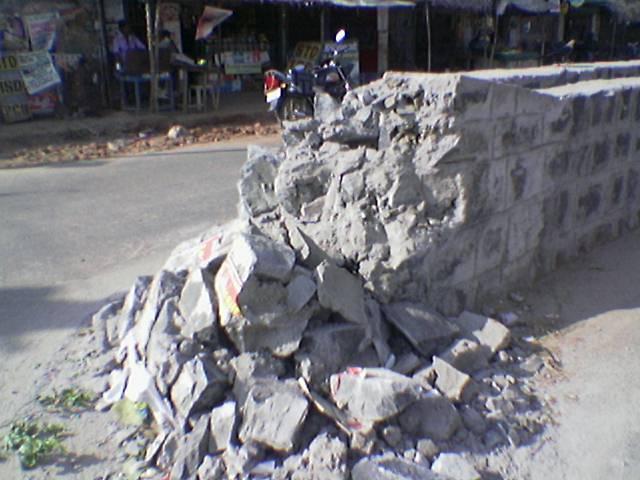
Thiruvallur,Kanchipuram and Chennai district administrations are fast removing encroachments.Especially Thiruvallur district administrattion is doing a good job.Almost 5 buildings occuping around 7 acres of a deemed university were demolished and still the demolition continues for the second day.This is a bold step forward.Days when encroachers taking shelter of judicial system are gone.Courts started realising the seriousness of the issue and turns hard againt encroachers.
Things should not stop with this.They have occupied the land and brought agony to public.They must be made to hold the liability.I dont think any such law provision exists in India to make encroachers liable for their illegal activity.Even if there exists one none of the governments or administrations makes use of it.Like Polluter Pays Principle there must be Encroacher Pays Principle.If governments or judicial system has soft corner towards them its equivalent to encouraging them.
In India it is common sight to see encroachers reoccuping land within few days or even hours after the enviction.This reflects the ineffectiveness of the entire system.
Even interesting is the case if the public land is occupied for religious needs.Some argue that demolishing such occupied structures hits the religious sentiments of the people.Certain group of organisations always to ready to back such arguers.Even distressing were the verdicts of the courts in such cases.
In Cuddalore the situation is much the same.There are several instances where encroachers have transfered government property into their own.Particularly in Nellikuppam Road most shops and work-shops between Hospital Road and Semandalam are on such occupied land.Most of these shops were inundated a few weeks back.
There is a proposal to rise and strengthen the bunds on Gedilam river and to construct a new road over that.So the present situation can be well utilised by the district administration to remove those encroachments and kick start the proposed project.Let us see how the Collector Mr.GanadeepSingh Bedi handles this.
Thursday, December 15, 2005


Wednesday, December 14, 2005
Sunday, December 11, 2005
Vinyl Chloride not an explosive ??
In the previous post you would see Chemplast claiming Vinyl Cholride is not an explosive or carcinogenic.This is ridiculous.It is a well established fact that vinyl chloride is carcinogenic.Below I have pasted some of the health hazards caused by vinyl chloride from AGENCY FOR TOXIC SUBSTANCE AND DISEASE REGISTRY
Inhalation
In the following posts I will bring in more details from a report by Dr.Mark Chernaik
- At room temperature, vinyl chloride is a colorless, highly flammable, potentially explosive gas.
- The primary target of vinyl chloride acute exposure is the CNS. Signs and symptoms include dizziness, ataxia, inebriation, fatigue, numbness and tingling of the extremities, visual disturbances, coma, and death.
- Chronic exposure can cause permanent liver injury and liver cancer, neurologic or behavioral symptoms, and changes to the skin and bones of the hand.
Inhalation
Inhalation is the primary route of exposure, and vinyl chloride is readily absorbed from the lungs. Its odor threshold is too high to provide an adequate warning of hazardous concentrations. The odor of vinyl chloride becomes detectable at around 3,000 ppm and the OSHA PEL is 1 ppm (8-hour TWA). Therefore, workers can be overexposed to vinyl chloride without being aware of its presence. A 5-minute exposure to airborne concentrations of 8,000 ppm can cause dizziness. As airborne levels increase to 20,000 ppm, effects can include drowsiness, loss of coordination, visual and auditory abnormalities, disorientation, nausea, headache, and burning or tingling of the extremities. Exposure to higher concentrations of vinyl chloride for longer durations can cause death, presumably due to central nervous system (CNS) and respiratory depression. The gas is heavier than air and can cause asphyxiation in poorly ventilated or enclosed spaces.
Children exposed to the same levels of vinyl chloride as adults may receive a larger dose because they have greater lung surface area:body weight ratios and increased minute volumes:weight ratios. In addition, they may be exposed to higher levels than adults in the same location because of their short stature and the higher levels of vinyl chloride found nearer to the ground.
Respiratory
Vinyl chloride gas inhalation can cause mild respiratory tract irritation, wheezing, and chemical bronchitis. These effects are transient and resolve quickly following removal from exposure. Death may result from respiratory depression.
Carcinogenicity
The U.S. Department of Health and Human Services (DHHS) and the International Agency for Research on Cancer (IARC) have classified vinyl chloride as a known human carcinogen. Vinyl chloride has caused angiosarcoma of the liver in heavily exposed.
Reproductive and Developmental Effects
Vinyl chloride is included in Reproductive and Developmental Toxicants, a 1991 report published by the U.S. General Accounting Office (GAO) that lists 30 chemicals of concern because of widely acknowledged reproductive and developmental consequences. However, there is no conclusive evidence of reproductive or developmental effects in humans. A few case reports describe decreased libido or fertility in men with chronic occupational exposure, and some animal studies also support this finding. Some studies in experimental animals have reported developmental toxicity associated with high-dose exposures, but vinyl chloride is not considered a developmental toxicant.
Special consideration regarding the exposure of pregnant women is warranted, since vinyl chloride has been shown to be a genotoxin; thus, medical counseling is recommended for the acutely exposed pregnant women.
-----------------------------------------------------------------------------------------------------------------------------------------------------------------
For more information log on to http://www.atsdr.cdc.gov/MHMI/mmg20.html
In the following posts I will bring in more details from a report by Dr.Mark Chernaik
Chemplast clarifies ?
I have pasted the following news report from New Today
Chemplast clarifies on news report
Chemplast Sanmar Limited has clarified that the proposed new PVC Project at Cuddalore SIPCOT would not affect health or cause pollution hazards as claimed by community groups and environmentalists.
Following the news report that appeared on News Today dated 9 December, the company claimed the project clearance had been given by the Union Ministry of Environment and Forests only after taking into consideration the observation made in the public hearing and the apprehensions raised by some of the environmental groups.
The company maintains that there is no violation of the EIA notification 1994, as the setting up of the de-salination plant and captive power plant in the plan as per the direction of the Technical Committees had been approved only after assessing their impact.
The company also denied Vinly Chloride Monomer is not an explosive or carcinogenic. Chemplast further said it was not correct to state that International Finance Corporation (IFC) abandoned the project on the basis of the opposition to the project at the public hearing in Cuddalore.
It added that due to delay in getting the approvals, the company requested IFC to put the project on hold.
The last public hearing conducted in Cuddalore was on 7 June, 2002. After that the company relocated its proposal to setup its new PVC plant to Krishnapatnam in Nellore district, Andhra Pradesh. In 1999, the Sernmankuppam Panchayat, within the jurisdiction of which SIPCOT Phase II lies, passed a resolution prohibiting the setting up of polluting or water-intensive industries in that complex.People Condemn Govt. Nod to Chemplast's Poison Plastic Factory
Contributed by Mr.Nityanand Jayaraman
People Condemn Govt. Nod to Chemplast's Poison Plastic Factory
Environmental and community groups have condemned the clearance granted by the Union Ministry of Environment & Forests to Chemplast Sanmar's controversial proposal to set up a PVC factory in SIPCOT Cuddalore. Cuddalore residents and environmental groups have said they will fight the proposal in the courts and in public fora. PVC is a poison plastic whose production, usage and disposal are associated with the release of a variety of life-threatening poisons including dioxins and furans.
The project clearance is illegal for a variety of reasons, including the fact that the decision was taken based on an outdated Environmental Impact Assessment prepared using 1999 data. The EIA is fundamentally flawed, and the project has several new components whose environmental impacts have neither been assessed nor understood. A desalination plant and a captive power plant have been added to the project. Both have significant environmental impacts, but neither have been assessed for their impacts, in violation of the EIA Notification, 1994. Additionally, the factory will use explosive and carcinogenic Vinyl Chloride Monomer (VCM) as raw material and will be located adjacent to a rocket fuel manufacturing facility. A mishap in one factory could snowball into a major disaster owing to the proximity of the two factories storing large quantities of explosive chemicals to residential areas.
The proposal was initially mooted in 2002. But the company relocated its proposal to Krishnapatnam, Andhra Pradesh, after Cuddalore residents expressed their opposition to the factory at a Government-held public hearing and forced one of the project financiers, the International Finance Corporation, to abandon the project. Krishnapatnam villagers too rejected Chemplast after a delegation visited Mettur to see first-hand the company's track record. Until late 2004, the company was unable to secure permission from the Andhra Pradesh Pollution Control Board. In April 2005, the project proposal was revived in Tamilnadu, and the Government granted it a "No Objection Certificate" without consulting with public despite the project's history of rejections by communities.
Chemplast is a major polluter with a poor track record of environmental compliance. In July 2005, the Indian People's Tribunal chaired by Justice (Retd) Akbar B. Kadri of the Madras High Court found the company's Mettur facilities guilty of discharging toxic effluents into the Kaveri, degrading several thousand acres of farmland, contaminating groundwater and affecting the health of villagers and workers.
The decisions by the State Government and the Ministry of Environment & Forests shows how all political parties are united when it comes to supporting corporations and ignoring the sentiments of local communities. Pollution-impacted villagers in Cuddalore have pleaded for a ban on the setting up of polluting factories in SIPCOT owing to the over-polluted nature of the industrial estate and its location within residential areas. Indeed, the State Human Rights Commission, the Indian People's Tribunal, leaders of various political parties including the PMK, MDMK, and the local DMK MLA Mr. Pugazhenthi have conveyed their opposition to the setting up of polluting units in SIPCOT. The factory has been approved despite resolutions against such units by the Panchayat and the Panchayat Union. However, rather than clean up the region and make it safe for residents, the Government has announced plans to relocate several more polluting units including dyeing and tanning units to SIPCOT Cuddalore.
Contact details:
(In Chennai) Shweta Narayan 9444024315/ Nityanand Jayaraman 9444082401
M. Nizamudeen in Cuddalore 9443231978
Website: http://www.sipcotcuddalore.com/
People Condemn Govt. Nod to Chemplast's Poison Plastic Factory
Environmental and community groups have condemned the clearance granted by the Union Ministry of Environment & Forests to Chemplast Sanmar's controversial proposal to set up a PVC factory in SIPCOT Cuddalore. Cuddalore residents and environmental groups have said they will fight the proposal in the courts and in public fora. PVC is a poison plastic whose production, usage and disposal are associated with the release of a variety of life-threatening poisons including dioxins and furans.
The project clearance is illegal for a variety of reasons, including the fact that the decision was taken based on an outdated Environmental Impact Assessment prepared using 1999 data. The EIA is fundamentally flawed, and the project has several new components whose environmental impacts have neither been assessed nor understood. A desalination plant and a captive power plant have been added to the project. Both have significant environmental impacts, but neither have been assessed for their impacts, in violation of the EIA Notification, 1994. Additionally, the factory will use explosive and carcinogenic Vinyl Chloride Monomer (VCM) as raw material and will be located adjacent to a rocket fuel manufacturing facility. A mishap in one factory could snowball into a major disaster owing to the proximity of the two factories storing large quantities of explosive chemicals to residential areas.
The proposal was initially mooted in 2002. But the company relocated its proposal to Krishnapatnam, Andhra Pradesh, after Cuddalore residents expressed their opposition to the factory at a Government-held public hearing and forced one of the project financiers, the International Finance Corporation, to abandon the project. Krishnapatnam villagers too rejected Chemplast after a delegation visited Mettur to see first-hand the company's track record. Until late 2004, the company was unable to secure permission from the Andhra Pradesh Pollution Control Board. In April 2005, the project proposal was revived in Tamilnadu, and the Government granted it a "No Objection Certificate" without consulting with public despite the project's history of rejections by communities.
Chemplast is a major polluter with a poor track record of environmental compliance. In July 2005, the Indian People's Tribunal chaired by Justice (Retd) Akbar B. Kadri of the Madras High Court found the company's Mettur facilities guilty of discharging toxic effluents into the Kaveri, degrading several thousand acres of farmland, contaminating groundwater and affecting the health of villagers and workers.
The decisions by the State Government and the Ministry of Environment & Forests shows how all political parties are united when it comes to supporting corporations and ignoring the sentiments of local communities. Pollution-impacted villagers in Cuddalore have pleaded for a ban on the setting up of polluting factories in SIPCOT owing to the over-polluted nature of the industrial estate and its location within residential areas. Indeed, the State Human Rights Commission, the Indian People's Tribunal, leaders of various political parties including the PMK, MDMK, and the local DMK MLA Mr. Pugazhenthi have conveyed their opposition to the setting up of polluting units in SIPCOT. The factory has been approved despite resolutions against such units by the Panchayat and the Panchayat Union. However, rather than clean up the region and make it safe for residents, the Government has announced plans to relocate several more polluting units including dyeing and tanning units to SIPCOT Cuddalore.
Contact details:
(In Chennai) Shweta Narayan 9444024315/ Nityanand Jayaraman 9444082401
M. Nizamudeen in Cuddalore 9443231978
Website: http://www.sipcotcuddalore.com/
Flood Update -- Cuddalore
Contributed by Mr.Nityanand Jayaraman
Just as life is limping back to normal in the flood-hit areas of Cuddalore and Chennai, yet another "severe depression" -- named Fanoos -- is poised in the Bay of Bengal southeast of Chennai, threatening to make landfall somewhere between Nagapattinam and Chennai, i.e. Cuddalore. In Cuddalore, AID-India and Cuddalore District Consumer Protection Organisation are liaising with the SIPCOT Area Community Environmental Monitors to distribute relief material to those hardest hit by the floods.
In the vicinity of the SIPCOT Chemical industrial area, Sonnanchavadi and Semmankuppam villages were worst hit. Some houses in Sangolikuppam and Eachangadu were marginally affected. Our relief efforts, therefore, focused on these villages.
Sonnanchavadi registered 100 percent damage. All 90 households were severely damaged or had several feet of standing water inside. Sonnanchavadi is a fishing village, and among the poorest in the region. Many of the huts could not withstand the onslaught of nature's fury. The families were staying in temporary shelters, in temples, the local school and houses outside that were not severely damaged. Over the last few days, people repaired some of the houses to allow them to return home. However, if Fanoos hits again, the villagers are likely to be out in the water once again. The school, where SACEM workshops are usually held, is totally washed out. This village is likely to require concerted near-term assistance, because most of the families are below-poverty line, and are unlikely to recover anytime soon given that fishing has not returned to normal yet. According to SACEM member and fisherman S. Pugazhenthi, Uppanar river is heavily silted up. As a result, fish catch has dwindled. Those who venture out to fish barely make Rs. 20 for a day's fishing. "It will take a few weeks after the rains stop for the tide to flush out the silt, and only then will fishing return to normal," says Pugazhenthi. Less than a year ago, Sonnanchavadi fishermen lost gear and craft to the Tsunami.
In Semmankuppam, a far better-off farming village, many houses had at least 2 feet of water. Farmers have suffered extensive crop damage, and some have lost entire year's stock of provisions in the water. Nearly 4000 acres of standing crops belonging to Semmankuppam farmers have been destroyed. According to SACEM member S. Ramanathan, the Government has surveyed the crop loss, and there is talk of distribution of compensation of Rs. 8000/acre by the State Government. Also, it is rumoured that on 10 December, interim relief of Rs. 1000 will be distributed.
Relief Distributed
Thanks to contributions from AID-India, AID-Austin, AID-Bay Area and Denny Larson of Global Community Monitor, 1385 packs containing 10 kg rice, 1240 packs of 1-litre cooking oil, and 800 blankets were distributed on a priority basis to those hardest hit.
All 90 families in Sonnanchavadi, including 3 that did not have a ration card, received complete packs containing rice, oil and blankets. In Semmankuppam, 690 kits containing rice, oil and blankets were reached to affected residents from Thachan Colony, Mettu Semmankupam and Semmankuppam village.
In Sangolikuppam, a multi-community village, only 30 huts were affected, and only marginally. However, given that many of the residents here too are at or below poverty level, it was decided to distribute smaller packs -- containing 5 kg rice and 1 litre oil -- to all 465 households.
In Eachangadu, only rice packets were distributed to 145 households.
Besides those living in the villages, we had identified stray families ostracised by the villages and living in the peripheries. About 10 such families were also given blankets. Rice and other provisions will be delivered in a couple of days.
Eachangadu -- 145 families. Only rice.
10 blankets -- People outside villages. Monday or Tuesday.
Just as life is limping back to normal in the flood-hit areas of Cuddalore and Chennai, yet another "severe depression" -- named Fanoos -- is poised in the Bay of Bengal southeast of Chennai, threatening to make landfall somewhere between Nagapattinam and Chennai, i.e. Cuddalore. In Cuddalore, AID-India and Cuddalore District Consumer Protection Organisation are liaising with the SIPCOT Area Community Environmental Monitors to distribute relief material to those hardest hit by the floods.
In the vicinity of the SIPCOT Chemical industrial area, Sonnanchavadi and Semmankuppam villages were worst hit. Some houses in Sangolikuppam and Eachangadu were marginally affected. Our relief efforts, therefore, focused on these villages.
Sonnanchavadi registered 100 percent damage. All 90 households were severely damaged or had several feet of standing water inside. Sonnanchavadi is a fishing village, and among the poorest in the region. Many of the huts could not withstand the onslaught of nature's fury. The families were staying in temporary shelters, in temples, the local school and houses outside that were not severely damaged. Over the last few days, people repaired some of the houses to allow them to return home. However, if Fanoos hits again, the villagers are likely to be out in the water once again. The school, where SACEM workshops are usually held, is totally washed out. This village is likely to require concerted near-term assistance, because most of the families are below-poverty line, and are unlikely to recover anytime soon given that fishing has not returned to normal yet. According to SACEM member and fisherman S. Pugazhenthi, Uppanar river is heavily silted up. As a result, fish catch has dwindled. Those who venture out to fish barely make Rs. 20 for a day's fishing. "It will take a few weeks after the rains stop for the tide to flush out the silt, and only then will fishing return to normal," says Pugazhenthi. Less than a year ago, Sonnanchavadi fishermen lost gear and craft to the Tsunami.
In Semmankuppam, a far better-off farming village, many houses had at least 2 feet of water. Farmers have suffered extensive crop damage, and some have lost entire year's stock of provisions in the water. Nearly 4000 acres of standing crops belonging to Semmankuppam farmers have been destroyed. According to SACEM member S. Ramanathan, the Government has surveyed the crop loss, and there is talk of distribution of compensation of Rs. 8000/acre by the State Government. Also, it is rumoured that on 10 December, interim relief of Rs. 1000 will be distributed.
Relief Distributed
Thanks to contributions from AID-India, AID-Austin, AID-Bay Area and Denny Larson of Global Community Monitor, 1385 packs containing 10 kg rice, 1240 packs of 1-litre cooking oil, and 800 blankets were distributed on a priority basis to those hardest hit.
All 90 families in Sonnanchavadi, including 3 that did not have a ration card, received complete packs containing rice, oil and blankets. In Semmankuppam, 690 kits containing rice, oil and blankets were reached to affected residents from Thachan Colony, Mettu Semmankupam and Semmankuppam village.
In Sangolikuppam, a multi-community village, only 30 huts were affected, and only marginally. However, given that many of the residents here too are at or below poverty level, it was decided to distribute smaller packs -- containing 5 kg rice and 1 litre oil -- to all 465 households.
In Eachangadu, only rice packets were distributed to 145 households.
Besides those living in the villages, we had identified stray families ostracised by the villages and living in the peripheries. About 10 such families were also given blankets. Rice and other provisions will be delivered in a couple of days.
Eachangadu -- 145 families. Only rice.
10 blankets -- People outside villages. Monday or Tuesday.
Saturday, December 10, 2005
History:Central Prison, Cuddalore
This Prison was constructed during the year 1865.During the year 1986 this Prison was classified as Prison for Habitual Prison offenders. Once again this Prison was converted as casual Prison during the year 1996. The National poet Mahakavi Subramaniya Bharathiyar was confined during freedom struggle from 20.11.1918 to 14.12.1918. The authorised accommodation of this Prison is 723.
Friday, December 09, 2005
Thursday, December 08, 2005
Plastics in marine ecosystem
I could see a lot of plastic materials and poly-ethene papers being carried into the sea by rivers during the recent flooding.These plastic papers detoriate agricultural productivity and have several other adverse effects on land ecosystem.Until recently I have never imagined what effect it would have on marine ecosystem.It dont think much research work had been carried out in this area.Any such a research work would be too expensive for any government or NGO.One simple thing we can do is reduce the usage of plastic.
Wednesday, December 07, 2005
CYCLONE WARNING FROM MET DEPT.

The Cyclonic storm (FANOOS) over Southwest Bay of Bengal moved slightly westwards and lies centred at 1430hrs IST of 09th December at about 300 Kilometres East of Nagapattinam. It is likely to intensify further and move in a west northwesterly direction and cross North Tamilnadu coast between Chennai and Nagapattinam by tomorrow noon the 10th December
Source http://education.vsnl.com/imdchennai/info_cyc.htm
Photo source: https://afweather.afwa.af.mil/images/satellite/IGMSIR01_L.GIF
Sunday, December 04, 2005
Chemplast-Sanmar Cuddalore PVC plant cleared
Ministry for Environment and Forests (MoEF) has given the clearance for a Rs. 400 crore PVC (poly vinyl chloride) plant to be set up by the Chemplast-Sanmar Group at Cuddalore.The ground-breaking ceremony will be on March 2006.
Tamil Nadu Pollution Control Board and the MoEF said that they were satified with the precautions taken by the promoters.
There were lots of protest againt the project by various environmental groups and local people.Scientists have spoted out various flaws in the proposed design.They have also pointed out various shortcomings in 'Environmental Impact Assesment (EIA) for the PVC plant'.
The feedstock for the PVC plant will be vinyl chloride monomer(VCM).VCM is carcinogenic compound. The initial production will be for 1.40 lakh tonnes.The production will be stepped up to 1.70 lakh tonnes on a later stage.
Chemplast puts that the unit will be a "zero discharge unit"(certainly not going to be the case).It adds that it will not use ground water but setup a desalination plant to process seawater. An 8 MW power plant will be part of the Cuddalore complex, to come up in the SIPCOT industrial
estate.
Tamil Nadu Pollution Control Board and the MoEF said that they were satified with the precautions taken by the promoters.
There were lots of protest againt the project by various environmental groups and local people.Scientists have spoted out various flaws in the proposed design.They have also pointed out various shortcomings in 'Environmental Impact Assesment (EIA) for the PVC plant'.
The feedstock for the PVC plant will be vinyl chloride monomer(VCM).VCM is carcinogenic compound. The initial production will be for 1.40 lakh tonnes.The production will be stepped up to 1.70 lakh tonnes on a later stage.
Chemplast puts that the unit will be a "zero discharge unit"(certainly not going to be the case).It adds that it will not use ground water but setup a desalination plant to process seawater. An 8 MW power plant will be part of the Cuddalore complex, to come up in the SIPCOT industrial
estate.

Saturday, December 03, 2005
Sea water surges inwards in Silver Bay Area
 The photo you see here was taken a few days before the flooding. Now due to the slight rise in water level after flooding in Gedila the sandscape is completely under water.
All these chairs are washed away. There were similar chair arrangements before the tsunami. But shore looked bare after it. Collector Mr.GagandeepSingh Bedi must have taken much effort to get the chairs from donors. But everything is lost for the second time.
Anyway beach without these chairs will be even more beautiful. To me beaches should be a place untouched by any sort of human interference. In recent years there has been many (so called) developments in the Silver Beach Area. Sandscape of the beaches should left without any sort of construction work. Beaches are beautiful by itself one cannot make it more beautiful.
TN floods: Kalam assures support-NDTV
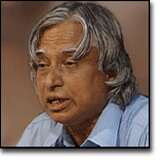
The following news item was originally from NDTV on 29th of November
President A P J Abdul Kalam assured Tamil Nadu Chief Minister Jayalalithaa of the Centre's support to the state in coping with the flood situation.
He also said he will undertake an aerial survey of the flood-affected areas of Cuddalore district on December 1.
Welcoming his visit and the assurance of support from the President, the Chief Minister told Kalam that she would make a detailed presentation to him on the flood situation.
She also promised to make available details of the extent of damage caused to property and crops and the relief operations undertaken by her government. (PTI)
© NDTV 2005
Cuddalore battles incessant rains-NDTV
The following news item was originally from NDTV on 29th of November
For a district that literally means 'town by the sea', Cuddalore is completely at sea battling the merciless rain god.
Take for example, the 5,000 villagers in Perampet, for whom water is now associated with death, destruction, disease and misery.
Three thousand hectares of cultivable land, where farmers grew paddy, drumsticks, flowers and bananas, have been under water since 25 October.
Three spells of heavy rainfall have meant that the water had no chance to dry up. "People are just managing to save their lives. We have lost crops, cattle and fishing nets," says a villager.
Grim situation
Three villages ahead of Perampet have been cut off for several days now and boats are the only lifeline left. And the situation is pretty much the same even closer to the district headquarters.
"We have lost all our household goods. We have just managed to come out alive," explains a villager who belongs to the Alapakkam panchayat.
Relief supplies are being brought in to the affected areas but with thousands of people rendered homeless, it is an uphill task for the district administration.
"During tsunami we had to attend to only 50 villages but in these floods, the administration's focus is on a large area of 420 villages of which 383 are affected in a big way,'' said Gagandeep Singh, Collector, Cuddalore.
Cuddalore suffers every time there is heavy rainfall in Tamil Nadu's catchment areas because five major rivers pass through the district before flowing into the sea. But geography alone cannot be a crime to push Cuddalore on to the road.
© NDTV 2005
For a district that literally means 'town by the sea', Cuddalore is completely at sea battling the merciless rain god.
Take for example, the 5,000 villagers in Perampet, for whom water is now associated with death, destruction, disease and misery.
Three thousand hectares of cultivable land, where farmers grew paddy, drumsticks, flowers and bananas, have been under water since 25 October.
Three spells of heavy rainfall have meant that the water had no chance to dry up. "People are just managing to save their lives. We have lost crops, cattle and fishing nets," says a villager.
Grim situation
Three villages ahead of Perampet have been cut off for several days now and boats are the only lifeline left. And the situation is pretty much the same even closer to the district headquarters.
"We have lost all our household goods. We have just managed to come out alive," explains a villager who belongs to the Alapakkam panchayat.
Relief supplies are being brought in to the affected areas but with thousands of people rendered homeless, it is an uphill task for the district administration.
"During tsunami we had to attend to only 50 villages but in these floods, the administration's focus is on a large area of 420 villages of which 383 are affected in a big way,'' said Gagandeep Singh, Collector, Cuddalore.
Cuddalore suffers every time there is heavy rainfall in Tamil Nadu's catchment areas because five major rivers pass through the district before flowing into the sea. But geography alone cannot be a crime to push Cuddalore on to the road.
© NDTV 2005
Over 100,000 people affected by rains in south India, World Vision responds-ReliefWeb
New item from ReliefWeb
Over 100,000 people have been made homeless in southern Tamil Nadu after the heaviest rains in 50 years lashed the area.
The worst devastation occurred in Cuddalore district where 500 villages have been left under water and most parts are without power. News channel NDTV reported that six lakes in the area are overflowing.
Authorities have reportedly evacuated around 100,000 people and distributed food packets to survivors. If the weather improves, authorities say it will take at least 10 days for the water to recede. The army is expected to help with rescue and relief work.
World Vision Emergency Response and Disaster Mitigation Director Franklin Joseph reported that, "Apart from the Cuddalore and Nagapattinam tsunami locations, four other ADPs [World Vision Area Development Programs] in Tamil Nadu are affected by the floods." These include Mannargudi, Karikudi , Usilampatty and Perambalur ADPs.
World Vision staff whose homes were also affected by flooding are struggling to provide relief in the target areas. "We are using the self-help groups and village development committees to carry out the relief," reported Christabel Albert, Associate Director, Chennai. "Accessibility is the main problem now. Even our staff are stranded and they are not able to reach the communities for a situation assessment."
Community development coordinators who live in the communities arranged the initial supply of food packets and biscuits. "External aid is needed to respond to a situation of this magnitude," said Christabel.
Reporting from the flood affected villages of Perambalur where World Vision works through the Perambalur ADP, Program Manager Vani Victor said that the team had helped close to 6,000 families with food over the last two days. "We are concentrating on the most affected villages, and are looking at providing dry food by tomorrow," she said.
While the situation is not so grim in Usilampatty ADP, located in Madurai district, eight target villages are under water. All community members (nearly 300 families) from these villages are now sheltered in community halls and schools.
Assistance has been provided in coordination with the government. Over 200 bed sheets along with medicines have been provided to evacuated families.
In the tsunami-affected areas, World Vision India Tsunami Response Team are responding to the needs of the villages affected by the floods.
"We are looking at a coordinated effort in consultation with the government in each of these locations," said Franklin Joseph.
© 2004 ReliefWebFriday, December 02, 2005
Sea water surges inwards in Silver Beach
As a large quantity of water enters into the sea from Gadilam river sea water surges inwards in Silver Beach area.There is no reason to worry as the water will recede back in a week time but what is really amazing is that only a few feet of coast left.Most of the chairs in the beach are washed only a few left.I will get the photos if time permits.
Kalam's visit
President Abdul Kalam visited the flood affected parts of the Cuddalore district yesterday.He later addressed the student of IITM and attended various other functions in Chennai and Vellore.
Wednesday, November 30, 2005
President Abdul Kalam visiting Cuddalore
President A.P.J.Abdul Kalam visiting Cuddalore tommorow to asess the flood situation here.He is visiting the flood affected parts of Cuddalore district on his way to Chennai from Trichy.
Cuddalore flooding round up
After a long break I am updating the blog due to unusual scenario here.
Since the onset of the monsoon there has been three consecutive floods in Cuddalore district last proving fatal.Massive flooding in almost all parts of Cuddalore district has caused severe damage to life and property.This is the second large scale disaster in a years time.Many hamlets which were worst hit by tsunami are also affected by recent floodings.Gadilam and Then Pannai in Cuddalore and Coleeron in southern part of the district flooded inundating the surrounding area.
Flood water of Then Pennai raised atleast 15 feet above the normal level submerging the lowlying areas like Uppalavadi,Thazhalnguda(badly affected by tsunami) and also the north bank of the river.
Similarly was the condition of Gadilam.Furiousity was even greater here.River was flowing in its full capacity thus betraying the occupants.Several garages and shops in Nellikupam High Road were flooded completely.Most among them are encroachers of the river bank.I could barely see tops of the lorries there.
Coleeron was carrying mammoth quantity of water.Probably this time it carried highest amount of water in recorded history.
Veeranam lake nearly reached its full capacity.The water level was maintained below 46feet(recall the bunds of the tank was raised as a part of New Veeranam Project to provide drinking water for Chennai).A large amount of water was opened into Vellar.At a certain stage the water from Vellar started entering into the tank on opening the shutters to worsen the situation.
Excess outlet water from the lake and Coleeron inundated several parts of the district like Chidambaram,Sathiyathope,Kattumanarkoil and Parengipettai.
Water level in Sathiyathope was said to be soo high that water even reached the first floor of houses whose ground floor was already submerged.It was here district collector Mr.GanandeepSingh Bedi got trapped while on rescue opertation.Later Coast Guard helicopter rescued him.
Now after a week the flood water is slowly receding.Cuddalore, the headquaters is as normal.But places like Chidambaram are still surrounded by water.Human bodies and that of animal are found scattered in decayed state in this area.The situation is far worst that people start fleeding their homes.There is a greater chance for outbreak of infectious diseases.But the Cuddalore district administration is taking no chances.But magnitude of the disaster proves a real challenge.Military personnel called in.Military doctors treats people in worst affected areas.The situation is gradually improving and it would take atleast a few weeks for things get back to normal.
Since the onset of the monsoon there has been three consecutive floods in Cuddalore district last proving fatal.Massive flooding in almost all parts of Cuddalore district has caused severe damage to life and property.This is the second large scale disaster in a years time.Many hamlets which were worst hit by tsunami are also affected by recent floodings.Gadilam and Then Pannai in Cuddalore and Coleeron in southern part of the district flooded inundating the surrounding area.
Flood water of Then Pennai raised atleast 15 feet above the normal level submerging the lowlying areas like Uppalavadi,Thazhalnguda(badly affected by tsunami) and also the north bank of the river.
Similarly was the condition of Gadilam.Furiousity was even greater here.River was flowing in its full capacity thus betraying the occupants.Several garages and shops in Nellikupam High Road were flooded completely.Most among them are encroachers of the river bank.I could barely see tops of the lorries there.
Coleeron was carrying mammoth quantity of water.Probably this time it carried highest amount of water in recorded history.
Veeranam lake nearly reached its full capacity.The water level was maintained below 46feet(recall the bunds of the tank was raised as a part of New Veeranam Project to provide drinking water for Chennai).A large amount of water was opened into Vellar.At a certain stage the water from Vellar started entering into the tank on opening the shutters to worsen the situation.
Excess outlet water from the lake and Coleeron inundated several parts of the district like Chidambaram,Sathiyathope,Kattumanarkoil and Parengipettai.
Water level in Sathiyathope was said to be soo high that water even reached the first floor of houses whose ground floor was already submerged.It was here district collector Mr.GanandeepSingh Bedi got trapped while on rescue opertation.Later Coast Guard helicopter rescued him.
Now after a week the flood water is slowly receding.Cuddalore, the headquaters is as normal.But places like Chidambaram are still surrounded by water.Human bodies and that of animal are found scattered in decayed state in this area.The situation is far worst that people start fleeding their homes.There is a greater chance for outbreak of infectious diseases.But the Cuddalore district administration is taking no chances.But magnitude of the disaster proves a real challenge.Military personnel called in.Military doctors treats people in worst affected areas.The situation is gradually improving and it would take atleast a few weeks for things get back to normal.
Thursday, November 24, 2005
FLOOD SITUATION IN GADILUM AND PENNAR RIVERS
The water flowing in these two rivers is alarming.The following is the situation witnessed today morning 24/11/2005 at 10.00 a.m.
In the pennar bridge (Pondy – Cuddalore Road)
Water release from Sattanur dam which is expected to be increased is expected to aggravate the flood situation in river pennar.
In the pennar bridge (Pondy – Cuddalore Road)
The water level is such that it is touching nearly 6 feet upto the ceiling level of the old bridge which is parallel to the new bridge.
In Gadilum - Kammiampet new bridge (Kammiampet - Semmandalam Road)
In Gadilum - Kammiampet new bridge (Kammiampet - Semmandalam Road)
The level as is such that its is only 2 feet nearer to the ceiling of the new bridge.
Water release from Sattanur dam which is expected to be increased is expected to aggravate the flood situation in river pennar.
Saturday, November 19, 2005
World Vision Asia Tsunami Response - Oct/Nov Update
Here I paste you a part of the Oct/Nov Update from World Vision
World Vision Asia Tsunami Response - Oct/Nov Update
India Program Update Working in the following areas: Tamil Nadu – Cuddalore, Nagapattinam, Kanyakumari, Chennai/Kalpuakkam; Pondicherry; Kerala – Kollam/Alleppy; Andhra Pradesh - Machilipatnam, Narsapur and Singarayakonda; Andaman and Nicobar islands Gender and Health · More than 2000 hygiene kits distributed in the Andamans and Cuddalore. · Dental and medical camps conducted in Chennai and post-natal care provided to mothers in the Andamans, Nagapattinam and Cuddalore. · Elderly women targeted with supplementary feeding in Cuddalore. · Water management training conducted in Chennai and Nagapattinam. · Health awareness programmes provided to more than 100 individuals in Cuddalore, Kerala and Pondicherry. Infrastructure · Infrastructure recovery is gaining pace with 100 permanent houses handed over in Kerala. Construction work has also started in Cuddalore, Kanyakumari, Andhra Pradesh, Nagapattinam, and Pondicherry. · A foundation stone laid for construction of a new school in Cuddalore. · Playground equipment installed in the Andamans. · Drainage repair undertaken in 150 transitional shelters in Nagapattinam. · A Child Friendly Space is under construction in Cuddalore. · Maintenance work conducted for 625 transitional shelters in Nagapattinam. Economic Recovery · More than 50 boats donated in Pondicherry and the Andamans; over 200 people receive fishing nets and tackles. · Cash for Work programs benefit 1,057 families in Chennai and the Andamans. · 870 sewing machines distributed in the Andamans and 163 women attend tailoring classes. · Livestock (cows, goats and buffaloes) provided to 118 families in Cuddalore and Narsapur. · Traders provided with shop supplies in Nagapattinam. · Training in book keeping, driving, engine mechanics and computer applications conducted. Community Rehabilitation · 124 families provided resettlement kits (including cooking utensils, buckets, plastic containers, torch lights, water filter, pillows, mugs) in the Andamans. · School supplies (school bags, shoes, pencils, etc) distributed in the Andamans and Pondicherry. · Sandals and monsoon kits distributed in Cuddalore. · Nearly 4000 people benefit from sports and recreational activities such as zoo visits, puppet shows and music events in Chennai, Cuddalore, Kanyakumari and Kerala · Supported tuition fees for 600 school children in Kanyakumari. · Chennai children participated in a creative workshop and a child protection committee formed.full story>>
World Vision Asia Tsunami Response - Oct/Nov Update
India Program Update Working in the following areas: Tamil Nadu – Cuddalore, Nagapattinam, Kanyakumari, Chennai/Kalpuakkam; Pondicherry; Kerala – Kollam/Alleppy; Andhra Pradesh - Machilipatnam, Narsapur and Singarayakonda; Andaman and Nicobar islands Gender and Health · More than 2000 hygiene kits distributed in the Andamans and Cuddalore. · Dental and medical camps conducted in Chennai and post-natal care provided to mothers in the Andamans, Nagapattinam and Cuddalore. · Elderly women targeted with supplementary feeding in Cuddalore. · Water management training conducted in Chennai and Nagapattinam. · Health awareness programmes provided to more than 100 individuals in Cuddalore, Kerala and Pondicherry. Infrastructure · Infrastructure recovery is gaining pace with 100 permanent houses handed over in Kerala. Construction work has also started in Cuddalore, Kanyakumari, Andhra Pradesh, Nagapattinam, and Pondicherry. · A foundation stone laid for construction of a new school in Cuddalore. · Playground equipment installed in the Andamans. · Drainage repair undertaken in 150 transitional shelters in Nagapattinam. · A Child Friendly Space is under construction in Cuddalore. · Maintenance work conducted for 625 transitional shelters in Nagapattinam. Economic Recovery · More than 50 boats donated in Pondicherry and the Andamans; over 200 people receive fishing nets and tackles. · Cash for Work programs benefit 1,057 families in Chennai and the Andamans. · 870 sewing machines distributed in the Andamans and 163 women attend tailoring classes. · Livestock (cows, goats and buffaloes) provided to 118 families in Cuddalore and Narsapur. · Traders provided with shop supplies in Nagapattinam. · Training in book keeping, driving, engine mechanics and computer applications conducted. Community Rehabilitation · 124 families provided resettlement kits (including cooking utensils, buckets, plastic containers, torch lights, water filter, pillows, mugs) in the Andamans. · School supplies (school bags, shoes, pencils, etc) distributed in the Andamans and Pondicherry. · Sandals and monsoon kits distributed in Cuddalore. · Nearly 4000 people benefit from sports and recreational activities such as zoo visits, puppet shows and music events in Chennai, Cuddalore, Kanyakumari and Kerala · Supported tuition fees for 600 school children in Kanyakumari. · Chennai children participated in a creative workshop and a child protection committee formed.full story>>
Thursday, November 03, 2005
Sight and hope restored in Cuddalore - ReliefWeb
Sight and hope restored in Cuddalore
Baltimore, November 3, 2005 -- "Believe it or not, many opportunities and much good have come from the tsunami," said Dr. Thiru Krishnan, an optometrist and eye surgeon who works at a monthly clinic for hypertension and diabetes screening, nutrition education, and blindness prevention in Pondicherry. The clinic is run by ADEPT (the Academy for Disaster Management, Education and Training), a program of Lutheran World Relief's long-time partner, UELCI (United Evangelical Lutheran Church in India). ADEPT increased their capacity and expanded the clinic after the tsunami to respond to the many medical and psycho-social needs of area villagers.
Inside the clinic is a festival-like atmosphere as hundreds of men, women and children moved from station to station. In one area, villagers could receive a comprehensive eye exam and recommendations for glasses, treatment or surgery. In another, three young women -- new volunteers -- educated their peers about nutrition and the value of high-protein, low-cost foods. Across the courtyard, older men and women had their blood pressure tested and received information about hypertension and how to avoid or control it. Finally, in another corner of the courtyard, young nurses screened patients for diabetes and educated those who had been previously diagnosed about how to eat right or how to administer their own insulin.
As visitors from LWR walked through the clinic, one doctor and one patient stood out from the rest of the crowd. Dr. Krishnan's enthusiasm for his work was unmistakable. As he walked the group through the clinic, he introduced them to many patients and offered stories of sight corrected, sight given and eye-related diseases overcome.
"I could work many places in this country or in the world but none would be as exciting as working here," he told LWR President, Kathryn Wolford. When Wolford asked him why he enjoyed his work at the clinic so much, he responded, "Nowhere could the need be as great as here. Many of the patients at this clinic lost everything to the tsunami -- their family members, their homes, their ability to work, their communities and their sense of safety." He continued, "In the face of such great losses, it is our duty to give something back to these people. I am honored to be able to give even a few of them the gift of sight, clear vision or a future without blindness. I am a very lucky man."
Dr. Krishnan excitedly introduced one of his post-tsunami patients, Sevaramun. Before the tsunami, Sevaramun, a 60-year old man with white hair, had suffered for four years with failing sight due to advanced cataracts on both eyes. Sevaramun had lost his wife and children in the tsunami and therefore had lost the people who could serve as his eyes on the world.
A little over two months ago, he attended an ADEPT clinic and talked to the doctor about his cataracts. At first, Sevaramun was too scared to have the surgery the doctor recommended but, over time, the doctor gained his trust and the surgery was scheduled.
Now, only 3 weeks after surgery, the doctor and Sevaramun excitedly demonstrated that sight had been restored to the previously cataract-clouded eye. Sevaramun covered his bad eye with one hand and the doctor had him call out how many fingers he was holding up and had him read a sign on the wall far across the room. Both doctor and patient displayed a contagious enthusiasm at the sight regained through this relatively simple surgery that would have usually been impossible for most villagers to obtain.
Life is bittersweet for Sevaramun, who has regained some of his sight but still suffers from the aching loss of his family, his house, and his ability to earn a living. In spite of his loses, Sevaramun spoke positively about his future. Now that he has seen, literally, how cataract surgery restored his sight, he will allow Dr. Krishnan to operate to remove the cataract from his other eye next month.
Before the LWR delegation left, Sevaramun told them that he had gained something from the Doctor and the ADEPT clinic that he thought he had lost forever: hope.
© 2005 ReliefWeb
Baltimore, November 3, 2005 -- "Believe it or not, many opportunities and much good have come from the tsunami," said Dr. Thiru Krishnan, an optometrist and eye surgeon who works at a monthly clinic for hypertension and diabetes screening, nutrition education, and blindness prevention in Pondicherry. The clinic is run by ADEPT (the Academy for Disaster Management, Education and Training), a program of Lutheran World Relief's long-time partner, UELCI (United Evangelical Lutheran Church in India). ADEPT increased their capacity and expanded the clinic after the tsunami to respond to the many medical and psycho-social needs of area villagers.
Inside the clinic is a festival-like atmosphere as hundreds of men, women and children moved from station to station. In one area, villagers could receive a comprehensive eye exam and recommendations for glasses, treatment or surgery. In another, three young women -- new volunteers -- educated their peers about nutrition and the value of high-protein, low-cost foods. Across the courtyard, older men and women had their blood pressure tested and received information about hypertension and how to avoid or control it. Finally, in another corner of the courtyard, young nurses screened patients for diabetes and educated those who had been previously diagnosed about how to eat right or how to administer their own insulin.
As visitors from LWR walked through the clinic, one doctor and one patient stood out from the rest of the crowd. Dr. Krishnan's enthusiasm for his work was unmistakable. As he walked the group through the clinic, he introduced them to many patients and offered stories of sight corrected, sight given and eye-related diseases overcome.
"I could work many places in this country or in the world but none would be as exciting as working here," he told LWR President, Kathryn Wolford. When Wolford asked him why he enjoyed his work at the clinic so much, he responded, "Nowhere could the need be as great as here. Many of the patients at this clinic lost everything to the tsunami -- their family members, their homes, their ability to work, their communities and their sense of safety." He continued, "In the face of such great losses, it is our duty to give something back to these people. I am honored to be able to give even a few of them the gift of sight, clear vision or a future without blindness. I am a very lucky man."
Dr. Krishnan excitedly introduced one of his post-tsunami patients, Sevaramun. Before the tsunami, Sevaramun, a 60-year old man with white hair, had suffered for four years with failing sight due to advanced cataracts on both eyes. Sevaramun had lost his wife and children in the tsunami and therefore had lost the people who could serve as his eyes on the world.
A little over two months ago, he attended an ADEPT clinic and talked to the doctor about his cataracts. At first, Sevaramun was too scared to have the surgery the doctor recommended but, over time, the doctor gained his trust and the surgery was scheduled.
Now, only 3 weeks after surgery, the doctor and Sevaramun excitedly demonstrated that sight had been restored to the previously cataract-clouded eye. Sevaramun covered his bad eye with one hand and the doctor had him call out how many fingers he was holding up and had him read a sign on the wall far across the room. Both doctor and patient displayed a contagious enthusiasm at the sight regained through this relatively simple surgery that would have usually been impossible for most villagers to obtain.
Life is bittersweet for Sevaramun, who has regained some of his sight but still suffers from the aching loss of his family, his house, and his ability to earn a living. In spite of his loses, Sevaramun spoke positively about his future. Now that he has seen, literally, how cataract surgery restored his sight, he will allow Dr. Krishnan to operate to remove the cataract from his other eye next month.
Before the LWR delegation left, Sevaramun told them that he had gained something from the Doctor and the ADEPT clinic that he thought he had lost forever: hope.
© 2005 ReliefWeb
Sunday, October 30, 2005
Narrow point in Hospital Road
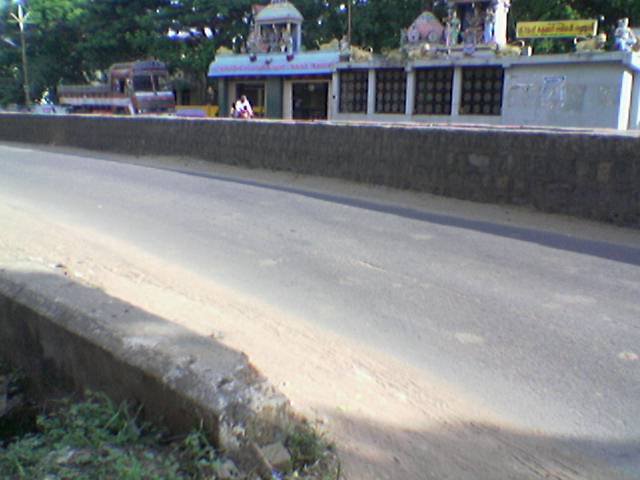
A narrow point in the Hospital Road leading into Chitoor-Cuddalore High Road.
As you see merely a bus can pass though.This is one of the busiest road and this narrow point posses a threat especially to two whellers.The space available on the left side can be well utilized to expand the road at this point.
On opposite side you could see a temple occupying much of the space meant for road.This temple can be relocated elsewhere to provide more room for the traffic.
The Asian Tsunami: A Protective Role for Coastal Vegetation -with graphic details
 The graphics here shows how far the tsunami waves penetrated in areas where there were no coastal vegetation.
Take a look at the image. Dark green shows dense costal forest/tree cover. Light green shows open tree vegetation. Blue with dots show inundated regions, and red shows damaged regions.
There is NO overlap between the greens, and the red and blue. Basically, the costal forest areas suffered almost no damage.
The data speaks for itself. (Science, Vol 310, Issue 5748, 643)
Saturday, October 29, 2005
The Asian Tsunami: A Protective Role for Coastal Vegetation - Science
Below I have pasted the full text of an interesting article I came across in US Newswire.
'The Asian Tsunami: A Protective Role for Coastal Vegetation'
by
Finn Danielsen, Mikael K. Sørensen, Mette F. Olwig, Vaithilingam Selvam, Faizal Parish, Neil D. Burgess, Tetsuya Hiraishi, Vagarappa M. Karunagaran, Michael S. Rasmussen, Lars B. Hansen, Alfredo Quarto, Nyoman Suryadiputra
originally published in Science .The summary of the findings is found in Newswire's article.
New Science Study: Mangroves Shielded Communities Against Tsunami
To: National Desk, Environment Reporter
Contact: Tom Lalley of the World Wildlife Fund, 202-997-0899 or tom.lalley@wwfus.org
WASHINGTON, Oct. 27 /U.S. Newswire/ -- A new study released today in the journal "Science" shows that areas buffered by coastal forests, like mangroves, were strikingly less damaged by the 2004 tsunami than areas without tree vegetation. This is believed to be the first peer-reviewed empirical and field-based study to document a clear link between coastal vegetation and protection from the tsunami. The study was undertaken by a large research team, comprising ecologists, a botanist, geographers, a forester, and a tsunami wave engineer, from seven nations.
"The tsunami left a horrific human tragedy in its wake but also some lessons. Among them is the tremendous importance of mangroves, which are one of the world's most threatened tropical ecosystems," said Faizal Parish, director of the Global Environment Centre in Malaysia and co-author. "While no one could have prevented the tsunami, we can use this experience to prevent some of the destruction future events will cause."
The study's authors used before and after satellite photographs of the Cuddalore District in southeastern India and surveys on the ground to reach their conclusions. The study confirms earlier laboratory experiments which have shown that 30 trees per 100 square meters may reduce the maximum flow of a tsunami by more than 90 percent.
The Cuddalore District provided a unique experimental setting to test the benefits of coastal forests against the tsunami. The shoreline there is relatively straight and the beach profile is relatively uniform. It also contains stretches of vegetated and non-vegetated areas and there are well-documented cloud-free pre- and post-tsunami satellite images.
"Coastal vegetation could probably not have protected against catastrophic destruction in areas of maximum tsunami intensity. In less hard hit areas, however, this study shows very clearly that areas with trees suffered less destruction than areas without trees," said Finn Danielsen, director at the Nordic Agency for Development and Ecology in Denmark and lead author.
While the study adds another important example to the list of key life support services provided by natural wetlands, the study's authors caution against blanket tree-planting programs. While in some cases these programs are useful to restore deforested areas, they can be counterproductive if beach ecology is disrupted. Some countries affected by the tsunami have initiated tree planting programs without fully considering their ecological impact.
Five of the villages examined in the study include two on the coast and three behind mangroves. The villages on the coast were completely destroyed, whereas those behind the mangrove suffered no destruction even though other areas unshielded by vegetation at the same distance from the coast were damaged. The study concluded that the forested areas protected the villages from tsunami damage by reducing the energy of waves.
"The sorrow I feel over the tsunami is magnified by the knowledge that a great deal of destruction could have been avoided," said Selvam Vaithilingam, programme director with the M.S. Swaminathan Foundation in Chennai, India and co-author. "In the five countries most affected by the tsunami, human activities reduced the area of mangroves by 26 percent between 1980 and 2000."
Although the study only looked at the 2004 tsunami, the study's authors say that the lessons from the tsunami are transferable to other extreme coastal events, such as storms. While tsunamis are relatively rare events, coastal storms occur many times every year and create significant destruction.
"Just as the degradation of wetlands in Louisiana almost certainly increased Hurricane Katrina's destructive powers, the degradation of mangroves in India magnified the tsunami's destruction," said Neil Burgess, a conservation specialist with World Wildlife Fund and a co-author. "Mangroves provide a valuable ecological service to the communities they protect."
Along with providing a buffer for tsunamis and storms, conserving or replanting mangroves also enhances fisheries and forestry production, benefits that man-made coastal protection structures do not provide. Mangroves and other coastal vegetation can be replanted relatively inexpensively. Mangroves are however suitable for planting only in certain locations where tidal currents and wave actions are not too strong, such as in former mangrove areas, behind coastal mudflats, in river estuaries and lagoons. . Elsewhere, the conservation of dune ecosystems or green belts of beach forest trees could fulfil the same protective role.
In response to the tsunami a number of organizations coordinated by the Malaysian based non-governmental organization Global Environment Centre have developed a Coastal Greenbelt Initiative to share experiences and resources between groups involved in rehabilitation of coastlines.
"Since the tsunami we have been working to help local communities to rebuild their lives and reestablish coastal vegetation in the areas affected by the tsunami in Aceh," said Nyoman Suryadiputra from Wetlands International-Indonesia and co-author of the study. "Local community members strongly support this action as they realize that areas with intact vegetation were less damaged."
The new "Science" study was funded by Solstice Foundation, Denmark.
Courtesy: US Newswire
'The Asian Tsunami: A Protective Role for Coastal Vegetation'
by
Finn Danielsen, Mikael K. Sørensen, Mette F. Olwig, Vaithilingam Selvam, Faizal Parish, Neil D. Burgess, Tetsuya Hiraishi, Vagarappa M. Karunagaran, Michael S. Rasmussen, Lars B. Hansen, Alfredo Quarto, Nyoman Suryadiputra
originally published in Science .The summary of the findings is found in Newswire's article.
New Science Study: Mangroves Shielded Communities Against Tsunami
To: National Desk, Environment Reporter
Contact: Tom Lalley of the World Wildlife Fund, 202-997-0899 or tom.lalley@wwfus.org
WASHINGTON, Oct. 27 /U.S. Newswire/ -- A new study released today in the journal "Science" shows that areas buffered by coastal forests, like mangroves, were strikingly less damaged by the 2004 tsunami than areas without tree vegetation. This is believed to be the first peer-reviewed empirical and field-based study to document a clear link between coastal vegetation and protection from the tsunami. The study was undertaken by a large research team, comprising ecologists, a botanist, geographers, a forester, and a tsunami wave engineer, from seven nations.
"The tsunami left a horrific human tragedy in its wake but also some lessons. Among them is the tremendous importance of mangroves, which are one of the world's most threatened tropical ecosystems," said Faizal Parish, director of the Global Environment Centre in Malaysia and co-author. "While no one could have prevented the tsunami, we can use this experience to prevent some of the destruction future events will cause."
The study's authors used before and after satellite photographs of the Cuddalore District in southeastern India and surveys on the ground to reach their conclusions. The study confirms earlier laboratory experiments which have shown that 30 trees per 100 square meters may reduce the maximum flow of a tsunami by more than 90 percent.
The Cuddalore District provided a unique experimental setting to test the benefits of coastal forests against the tsunami. The shoreline there is relatively straight and the beach profile is relatively uniform. It also contains stretches of vegetated and non-vegetated areas and there are well-documented cloud-free pre- and post-tsunami satellite images.
"Coastal vegetation could probably not have protected against catastrophic destruction in areas of maximum tsunami intensity. In less hard hit areas, however, this study shows very clearly that areas with trees suffered less destruction than areas without trees," said Finn Danielsen, director at the Nordic Agency for Development and Ecology in Denmark and lead author.
While the study adds another important example to the list of key life support services provided by natural wetlands, the study's authors caution against blanket tree-planting programs. While in some cases these programs are useful to restore deforested areas, they can be counterproductive if beach ecology is disrupted. Some countries affected by the tsunami have initiated tree planting programs without fully considering their ecological impact.
Five of the villages examined in the study include two on the coast and three behind mangroves. The villages on the coast were completely destroyed, whereas those behind the mangrove suffered no destruction even though other areas unshielded by vegetation at the same distance from the coast were damaged. The study concluded that the forested areas protected the villages from tsunami damage by reducing the energy of waves.
"The sorrow I feel over the tsunami is magnified by the knowledge that a great deal of destruction could have been avoided," said Selvam Vaithilingam, programme director with the M.S. Swaminathan Foundation in Chennai, India and co-author. "In the five countries most affected by the tsunami, human activities reduced the area of mangroves by 26 percent between 1980 and 2000."
Although the study only looked at the 2004 tsunami, the study's authors say that the lessons from the tsunami are transferable to other extreme coastal events, such as storms. While tsunamis are relatively rare events, coastal storms occur many times every year and create significant destruction.
"Just as the degradation of wetlands in Louisiana almost certainly increased Hurricane Katrina's destructive powers, the degradation of mangroves in India magnified the tsunami's destruction," said Neil Burgess, a conservation specialist with World Wildlife Fund and a co-author. "Mangroves provide a valuable ecological service to the communities they protect."
Along with providing a buffer for tsunamis and storms, conserving or replanting mangroves also enhances fisheries and forestry production, benefits that man-made coastal protection structures do not provide. Mangroves and other coastal vegetation can be replanted relatively inexpensively. Mangroves are however suitable for planting only in certain locations where tidal currents and wave actions are not too strong, such as in former mangrove areas, behind coastal mudflats, in river estuaries and lagoons. . Elsewhere, the conservation of dune ecosystems or green belts of beach forest trees could fulfil the same protective role.
In response to the tsunami a number of organizations coordinated by the Malaysian based non-governmental organization Global Environment Centre have developed a Coastal Greenbelt Initiative to share experiences and resources between groups involved in rehabilitation of coastlines.
"Since the tsunami we have been working to help local communities to rebuild their lives and reestablish coastal vegetation in the areas affected by the tsunami in Aceh," said Nyoman Suryadiputra from Wetlands International-Indonesia and co-author of the study. "Local community members strongly support this action as they realize that areas with intact vegetation were less damaged."
The new "Science" study was funded by Solstice Foundation, Denmark.
Courtesy: US Newswire
History:Cuddalore under British Regime
Europeans started establishing their business settlements in Indian coast ever since 17th century.In the eastern coast French establised their business settlements in Pondichéry and British established their settelements and business establishments in Cuddalore.
Later British started ruling the region and they built several forts.Fort St.David was the first fort built by British.Robert Clive,who laid a strong foundation for British rule in Indian subcontinent used St.David Fort as the centre for his military operations.
Fort St.David: Fort St.David was built in 1653 A.D. by Elihu Yale.The fort was strengthened on 1693,1698,1702,1725,1740 and on 1745.
Until 1758 Cuddalore was the capital to South Indian terrioties which was under British control then.British ruled a greater part of South India(entire Tamil Nadu,parts of present Andra Pradesh,Kerala and Karnataka) from this fort(St.David).
The fort was attacked by French in 1758.It was after this attack St.David Fort lost its political importance.The operational power was shifted to Fort St.George,Madras. Even today the post office in Devanampattinam (popularly know as Silver Beach) uses the rubberstamp with Ft. St.David embossed in it.
Garden House: The present official residence of Cuddalore District Collector was then know as Garden House.It was then the residence of Robert Clive.The roof of the Garden House was built without steel and wood.It was built using only bricks and slaked lime.It bears testimony of the later medival architecture.St.David fort was also built using the same ingredients and techniques.
The large vacant space next to Garden House which now know Chevalier Shivaji Arangam or Manajai Nagar Ground was an esplanade then.British used to have esplanades near their fortresses.
Brookes Pet: Brookes Pet is half a kilometer from present Vandipalayam.It was named after Henry Brookes who ruled between 1767 and 1769.
Cumming Pet: The area to north of Thriupathiripuliyur is know as Cumming Pet.It was named after William Cumming who ruled the region from 1778.Cumming Pet was once a place meant for washermen.On 1798 Tipu Sultan-The King of Mysore invaded Cumming Pet and the settelements there cleared on the invasion.
Cuddalore Old Town(O.T.) Present day Cuddalore O.T. was know as Islamabad during the Mughal period.Even today the majority of the people in Cuddalore O.T. follow islam. Cuddalore O.T. has one of the oldest and biggest mosque in South India.The mosque and most of the houses there(still) were built in Persian style.Until 1866 District Collectorate,Cuddalore Municipal Office and other administartive offices were in present Cuddalore O.T..In 1866 all these offices were shifted to Manjai Nagar.It was only after the shift in 1866 the term Cuddalore OT and Cuddalore NT (NewTown) came into existance.Still there are several streets and localities named after popular British rulers.Clive street,Wellington street are some to name.
Gadilam Castle: Nawab Umdat-ul-Umara built Gadilam Castle in 18th century.Gadilam Castle was located to the North of Gadilam river.It was bulit excatly in the place where the present Brindhavan Hotel is located.
Capper Hills: Capper Hills was named after Francis Capper who was the Captian till 1796.He resided in a palace in there.British buit a prison in the Capper Hills.Freedom fighters like Barathiar and other prisoners of war were imprisoned there.
Bristish educational instition: In 1717 St.David school was started in Cuddalore O.T. to educate the children of East India Company.On 1886 a college was started in its premises.The college was named after St.Joseph.It is one of the earliest schools in India which follows Western education system.
Roads named after British like Napier Road,Lawrence Road,Imperial Road and streets like Clive street,Wellington street, business establishments like Panpari market and Parry's House remains a reminder of the British rule here.
Thursday, October 27, 2005
Uneasy calm in Cuddalore
As the cyclone is expected to cross the coast tonight,uneasy calm prevails in Cuddalore.Most of the streets looks deserted.Despite being festive season even active shopping areas looks deserted.
There is some considerable activity in Panpari market area.People are hasting home after buying essential commodities.
Strong winds which were blowing up for the past few hours are also down.Things seems as if something big upto come.
Pity is the state of the tsunami victims who still remain in make-shift camps.
Bye for now,gonna charge my batteries.I will keep updating the blog if have got the power and connection right.
There is some considerable activity in Panpari market area.People are hasting home after buying essential commodities.
Strong winds which were blowing up for the past few hours are also down.Things seems as if something big upto come.
Pity is the state of the tsunami victims who still remain in make-shift camps.
Bye for now,gonna charge my batteries.I will keep updating the blog if have got the power and connection right.
Scanty rainfall in Cuddalore-potential threat
Though entire Tamil Nadu and other parts of South-India are receiving heavy rainfalls Cuddalore has received a very little rainfall till date.Rainfall here is 64% lesser than normal.If Cuddalore remains to be hotter than its surrounding areas there is a greater risk of pulling-in cyclonic clouds.
Cyclone warning for Cuddalore
Met. department has issued warnings of cyclone.Fishermen in Cuddalore are advised not to venture into the sea.People of low lying coastal areas like Devanampattinam,Thazhlanguda,Suba Uppalavadi (all three are badly affected by tsunami) are being shifted to other areas as a precautionary measure.
A huge quatity of water is flowing in Gadilam and Then Pannai rivers.Backflow of water from the sea into the rivers supposedly posing more threat that the flood itself. District admistration and the police department has issued warings to people in other lowlying areas (along the river) of possible flood and they are advised to shift to safer areas.
A huge quatity of water is flowing in Gadilam and Then Pannai rivers.Backflow of water from the sea into the rivers supposedly posing more threat that the flood itself. District admistration and the police department has issued warings to people in other lowlying areas (along the river) of possible flood and they are advised to shift to safer areas.
Tuesday, October 25, 2005
Cuddalore preparing for monsoon
Cuddalore is preparing for the monsoon ahead.One the major problems faced by the Municipal Corporations across India is water stagnation in the roads interupting the flow of traffic.
As a per-emptive measure,to faciliate the free flow of rain water Cuddalore Municipal Corporation is removing sludges from the drainages across Cuddalore.But the work is not without flaws.Removed sludges are not cleared immediately and it remain along the drainage for several days making it uneasy for the passerby.
It would be of good if the drainage construction work in Hospital Road is completed before the onset of the monsoon.
As a per-emptive measure,to faciliate the free flow of rain water Cuddalore Municipal Corporation is removing sludges from the drainages across Cuddalore.But the work is not without flaws.Removed sludges are not cleared immediately and it remain along the drainage for several days making it uneasy for the passerby.
It would be of good if the drainage construction work in Hospital Road is completed before the onset of the monsoon.
Saturday, October 22, 2005
P.T.Usha in Cuddalore
Couple of days back P.T.Usha was in Cuddalore for selecting girl athletes for Project Suvarna a sport-centred initiative of the Fair & Lovely Foundation.Selected athletes get an opportunity to be trained by Usha at Usha School Athletics,Calicut.
The selection trials was proposed to be held at Madurai, Coimbatore and Cuddalore and Chennai.
The selection was already held in Chennai.It is really encouraging to know there were 750 participants from Cuddalore as againt 500 in Chennai which is atleast 20 times larger in terms of area and 25 times larger in terms of population.She said many athletes could not shine for want of proper coaching and sponsorship.She was amazed by the huge participation here.
The selected girls from each city would be given kits worth Rs. 5,000 and would be made to train under their coach for certain period of time and their progress would be monitored.
The selection trials was proposed to be held at Madurai, Coimbatore and Cuddalore and Chennai.
The selection was already held in Chennai.It is really encouraging to know there were 750 participants from Cuddalore as againt 500 in Chennai which is atleast 20 times larger in terms of area and 25 times larger in terms of population.She said many athletes could not shine for want of proper coaching and sponsorship.She was amazed by the huge participation here.
The selected girls from each city would be given kits worth Rs. 5,000 and would be made to train under their coach for certain period of time and their progress would be monitored.
Wednesday, October 19, 2005
Expanding urban areas and environmental impact
In recent months there has been unprecedented heavy rains in urban areas.Few months back Mumbai received heavy rain which is a record high (nearly 100cm in 24hrs).This is an extreme case.Met. records say this is the highest in past 90 years.Few days back there has been heavy downpours in Chennai(>25cm in 24hrs).Again this is the highest in the decade.
Why rains target urban areas? Researchers in Spain has got the answer.They say it is the concrete structures that bring such heavy rainfall to urban.They are now planning to built concrete structures on the outskirts of the towns in the dry ares of Spain.
In Indian cities ever increasing concrete structures bring extremely heavy rainfall.Indian cities are poorly planned to manage anything of this sort.If alternatives are not taken we will be seeing the pictures like this year after year.
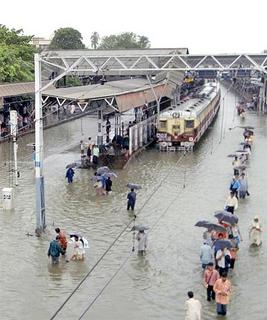
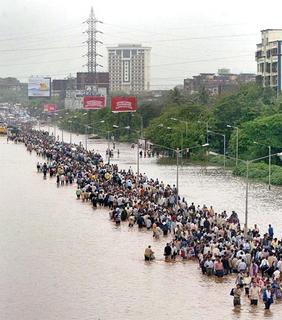
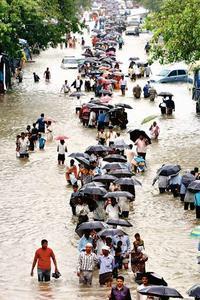
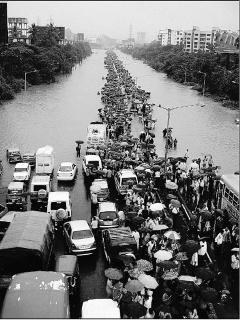
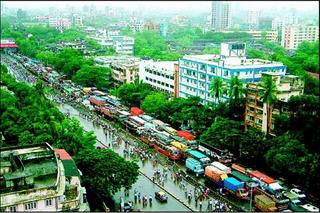
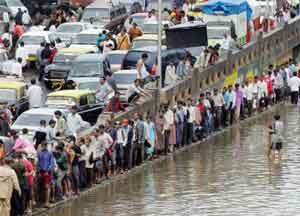
Why rains target urban areas? Researchers in Spain has got the answer.They say it is the concrete structures that bring such heavy rainfall to urban.They are now planning to built concrete structures on the outskirts of the towns in the dry ares of Spain.
In Indian cities ever increasing concrete structures bring extremely heavy rainfall.Indian cities are poorly planned to manage anything of this sort.If alternatives are not taken we will be seeing the pictures like this year after year.
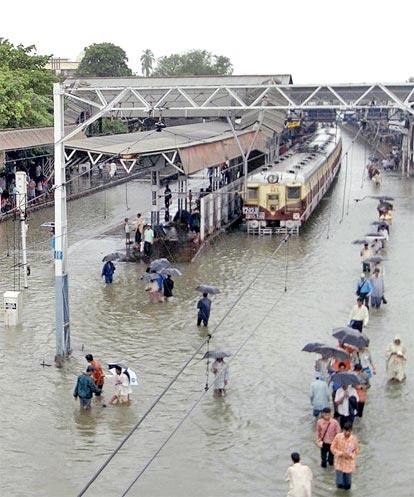

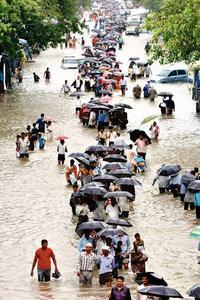

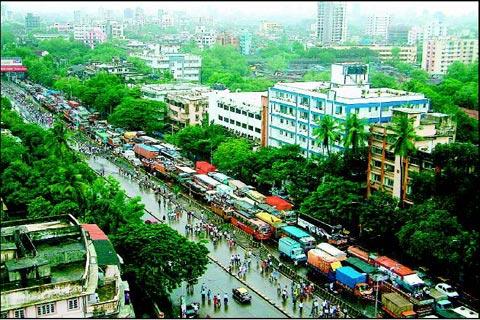

PVC factory soo poisonous!!
There had been strong opposition and protests againt seeting up a PVC plant in Cuddalore SIPCOT area. I never realized how hazardous PVC would be until I read the news item `Poison factory' takes the life of one more worker'.


Wednesday, October 12, 2005
Railway Ministry's medal for bravery
Railway Protection Force (RPF) constable B Deshi, attached to the Chennai Division of the RPF, has been selected for Railway Minister's medal for bravery for the year 2005.
Mr.Deshi is a native of Cuddalore.Mr Deshi was selected for saving the life of four persons at Devanampatnam seashore in Cuddalore district of Tamil Nadu, during the Tsunami on December 26 last.
It is said that Cuddalore District Collector Mr. Gagan Deep Singh Bedi wrote a letter to RPF Inspector General, Chennai, lauding the bravery of Mr Deshi for his courage and the IG recomended Mr Deshi's name for Railway Minister's Bravery medal, the sources said adding that the medal also carried a cash reward of Rs 20,000.
Mr.Deshi is a native of Cuddalore.Mr Deshi was selected for saving the life of four persons at Devanampatnam seashore in Cuddalore district of Tamil Nadu, during the Tsunami on December 26 last.
It is said that Cuddalore District Collector Mr. Gagan Deep Singh Bedi wrote a letter to RPF Inspector General, Chennai, lauding the bravery of Mr Deshi for his courage and the IG recomended Mr Deshi's name for Railway Minister's Bravery medal, the sources said adding that the medal also carried a cash reward of Rs 20,000.
Women's needs in Tsunami affected communities-ReliefWeb
ReliefWeb has come up with an article about the women in Cuddalore district.The article Women's need in Tsunami affected communities posted on 9th October 2005 brings the sufferings of women in tsunami affected regions into picture.Please make use of the link.I'm unable get you even parts of the article because of copy right restrictions.
Tuesday, October 11, 2005
Park outside Cuddalore General Hospital
Short lived the fortune of the park outside Cuddalore General Hospital.Setting up this park was one of the earliest measures taken by the District Administrator Mr.Gagandeep Singh Bedi to beautify Cuddalore.In less than a years time the park has gone unattended.Now even the potective structures are broken.
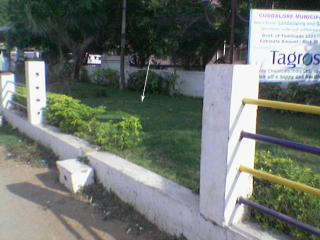
The park was setup and maintained (?) by Tagros Chemicals.The park once used to be watered regularly.As you see,the arrow pointing the hose-pipe (which was used to water the plants there) remains unattended for months together.
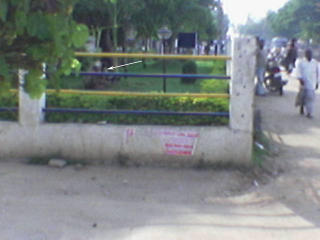 Now the lawn there became a resting ground for the auto-rickshaw drivers of the nearby auto stand.They convene there for a gossip.
In few months time remaining plants and the lawn will dry up and the demolished structures will remain to tell the story of a glorious past.
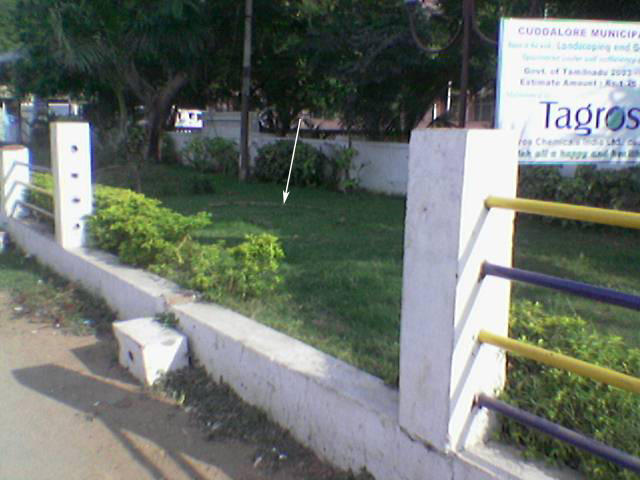
The park was setup and maintained (?) by Tagros Chemicals.The park once used to be watered regularly.As you see,the arrow pointing the hose-pipe (which was used to water the plants there) remains unattended for months together.
 Now the lawn there became a resting ground for the auto-rickshaw drivers of the nearby auto stand.They convene there for a gossip.
In few months time remaining plants and the lawn will dry up and the demolished structures will remain to tell the story of a glorious past.
Plight of archeological sites and antiquities?
The death tool has crossed 30000 mark after a devastating earthquake in Pakistan.Bulidings and roads are broken apart.Both local and foregin news agencies are concentrating on the coverage of rescue operations.Non till now (to my knowledge) reported about the archeological sites and buildings.
Indus Valley is a cradle for one of the world's oldest civilizations.Also there are sculptures of Budhhist period in NWFP and in Afganistan (one such was demolished my Talibans).The plight of them after the earthquake are unknow.
Also the plight of museums and antiquities remains a mystrey. Importance must be given to protect these the acheological treasures.If proper care is not taken certain section of people (who well know the value of antiquities in world market) would loot everything they could (as happend in Baghdad).
Indus Valley is a cradle for one of the world's oldest civilizations.Also there are sculptures of Budhhist period in NWFP and in Afganistan (one such was demolished my Talibans).The plight of them after the earthquake are unknow.
Also the plight of museums and antiquities remains a mystrey. Importance must be given to protect these the acheological treasures.If proper care is not taken certain section of people (who well know the value of antiquities in world market) would loot everything they could (as happend in Baghdad).
Consumer awareness poor: survey
Following deatails are from THE HINDU's article named Consumer awareness poor: survey
Federation of Consumer Organisations — Tamil Nadu and Pondicherry (FEDCOT) conducted the survey with the help of NSS volunteers.
Here I just paste some of the selected finding of the survey.
"consumers lack basic awareness about the purity of jewellery, wastage and cost. Over 78 per cent do not attach any importance to these factors, and concentrate only on design"
"... 54 per cent buy saris named after actresses, and do not bother about the texture of materials or the mills that have made them..."
"...75 per cent of them said most of the jewellery shops did not issue bills. Even if they did, they did not specify the caratage, wastage and making charges, vital data required for moving the consumer court, in case of a dispute..." .I will post more about this particular issue later on.
"....Less than 56 per cent of the consumers were aware that the unfair trade practices could be contested in the consumer courts. They did not even insist upon the correctness of bills. Hardly 30 per cent knew that the rate of sales tax should be mentioned in the bills....."
In hotels-"..82 per cent of the customers said the bills did not carry the names of dishes and their prices..." "...28 per cent alleged that child labour was rampant in hotels.."
Federation of Consumer Organisations — Tamil Nadu and Pondicherry (FEDCOT) conducted the survey with the help of NSS volunteers.
Here I just paste some of the selected finding of the survey.
"consumers lack basic awareness about the purity of jewellery, wastage and cost. Over 78 per cent do not attach any importance to these factors, and concentrate only on design"
"... 54 per cent buy saris named after actresses, and do not bother about the texture of materials or the mills that have made them..."
"...75 per cent of them said most of the jewellery shops did not issue bills. Even if they did, they did not specify the caratage, wastage and making charges, vital data required for moving the consumer court, in case of a dispute..." .I will post more about this particular issue later on.
"....Less than 56 per cent of the consumers were aware that the unfair trade practices could be contested in the consumer courts. They did not even insist upon the correctness of bills. Hardly 30 per cent knew that the rate of sales tax should be mentioned in the bills....."
In hotels-"..82 per cent of the customers said the bills did not carry the names of dishes and their prices..." "...28 per cent alleged that child labour was rampant in hotels.."
BloggerBar for Firefox
I have just now installed BloggerBar for Firefox extenstion.BloggerBar for Firefox extension is basically a toolbar which makes it possible to post from the toolbar.Also am posting this message through this functionality.Let me if it works.
Thursday, October 06, 2005
More details on Cuddalore - Chennai rail project
I have posted earlier( Cuddalore - Pondicherry connection ) about the proposal of connecting Chennai and Cuddalore through rail.I could not confirm by the time I posted it.But I have confirmed it now.New information is that Southern Railways will submit the proposal to Railway Board by October end.
If the project is cleared, a line will be laid from Chennai to Cuddalore through Mahabalipuram and Pondicherry.This is a healthy proposal as against the earlier one which had plans to connect Pondicherry through Thindivanam. If connected through Thindivanam it would increase the travelling time.
The first survey seems to have been conducted in 2002 to assess the rate of return from operations on the Chennai-Mahabalipuram section, and the second in 2004 to calculate the returns on the Cuddalore-Pondicherry-Tindivanam stretch. Both showed a negative trend. For railways to start operations, there has to be a minimum 14 per cent return.
The findings of two earlier surveys on the project's viability are being updated considering the development activities along the ECR.
The proposed new rail is to flow through Sedarapet and Thatanchavady industrial estates inside Pondicherry and the route thereafter is not yet planned I think.Making a path from Pondicherry into the Cuddalore must be the biggest challange of the project,as it would be necessary to clear some of the heavily congested residential areas in Cuddalore.
Let us hope that the project will take a right shape at the earliest.
Also see
Chennai-Pondicherry rail ? NO it must be Chennai-Cuddalore
If the project is cleared, a line will be laid from Chennai to Cuddalore through Mahabalipuram and Pondicherry.This is a healthy proposal as against the earlier one which had plans to connect Pondicherry through Thindivanam. If connected through Thindivanam it would increase the travelling time.
The first survey seems to have been conducted in 2002 to assess the rate of return from operations on the Chennai-Mahabalipuram section, and the second in 2004 to calculate the returns on the Cuddalore-Pondicherry-Tindivanam stretch. Both showed a negative trend. For railways to start operations, there has to be a minimum 14 per cent return.
The findings of two earlier surveys on the project's viability are being updated considering the development activities along the ECR.
The proposed new rail is to flow through Sedarapet and Thatanchavady industrial estates inside Pondicherry and the route thereafter is not yet planned I think.Making a path from Pondicherry into the Cuddalore must be the biggest challange of the project,as it would be necessary to clear some of the heavily congested residential areas in Cuddalore.
Let us hope that the project will take a right shape at the earliest.
Also see
Chennai-Pondicherry rail ? NO it must be Chennai-Cuddalore
Wednesday, October 05, 2005
Cuddalore - Pondicherry connection
There was already a proposal to connect Cuddalore and Pondicherry through rails.But it seems to been in cold storage for years together.
Recently a friend of mine told me that the work is to begin by mid 2007.I was really happy to know that but it did not post about that for I could not confirm it(even now as type this I could not confirm it).
He also told me that,they are to connect Chennai and Pondicherry and thus a link between Chennai and Cuddalore.He expressed his fear that all the train to Chennai would start only from Pondicherry and not from Cuddalore, and only connecting train from Cuddalore would start from Cuddalore to Pondicherry.
This is a fear worth it.If implemented this way,people from Cuddalore would not get the fullest benefit of the service.
Consider this case of a man travelling from Cuddalore to Chennai.His first phase of journey from Cuddalore to Pondicherry would take around 30 minutes and then his must start his second phase of his journey in another train.There would be atleast a 20 minutes gap between the trains,and the second train (Pondicherry<->Chennai) would would reach Chennai after a journey of around 2 hours (assuming 80km/hr).So here is take around 3 hours(30mins+20-30mins+2 hrs) on total to travel from Cuddalore to Chennai.
If a direct train had started from Cuddalore(to Chennai) it would have taken only 2 hours time(assuming 80km/hr).Thus saving 1 hour.
This difference in time would increase if the travelling speed is less than 80km/hr.Business people with huge volume to luggages would suffer the most.The kind of service would highly benefit Pondicherry compared to Cuddalore.Pondicherry would attain even higher developement rate(as the service would greatly help business people) in comparison with Cuddalore.
This acceleration in Pondicherry's developement would lead to Cuddalore's economic backwardness(may be for ever).
Recently a friend of mine told me that the work is to begin by mid 2007.I was really happy to know that but it did not post about that for I could not confirm it(even now as type this I could not confirm it).
He also told me that,they are to connect Chennai and Pondicherry and thus a link between Chennai and Cuddalore.He expressed his fear that all the train to Chennai would start only from Pondicherry and not from Cuddalore, and only connecting train from Cuddalore would start from Cuddalore to Pondicherry.
This is a fear worth it.If implemented this way,people from Cuddalore would not get the fullest benefit of the service.
Consider this case of a man travelling from Cuddalore to Chennai.His first phase of journey from Cuddalore to Pondicherry would take around 30 minutes and then his must start his second phase of his journey in another train.There would be atleast a 20 minutes gap between the trains,and the second train (Pondicherry<->Chennai) would would reach Chennai after a journey of around 2 hours (assuming 80km/hr).So here is take around 3 hours(30mins+20-30mins+2 hrs) on total to travel from Cuddalore to Chennai.
If a direct train had started from Cuddalore(to Chennai) it would have taken only 2 hours time(assuming 80km/hr).Thus saving 1 hour.
This difference in time would increase if the travelling speed is less than 80km/hr.Business people with huge volume to luggages would suffer the most.The kind of service would highly benefit Pondicherry compared to Cuddalore.Pondicherry would attain even higher developement rate(as the service would greatly help business people) in comparison with Cuddalore.
This acceleration in Pondicherry's developement would lead to Cuddalore's economic backwardness(may be for ever).
Tuesday, October 04, 2005
Sand heaps along-side medians
A large heap of sand(along with red soil) and gathered along the bottom edges of the newly built road divider(median).Some of the sand would have accumulated is natural elsewhere,but a large amount of red soil which contribute to the heap are those brought by workers to cover up the median's center part to grow the lawn over that.This gives a poor look.
Malfunctioning traffic lights
The traffic lights near the Krishnalaya complex is malfunctioning in every possible way it could.It appears to work well but that not the case always.For instance when I noticed once,the timer gradually decremented to zero but the there was no Green glow.Everyone was waiting for fews seconds only to realise thats there is something wrong about it.
This is just an example there are several other problems with it.
Also as a general case the Orange light is seldom glows(quiet often it dont-there is a transition from Red->Green).
This is just an example there are several other problems with it.
Also as a general case the Orange light is seldom glows(quiet often it dont-there is a transition from Red->Green).
Saturday, October 01, 2005
Traffic direction boards in poor condition
Long time ago the yellow coloured traffic boards in our cuddalore gives clear information on the distance of other towns and directions.
e.g. 1. opposite new cinema theatre (adjacent to ellaiamman temple)
2. Near Collector's office (adjacent to water filling station)
But these vital boards nowadays were pasted with so many posters and the very purpose of these boards were itself defeated. The Govt. has spent money on these boards for helping travellers know their routes, but these boards are now being used by various people for their propoganda purposes by pasting posters on these boards.
Ofcourse Govt of India is promoting "INCREDIBLE INDIA"
Will the concerned authorities look into this.
e.g. 1. opposite new cinema theatre (adjacent to ellaiamman temple)
2. Near Collector's office (adjacent to water filling station)
But these vital boards nowadays were pasted with so many posters and the very purpose of these boards were itself defeated. The Govt. has spent money on these boards for helping travellers know their routes, but these boards are now being used by various people for their propoganda purposes by pasting posters on these boards.
Ofcourse Govt of India is promoting "INCREDIBLE INDIA"
Will the concerned authorities look into this.
Tuesday, September 27, 2005
Blog censorship handbook released
Reporters Without Borders (Reporters sans frontières) released a book for bloggers called ' Handbook for bloggers and cyber-dissidents '.The handbook offers advice to bloggers who want to protect themselves from recrimination and censorships.It has handy tips and technical advice on how to remain anonymous.
Here is what they ( Reporters Without Borders ) say about the book " Blogs get people excited. Or else they disturb and worry them. Some people distrust them. Others see them as the vanguard of a new information revolution. Because they allow and encourage ordinary people to speak up, they’re tremendous tools of freedom of expression.
Bloggers are often the only real journalists in countries where the mainstream media is censored or under pressure. Only they provide independent news, at the risk of displeasing the government and sometimes courting arrest.
Reporters Without Borders has produced this handbook to help them, with handy tips and technical advice on how to to remain anonymous and to get round censorship, by choosing the most suitable method for each situation. It also explains how to set up and make the most of a blog, to publicise it (getting it picked up efficiently by search-engines) and to establish its credibility through observing basic ethical and journalistic principles. "
You can get a English version of the book in pdf format from http://www.rsf.org/rubrique.php3?id_rubrique=542 .The very page has a separate printer friendly version.
Here is what they ( Reporters Without Borders ) say about the book " Blogs get people excited. Or else they disturb and worry them. Some people distrust them. Others see them as the vanguard of a new information revolution. Because they allow and encourage ordinary people to speak up, they’re tremendous tools of freedom of expression.
Bloggers are often the only real journalists in countries where the mainstream media is censored or under pressure. Only they provide independent news, at the risk of displeasing the government and sometimes courting arrest.
Reporters Without Borders has produced this handbook to help them, with handy tips and technical advice on how to to remain anonymous and to get round censorship, by choosing the most suitable method for each situation. It also explains how to set up and make the most of a blog, to publicise it (getting it picked up efficiently by search-engines) and to establish its credibility through observing basic ethical and journalistic principles. "
You can get a English version of the book in pdf format from http://www.rsf.org/rubrique.php3?id_rubrique=542 .The very page has a separate printer friendly version.
Interesting post about Saint David Fort
Here is an interesting post I came across.The following message is actually a post from http://flatgirl.blogspot.com
Saint David Fort
British stronghold near the town of Cuddalore, about 100 miles (160 km) south of Madras on the southeastern coast of India. The fort was sold by the Marathas to the English East India Company in 1690. It was named for the patron saint of Wales because the governor of Madras at the time, Elihu Yale, was Welsh. It was purchased because of increasing political instability in southern India.
Saint David Fort
British stronghold near the town of Cuddalore, about 100 miles (160 km) south of Madras on the southeastern coast of India. The fort was sold by the Marathas to the English East India Company in 1690. It was named for the patron saint of Wales because the governor of Madras at the time, Elihu Yale, was Welsh. It was purchased because of increasing political instability in southern India.
Friday, September 23, 2005
Digital banner menace
As is obvious the popularity of digital banner is growing alarmingly.This is rather a troublsome trend not only because the material used is non-biodegradable but also because they placed where ever the feellike(You would seen them placing banners in front of Cuddalore Municipal Park and few in front of the fountain setup by TANFAC ).Apart form being hindrance to free flow of traffic it makes the town look untidy.
Our District Administrator rightly pointed out this problem and suggested a better solution.His idea of fixing some suitable sites for erecting such banners my muncipality itself and the idea of collection of rents for every banner placed is really great.
Apart for eliminating various problems,it would bring additional revenue for the mucipality which inturn can be used on developemental activities.
I think to follow all these regulatory procedures it would be necessary to bring up resolutions in the Municipal Council.How far the politicians will co-operate in this case is questionable because they would be biggest violators of such regulations.
Our District Administrator rightly pointed out this problem and suggested a better solution.His idea of fixing some suitable sites for erecting such banners my muncipality itself and the idea of collection of rents for every banner placed is really great.
Apart for eliminating various problems,it would bring additional revenue for the mucipality which inturn can be used on developemental activities.
I think to follow all these regulatory procedures it would be necessary to bring up resolutions in the Municipal Council.How far the politicians will co-operate in this case is questionable because they would be biggest violators of such regulations.
Water tanks inside bustand
Waters tanks are placed in many places inside the busstand.There must have been some goodwill behind placing that.But is it always doing good??.No.They are actually placed for drinking purpose not many use it for the same.They use the water for washing their faces,hands and legs(I did not see in the morning belive some may even take bath :)) ).This makes the water stagnate near every tank and make place really nasty.Tanks mostly attracts beggers and nomads(who stay near Railway Station and behind the Muthiya Theatre) so ordinary citizens dont make use of it.
I dont agree that it is a good idea placing such tanks for drinking purpose.It needs to be cleaned regularly which in present situation is practically impossible.So there is an easy chance of contamination.I think anyone who travel by bus can well afford a rupee or two to get a water pocket.So its needless to place such water tanks there.
I dont agree that it is a good idea placing such tanks for drinking purpose.It needs to be cleaned regularly which in present situation is practically impossible.So there is an easy chance of contamination.I think anyone who travel by bus can well afford a rupee or two to get a water pocket.So its needless to place such water tanks there.
Municipal building in bustand premises in dangerous state
The municipal building in the bus stand premises(along the Lawrence Road) is in very bad condition. It lacks cleanliness. No wonder if the building collapses(it is in such a bad condition).
Concrete worn away, you can see the steel structures protruding outside (as you see in many government buildings across India). Sidewalls of the stairs are broken apart. I am not certain whether it would make through this monsoon season.
Concrete worn away, you can see the steel structures protruding outside (as you see in many government buildings across India). Sidewalls of the stairs are broken apart. I am not certain whether it would make through this monsoon season.
Barathi Road getting yet another faceift
The space outside the Subrayulu Reddiar Hall is being fenced.Hope to see ornamental plants there.It would be nice if they many so proper arrangement for placing digital banners.Often the banners there intrude into the road.
Lawrence Road relitted
I am happy to see Lawrence Road being relitted.Its was just this morning is posted about it.Also the high mast lamps and the signals near the Krishnalaya Complex were also powered.But the timer in the signal there isnt working properly.
Not only the timer with this signal but also the timer with the signal in front of Collector's Camp.It makes me think we would be safe without such malfunctioning timers.
Not only the timer with this signal but also the timer with the signal in front of Collector's Camp.It makes me think we would be safe without such malfunctioning timers.
Thursday, September 22, 2005
Lawrence Road in darkness
For the third consecutive day the street lights in the Lawrence Road are down.I suppose this to be purposeful.
Also the high mast lamp near the Krishnalaya Complex and the signal there are without power for days together.(I will post more on this tonight).
Also the high mast lamp near the Krishnalaya Complex and the signal there are without power for days together.(I will post more on this tonight).
Sunday, September 18, 2005
An article from 'THE HINDU'
A tsunami art exhibition by NSS students was held recently. The exhibition was based on the relief activity carried out by the NSS volunteers of the Anna University.
More than 200 works of art from 230 engineering colleges were displayed. Vice-chancellor D. Vishwananthan inaugurated the exhibition. The exhibition was an expression of condolences to the people who suffered in the December 26, 2004 tsunami. It also aimed at creating awareness among the student community of how to carry out rescue operations.
The university NSS Cell has 250 units in the engineering colleges and 25,000 NSS volunteers doing development activities in adopted villages. The vice-chancellor also released the proceedings of a seminar, "Technologies for Rural Development", at the exhibition on September 13.
More than 200 works of art from 230 engineering colleges were displayed. Vice-chancellor D. Vishwananthan inaugurated the exhibition. The exhibition was an expression of condolences to the people who suffered in the December 26, 2004 tsunami. It also aimed at creating awareness among the student community of how to carry out rescue operations.
The university NSS Cell has 250 units in the engineering colleges and 25,000 NSS volunteers doing development activities in adopted villages. The vice-chancellor also released the proceedings of a seminar, "Technologies for Rural Development", at the exhibition on September 13.
More on New Textile Processing Project in Cuddalore SIPCOT
An integrated textile processing park, 'SIMA textile processing centre', comprising three or four parks would(within 18 to 24 months) soon be setup by South India Mills Association at Cuddalore SIPCOT area to promote textile processing.
About 1100 acres of land for the first phase,to accommodate seven processing units at an outlay of Rs.500 crore, have already been allotted and infrastructural works would begin in another 40 days.
Infrastructure Leasing and Financial Service (ILFS), the implementing agency would be working on impact assessment study, pollution study and also bankable projects for SIMA.
The centre would be careful in setting up the common effluent treatment plant. The proposed park has been assured of at least 10 to 15 MLD water.
The association would also motivate the farmers to go in for contract farming in cotton, which would benefit both them and end users.
Previous related posts
CM on new textile processing unit in Cuddalore SIPCOT
State-of-the-art textile processing park in Cuddalore
About 1100 acres of land for the first phase,to accommodate seven processing units at an outlay of Rs.500 crore, have already been allotted and infrastructural works would begin in another 40 days.
Infrastructure Leasing and Financial Service (ILFS), the implementing agency would be working on impact assessment study, pollution study and also bankable projects for SIMA.
The centre would be careful in setting up the common effluent treatment plant. The proposed park has been assured of at least 10 to 15 MLD water.
The association would also motivate the farmers to go in for contract farming in cotton, which would benefit both them and end users.
Previous related posts
CM on new textile processing unit in Cuddalore SIPCOT
State-of-the-art textile processing park in Cuddalore
A Blog on Human Rights
This morning I came across an intresting blog on Human Rights.Here it is http://democracyctr.org/blog/
and an intresting post from that blog
Dreaming About George Bush
My friends think that I made this up, but it is true. The other night I had a dream about George Bush. He was in the White House where Laura found him banging his head madly against a wall:
Laura: George, stop it! Why are you doing that?
The President: Because there are weapons of mass destruction in Iraq.
Laura: George, they didn’t find any weapons of mass destruction in Iraq. Why are you doing that?
The President: I am doing this to support human rights in Iraq.
Laura: George, we have killed people left and right in Iraq. Why are you banging your head against the wall?
The President: To build democracy in Iraq.
Laura: George, the new Iraqi constitution doesn’t even support women’s rights. Why are you doing that?
The President: I have to finish what I started.
I guess sometimes my dreams are kind of literal.
and an intresting post from that blog
Dreaming About George Bush
My friends think that I made this up, but it is true. The other night I had a dream about George Bush. He was in the White House where Laura found him banging his head madly against a wall:
Laura: George, stop it! Why are you doing that?
The President: Because there are weapons of mass destruction in Iraq.
Laura: George, they didn’t find any weapons of mass destruction in Iraq. Why are you doing that?
The President: I am doing this to support human rights in Iraq.
Laura: George, we have killed people left and right in Iraq. Why are you banging your head against the wall?
The President: To build democracy in Iraq.
Laura: George, the new Iraqi constitution doesn’t even support women’s rights. Why are you doing that?
The President: I have to finish what I started.
I guess sometimes my dreams are kind of literal.
Thursday, September 15, 2005
Unit for making solid fuel ingredient opened in Cuddalore SIPCOT
A Rs.7-crore unit for manufacturing ammonium perchlorate(an imporatant ingredient of solid fuels for missiles and rockets) was recently setup in Cuddalore SIPCOT.The unit is of indegeniuos technology and a advanced plant of this sort.
Defence Research and Development Organisation (DRDO) and Indian Space Research Organisation (ISRO) has helped in setting up the unit.DRDO had given the lisence and a financial assistance of Rs 1.80 crores to the company.M. Natarajan, Scientific Advisor to the Defence Minister, inaugurated the unit.He said,"plant that would experiment and enrich the quality of propellant."It seems the unit has been start to free ourselves from the control international producers of solid fuel.
The unit would convert the common salt into sodium perchlorate through electrolysis and by adding ammonium chloride, obtain the fuel, ammonium chlorate, in powder form.The unit would meet the major requirements of the DRDO and ISRO for ammonium perchlorate.The unit has production capacity of 400 tonnes per year.
I am not sure of the environmental impact of the unit.Impact if any I will post them soon.
Defence Research and Development Organisation (DRDO) and Indian Space Research Organisation (ISRO) has helped in setting up the unit.DRDO had given the lisence and a financial assistance of Rs 1.80 crores to the company.M. Natarajan, Scientific Advisor to the Defence Minister, inaugurated the unit.He said,"plant that would experiment and enrich the quality of propellant."It seems the unit has been start to free ourselves from the control international producers of solid fuel.
The unit would convert the common salt into sodium perchlorate through electrolysis and by adding ammonium chloride, obtain the fuel, ammonium chlorate, in powder form.The unit would meet the major requirements of the DRDO and ISRO for ammonium perchlorate.The unit has production capacity of 400 tonnes per year.
I am not sure of the environmental impact of the unit.Impact if any I will post them soon.
Sunday, September 11, 2005
Apes could disappear in a generation
Officals of United Nations Great Ape Survival Project has warned that the wild population of great apes could disappear in a generation full story>>
Sanctuary Asia
I have recently came to know about Sanctuary Asia.I did not have much idea about that except for it would be magazine about ecological conservation.I just googled which just returned the link http://www.sanctuaryasia.com/ and a description "Provides information on the natural history of the Indian subcontinent, andsuggestions on India's environmental and wildlife conservation movement."
Please visit the site.Its worth it.
Please visit the site.Its worth it.
Grazing at the middle of the road
Last wednesday when I was in Barathi Road I had saw a few cows grazing at the middle of the road.Grazing in the the middle of the road Barathi Road?.Yep.They were grazing the ornamental plants and grass in the crash averter.
All these happened in day light,inmidst of heavy traffic.If this could happen during the day time what would not happen during the night.
Following the Chennai Corporation , Cuddalore Municipality can bring up resolutions to arrest the owners of animals who let them to roam around the town.
All these happened in day light,inmidst of heavy traffic.If this could happen during the day time what would not happen during the night.
Following the Chennai Corporation , Cuddalore Municipality can bring up resolutions to arrest the owners of animals who let them to roam around the town.
Friday, September 09, 2005
An ideal site for piddling
Kamaraj Park has become an ideal site for piddling.If this is the case of a place near Collector's Camp Office I can very well imagine the condition of other places in the town.All his happens even in broad day light.Miscreants take shelter behind the Digital Banners erected there.
Thursday, September 08, 2005
National Award for teachers-2004
Tmt. Lourdes Ligoria an Assistant Teacher of Sacred Heart Middle School,Cuddalore is one of the reciepent of National Award for Teachers (2004).The president Dr. A.P.J. Abdul Kalam gave away National Awards to 306 teachers on the occasion of Teachers Day. Shri Arjun Singh, Minister for Human Resource Development were also present on the occasion.
Tuesday, September 06, 2005
Seismic survey in Cuddalore coast
An extensive Seismic survey sponsored by the Oil and Natural Gas Corporation (ONGC), commenced at the Cuddalore coast with the venture of a research vessel MV Geco Emerald on Monday to explore the possibility of excavation for oil and to conduct a quake related study.MV Pacific Lion-II and MV Ena Supply-I and smaller ships - Sameera-I, Nandan Fishermen, Susi, Evita, RR Hanuman, Priyansh and Sai Sudha would assist the MV Geco Emerald during the operation.
Permanent houses for tsunami victims in Cuddalore
87 new houses was handed over to tsunami victims at Pudukuppam,Cuddalore District on Sunday. Mata Amritanandamayi Mutt built the house for the tsunami victims.Amrita Mutt finished the job within three months of the state government allocating land....full story>>
Strong tidal waves in coastal Tamil Nadu
Nowadays quiet so often we come across the news of strong tidal waves in coastal Tamil Nadu in general and Chennai,Cuddalore and Kaniyakumari in particular.Many news sources project as if it were all the consequences of Indian Ocean Tsunami.But it is not the consequence of on tsunami alone says V. Sundar, Professor and Head of the Ocean Engineering Department in the Indian Institute of Technology-Madras, he puts it as "I will not accept the theory that the tsunami alone has brought about the present situation."
Prof. Sundar also suggests the following three measures to tackle turbulent waves.
1.The crest levels of seawalls in all the affected areas must be raised by a metre.
2.Voids among rubbles kept in the area have to be filled.
3. The sea walls have to be maintained at a flatter slope.
Prof. Sundar also suggests the following three measures to tackle turbulent waves.
1.The crest levels of seawalls in all the affected areas must be raised by a metre.
2.Voids among rubbles kept in the area have to be filled.
3. The sea walls have to be maintained at a flatter slope.
Monday, September 05, 2005
Rs 48 cr World Bank aid for Cuddalore
The World Bank has given Rs 48 crore for construction of bridges and re-laying of roads in tsunami-hit areas of Cuddalore district, Collector Gagandeep Singh Bedi said.
The Tamil Nadu Water Supply and Sewerage Board has allotted a sum of Rs 70 lakh to augment drinking water supply in tsunami-affected areas in Cuddalore harbour area, the government hospital and the government service home, where many of the affected girls are being accommodated.And a sum of Rs 2 crores is alloted for purchasing land for building permanent houses.
The Tamil Nadu Water Supply and Sewerage Board has allotted a sum of Rs 70 lakh to augment drinking water supply in tsunami-affected areas in Cuddalore harbour area, the government hospital and the government service home, where many of the affected girls are being accommodated.And a sum of Rs 2 crores is alloted for purchasing land for building permanent houses.
CM on new textile processing unit in Cuddalore SIPCOT
This is a news item which appeared on ChennailOnline few days back.I have already posted about the new textile processing unit that is to come up in Cuddalore SIPCOT State-of-the-art textile processing park in Cuddalore .She confirmed this in while addressing the national executive commitee meeting of the FCCI.She put it as "A new textile processing zone would be established in Cuddalore under the aegis of SIPCOT, besides some apparel parks in the state." full story>>
Sunday, September 04, 2005
Heavy downpour in Cuddalore
After long hot days Cuddalore finally relished cool shower this evening.The sky was as normal during the daytime as was during the evening.But by late evening about 8:00 PM there was a sudden heavy downpour taking everyone by surprise and the rain lasted for half-an-hour.
Sunday, August 28, 2005
'Men cleverer than women' claims a controversial study
"A somewhat controversial study that is expected to be published later this year in the British Journal of Psychology has, not surprisingly, sparked quite a bit of debate in the blog world. The study shows that, on average, men score five points higher on IQ tests." reports CNET.
Further it adds "Few bloggers have taken the opportunity to jump on the study and celebrate its results" in its post New study fuels battle of the sexes
Further it adds "Few bloggers have taken the opportunity to jump on the study and celebrate its results" in its post New study fuels battle of the sexes
Saturday, August 20, 2005
Track extension work completed
The track extension work at Anna Stadium got completed.But now the level ground aside the track is higher than the track itself.This will lead to to stagantion of the water in track during the rainy season.
Wednesday, August 17, 2005
High mast lamp in Silver Beach is dying out
The high mast lamp in Silver Beach is dying out.when I saw it a few months back a very few lamps in it weren't glowing but now only a few alive rest is dead(i think forever).
Large heap of drainage waste
Large heap of drainage waste in dumped in front of the Government Eye Hospital.These wastes would have been probably collected from the drainages in the Hospital Road and remains uncleared for quiet a long time.
AIRTEL destroys pedestrian foothpath
For more than a couple of weeks I have been waiting to see if there is any replacement made either by AIRTEL or the Cuddalore Municipality to restore the broken foothpath tiles in front of Durai Plaza.The tiles towards the outer end of the foothpath were broken.Certainly this would have been averted if the workers were a bit careful.
I think ARITEL is yet to bring more such damage to the public properties here before starting its landline service.
I think ARITEL is yet to bring more such damage to the public properties here before starting its landline service.
Wednesday, August 03, 2005
SIPCOT admits to excessive pollution
Cuddalore SIPCOT Industries Association (CSIA) has admitted to excessive presence of two Volatile Organic Compounds (VOCs) Chloroform and Triethylamine in the air according to findings of an air quality study conducted by Shiva Analyticals (India) Limited on behalf of CSIA.
The industry study tested for 21 toxic gases, in addition to standard parameters, in ambient air samples collected between 25 and 28 November, 2004, at 10 locations in and around SIPCOT. The study will be used as base data for carrying out regular monitoring at SIPCOT, K Indra Kumar, secretary, CSIA said.
'The tests confirmed the presence of at least 13 Volatile Organic Compounds (VOCs) in the air out of which two VOCs chloroform and triethylamine are found exceeding in two locations.' The association has asked two companies to bring down the emission level of chloroform and triethylamine in the air, he noted. The industries would bring down the VOC to prescribed limits, if Pollution Control Board sets standards for VOC and Sulphur-based gases, he said.
'In September 2004, the Supreme Court Monitoring Committee instructed the Central Pollution Control Board to develop standards for VOC. The SCMC asked the board use United States Environmental Protection Agency (US EPA) norms until the standards are developed,' M Nizamudeen, member, SIPCOT Area Community Environmental Monitors (SACEM).
Comparing the CSIA's study report to the USEPA, Nizamudeen, said, levels of chloroform were nearly 20,000 times higher than safe levels prescribed by US EPA Region 6 standards. Acrylonitrile found in the sample on top of Tagros Security-West room exceeded Region 6 levels by a factor of 6008. 1,2-dichloroethane found in the sample from Shasun Chemicals SW corner was 194 times safe levels, and Trichloroethylene levels as far away as Sonnanchavadi exceeded safe levels by a factor of 1237. All four chemicals are known or suspected carcinogens.
Chloroform and acetonitrile were found in six and eight out of 10 samples respectively. Eleven out of 13 chemicals found in the CSIA study are used as raw materials by SIPCOT industries, indicating the escape of these chemicals through fugitive emissions into the air breathed by SIPCOT residents. Six of the 13 chemicals found are potential human carcinogens, and confirmed animal carcinogens.
'The study by SIPCOT industries confirm SIPCOT Area Community Environmental Monitors's (SACEM) earlier studies that SIPCOT air is not fit to breathe,' Nizamudeen said. In September 2004 and May 2005, SACEM released two reports Gas Trouble I and Gas Trouble II that found at least 24 chemicals including 20 volatile organic compounds (VOC) and four sulphur compounds. SACEM's study tested for 69 VOCs and 20 sulphur compounds whereas CSIA conducted study only for 20 VOCs and 1 sulphur compound.
Meanwhile, TNPCB has asked Mumbai-based National Environment Engineering Research Institute (NEERI) to conduct a study on air quality in SIPCOT Cuddalore for 35 parameters of VOCs, sources in TNPCB told News Today. The board also asked the Central Pollution Control Board to set standards for toxic VOC and Sulphur based gases, so that result provided by NEERI air quality in Cuddalore can be compared with it, he said. NEERI has already completed preliminary tests last month and full report will be out in one year from August, he added. TNPCB has so far paid Rs 10 lakh of a total of Rs 21 lakh demanded by NEERI for the project, he noted.Editorial Cartoons
Here is an animation by Mark Foire an editorial cartoonist.
Homeland security
View more of Mark Foire's Political Cartoons
Homeland security
View more of Mark Foire's Political Cartoons
State-of-the-art textile processing park in Cuddalore
IL&FS to help set up state-of-the-art textile processing park in Cuddalore
IL&FS, one of the partners in the textile processing park to be set up at Cuddalore district of Tamil Nadu, has been appointed the nodal agency for overseeing the setting up of the shared infrastructure. It will also oversee operations and maintenance.
South Indian Mills Association (SIMA) and State Industries Promotion Corporation of Tamil Nadu (Sipcot) will jointly set up the park. Sipcot has already earmarked 1,100 acres of land for the purpose.
The association is laying great store by this project as it will both give the cluster state of the art infrastructure and eliminate the chronic environmental problems that have beset Tirupur, the established textile knitwear cluster.
The frist phase will cover 300 acres with an investment of Rs 500-600 crore. The total investment will be about Rs 2,500 crore. This will provide direct employment for 15,000 people and indirect employment for 75,000 people.
The Tamil Nadu government is providing land at economical costs. “Most of the investment is coming from blue chip companies,” said K Selvaraju, secretary, SIMA. The state government will reimburse 40 per cent of the investment per company up to a maximum of Rs 40 crore, whichever is lower.
The 300 acres already earmarked at the SIPCOT industrial complex’s phase III is designed to accomodate 15 greenfield projects to process yarn, fabrics and garments. “Nine companies have confirmed their particiaption and many more have shown interest in the park and this is very encouraging,” said K Sevaraju.
According to an estimate, the project will process a minimum of 6 lakh metres of fabric a day and this can give a boost to the export of value-added finished products from the state. The Tamil Nadu government has already agreed to dedicate a power station for the park.
“Our source of energy will be steam generation and since the Cuddalore port is nearby we can even import coal for this purpose,” said Selvaraju.
SIMA also plans to build a storage and testing facility in the park. The construction will be world class and will meet international standards, whether it is processing or effluent management,” said Vijay Venkatswamy, chairman, SIMA.
The Cuddalore processing park will handle problems such as lack of sufficient water for processing and difficulties in safe disposal of effluents. The area carries abundant ground water and sea discharge of treated effluent while remaining within the stipulated pollution norms is possible.
“The greatest advantage of the location is that if the situation arises, a desalinaton plant can be set up to draw water from the sea,” said K Selvaraju.
Among the technology options looked into to handle the effluent including the disposal of solid wastes in the TPP are the water frugal technology and biological treatement.
Courtesy:Business Standard
IL&FS, one of the partners in the textile processing park to be set up at Cuddalore district of Tamil Nadu, has been appointed the nodal agency for overseeing the setting up of the shared infrastructure. It will also oversee operations and maintenance.
South Indian Mills Association (SIMA) and State Industries Promotion Corporation of Tamil Nadu (Sipcot) will jointly set up the park. Sipcot has already earmarked 1,100 acres of land for the purpose.
The association is laying great store by this project as it will both give the cluster state of the art infrastructure and eliminate the chronic environmental problems that have beset Tirupur, the established textile knitwear cluster.
The frist phase will cover 300 acres with an investment of Rs 500-600 crore. The total investment will be about Rs 2,500 crore. This will provide direct employment for 15,000 people and indirect employment for 75,000 people.
The Tamil Nadu government is providing land at economical costs. “Most of the investment is coming from blue chip companies,” said K Selvaraju, secretary, SIMA. The state government will reimburse 40 per cent of the investment per company up to a maximum of Rs 40 crore, whichever is lower.
The 300 acres already earmarked at the SIPCOT industrial complex’s phase III is designed to accomodate 15 greenfield projects to process yarn, fabrics and garments. “Nine companies have confirmed their particiaption and many more have shown interest in the park and this is very encouraging,” said K Sevaraju.
According to an estimate, the project will process a minimum of 6 lakh metres of fabric a day and this can give a boost to the export of value-added finished products from the state. The Tamil Nadu government has already agreed to dedicate a power station for the park.
“Our source of energy will be steam generation and since the Cuddalore port is nearby we can even import coal for this purpose,” said Selvaraju.
SIMA also plans to build a storage and testing facility in the park. The construction will be world class and will meet international standards, whether it is processing or effluent management,” said Vijay Venkatswamy, chairman, SIMA.
The Cuddalore processing park will handle problems such as lack of sufficient water for processing and difficulties in safe disposal of effluents. The area carries abundant ground water and sea discharge of treated effluent while remaining within the stipulated pollution norms is possible.
“The greatest advantage of the location is that if the situation arises, a desalinaton plant can be set up to draw water from the sea,” said K Selvaraju.
Among the technology options looked into to handle the effluent including the disposal of solid wastes in the TPP are the water frugal technology and biological treatement.
Courtesy:Business Standard
NOC would begin production by 2008
Nagarjuna Oil Corporation would begin its fullfledged production by 2008. The finacial closure of the company was expected to be achived by 2005 but it has been delayed a years time.
Nagarjuna's website has been updated. But some of the pages are still under construction.
Nagarjuna's website has been updated. But some of the pages are still under construction.
Subscribe to:
Posts (Atom)